5

I just put up some shelves using brackets from Home Depot and Canadian Tire. The brackets themselves are rated for much more weight than I'm putting on them (like a thousand pounds each or something).

All the screws for the brackets are securely in studs except for the two centre brackets on the top shelf (i.e., the bracket over the door and the one to the left of that one). There weren't any studs around there that I could find (this wall's stud situation is very confusing). The screws fixing those two brackets to the wall are all fixed with these EZ Anchor Twist N Lock anchors, which claim to be rated at 75 pounds each. Each bracket is fixed to the wall with three screws in a vertical line.

How worried should I be about the strength of that upper shelf, particularly the parts held up by the drywall anchors? There's no recognizable wood to screw into above that door that I've been able to find. (I spent time looking up how studwork around a door is supposed to look, and couldn't make sense of what my stud finders were telling me).
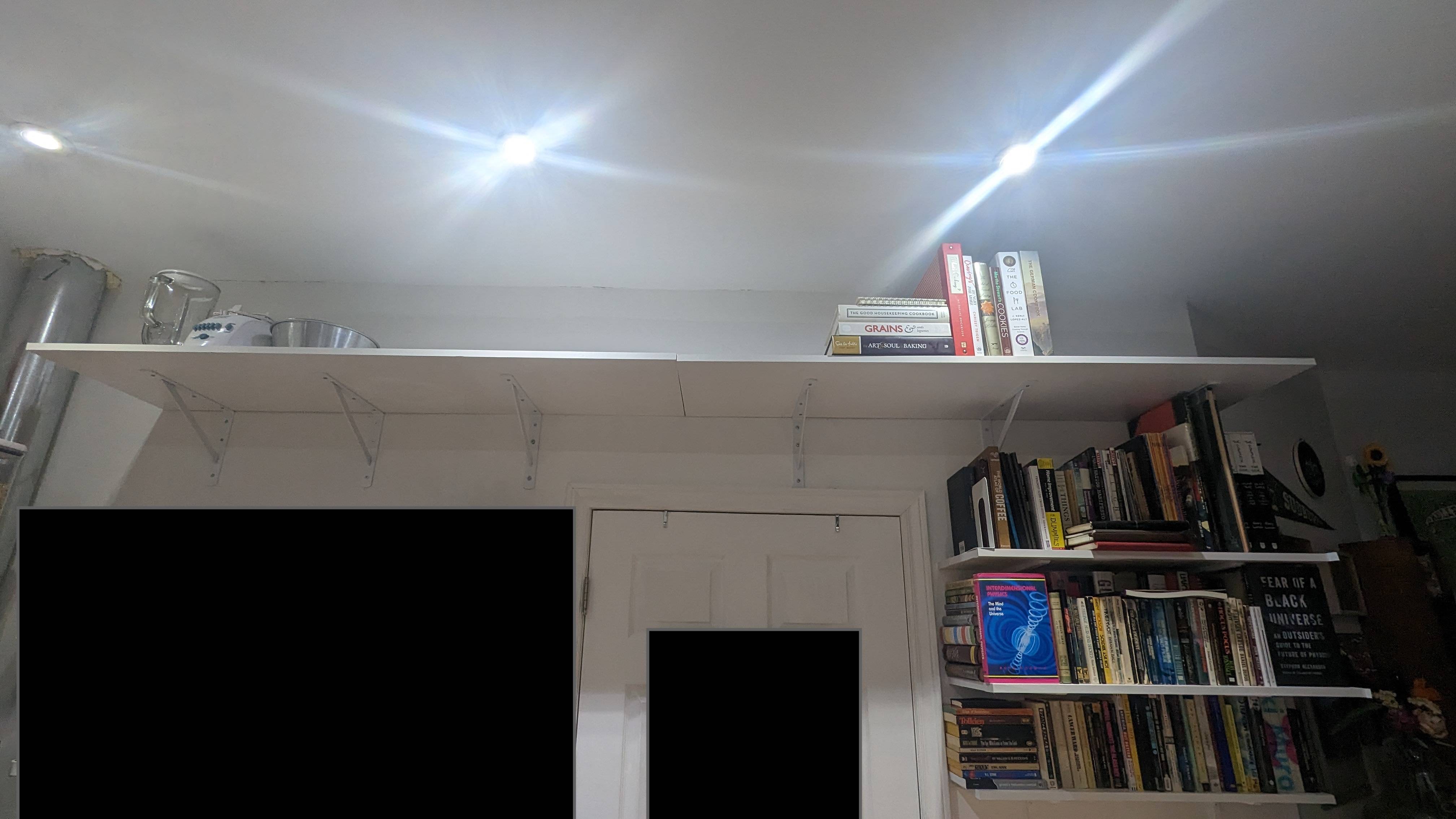
Shelves.

isherwood
  • 158,133
  • 9
  • 190
  • 463
Ivan
  • 51
  • 3

3 Answers3

0

part 2 - aligning the shelves.

Adding washers between the lower-shelf and the bracket will help a little now, but the wood shelves will move over time, likely at different rates.

You can also screw a metal strapping plate under both to secure them together. This will be visible below. If you choose to strap it on top, that can interfere with sliding things on/off the shelf.

Instead you could secure a thin strip of trim to the front, which will provide alignment and some additional strength. If mounted a couple millimetres higher, can also act as a safety ledge to reduce things falling off which can be an important consideration if this door is your only exit from the room.

Ideally you would have used one long shelf not two shorter ones, but that's not always possible. And the joint should have been aligned to be over one of the brackets. I'd have chosen two joints-over-brackets instead of a single unsupported butt-joint.

The main issue is that subtly-different loads there will bend each shelf different amounts, causing the cantilevered wood shelf to move visibly. It doesn't take much to be a visible difference.

Criggie
  • 11,950
  • 2
  • 26
  • 79
0

You don't need to worry about this coming down. The fact that two out of three brackets on each individual shelf are mounted to a stud, the remaining bracket isn't going to carry much load even if you do pile it high.

Plenty of such shelves have been mounted with just anchors like you're using, and even then they do fine. Just keep the stacks of cast iron cookware elsewhere.

isherwood
  • 158,133
  • 9
  • 190
  • 463
0

Yeah, you’re right to be a little cautious about this. Even though those EZ Anchors say they’re rated for 75 pounds, that number assumes everything’s perfect—like a clean pull straight down, no movement, no shifting, and that’s rarely how shelves actually work, especially over time, things can get pulled on or bumped a little and that can change things fast.

With three anchors in each bracket, you’ve got some load spread, but if they’re stacked vertically, the top one’s doing a lot more of the heavy lifting. If one of them goes, it’s not unusual for the rest to start working loose too, especially if there’s any weight far out on the shelf.

Above the door is a tricky area too. There’s probably a header running across there—a couple 2x4s horizontally—so your stud finder might be picking that up weird or missing it altogether. That might explain why things didn’t seem to make sense when you were checking for studs. It’s not you, it’s just how that framing is sometimes.

If you’re only storing light stuff, it’s probably fine for now. I’d just be careful not to load too much toward the center, and definitely wouldn’t put anything valuable or that you don’t want breaking right under it.

If you’re up for it, you could add a horizontal board screwed into a couple studs and then mount the brackets onto that. Spreads out the force and keeps everything more solid. Not critical, but it’s a safer route if this is gonna be a long-term thing.

So, short version—probably okay for light stuff, but if you want to sleep better at night (or not hear a crash in the middle of the night), adding more solid support wouldn’t be a bad move.