1

I have a garage and a house on my property and each of them have their own meter and 200amp panel. This was setup decades ago when original owner ran a business out of the garage. I would like to remove one meter (house meter) so that both structures are on one service/one meter.

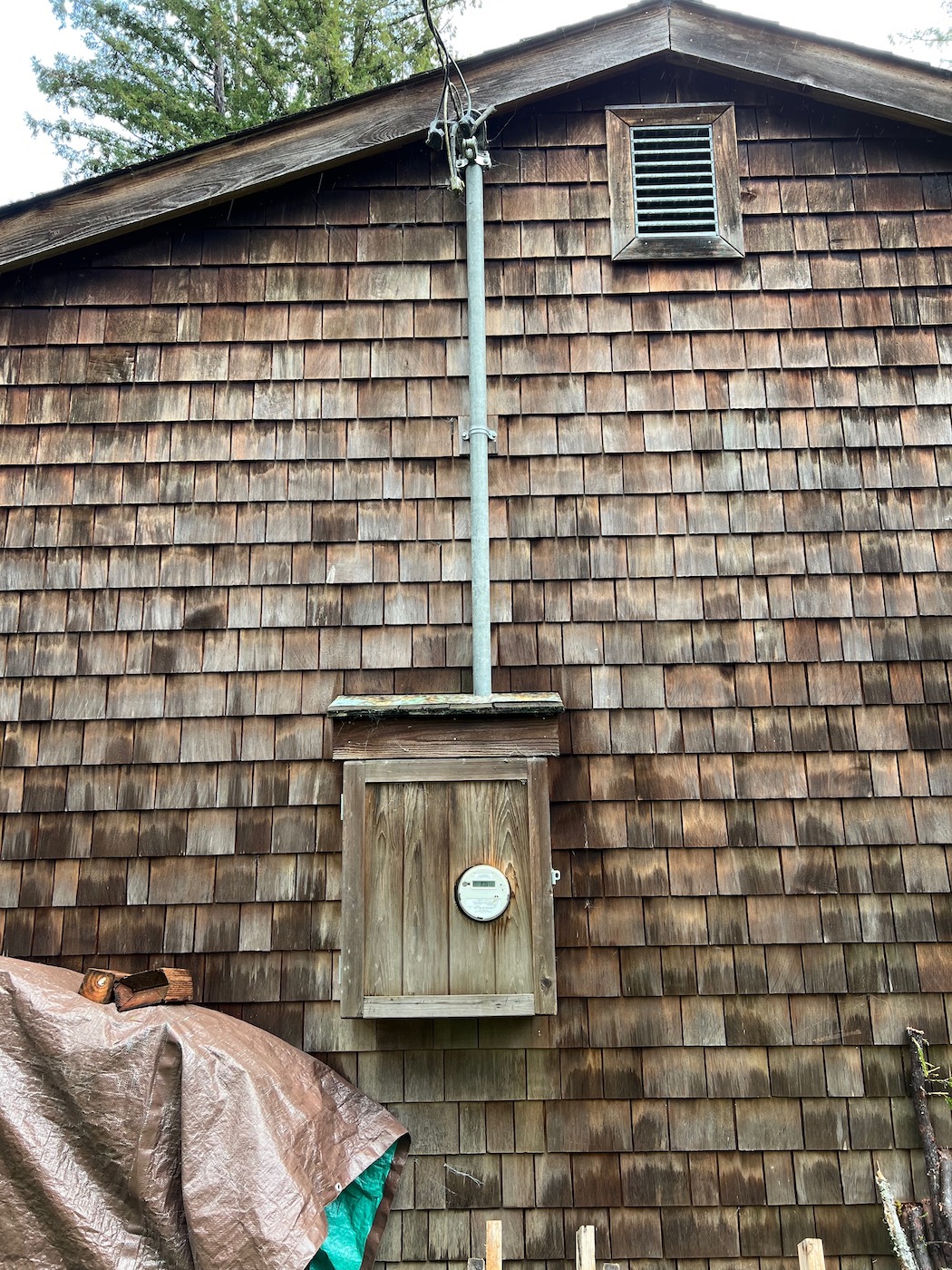
Currently, main service conductor from pole mounted transformer enters at the garage outside box (which only houses garage meter and cutoff switch). I assume that the incoming line splits in two with one end connecting to garage meter and the other ending is routed to the house meter. Garage panel is inside garage on wall just behind outside meter box.

Eliminating the house meter will allow me to add storage batteries and keep them in my garage and feed power to the house from the batteries if/when needed (e.g. power outage). Also, I have a plug-in hybrid and so PG&E offers special rate plan that reduces by almost 50% cost per kWh from midnight to 3pm. As I am setup now, this only affects my garage where my EV charger is located and I would like to take advantage of this rate plan for my house use as well. My house will soon have heat pump installed (40 amps), has dryer (30 amps) and water heater (30 amps) plus a number of standard (15 & 20amp) circuits for outlets and lights of course. The only 220 volt circuit I am using in garage is for EV charger (30 amps).

So, can I rework the system to still have the 2 200amp panels or does the house panel have to be reworked as a 125 amp (or?) sub panel from the 200 amp garage panel? Conductor that leads from the garage to the house is not visible anywhere so it must be underground to get to the house. Any advice/comments greatly appreciated!

P.S. I have opened up an application with PG&E to do this but am searching for information on how this can be accomplished and the requirements on my end for needed modifications.

Also - yes the house panel is Zinsco and I will more than likely replace it as part of the project.

And - yes I know I may be giving up a 400 amp system to accomplish this but I do not need 400 amps and what is more important is my current and future use of the property and not an imagined potential value to a future buyer (who most likely won't need 400 amps either). I just do not see a way to move battery stored electricity from garage based-storage into the house without doing this.

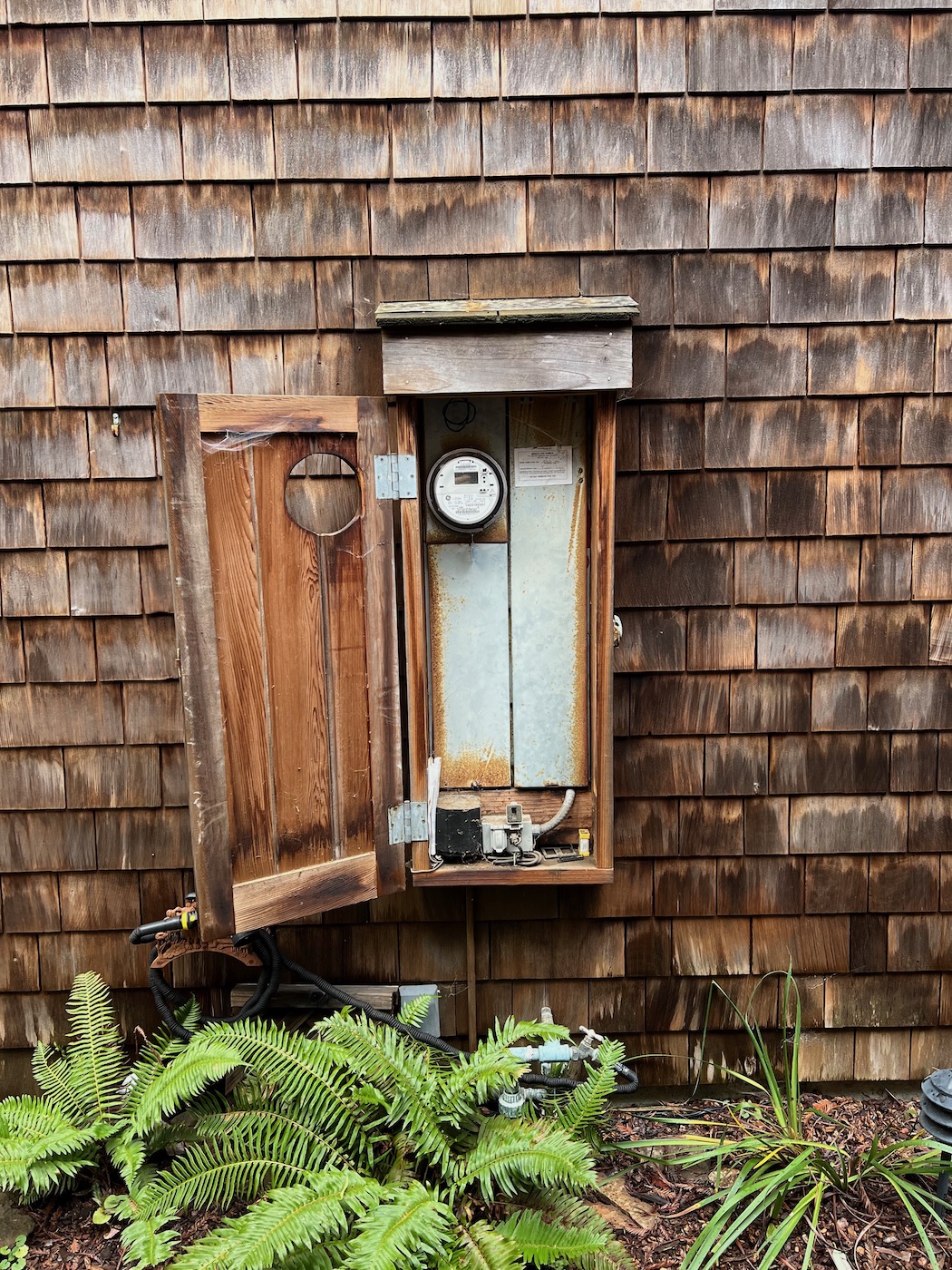
#1 - This is where service enters the property - at the garage outdoor meter box. This is just a meter box with cutoff switch. Service enters property at garage meter
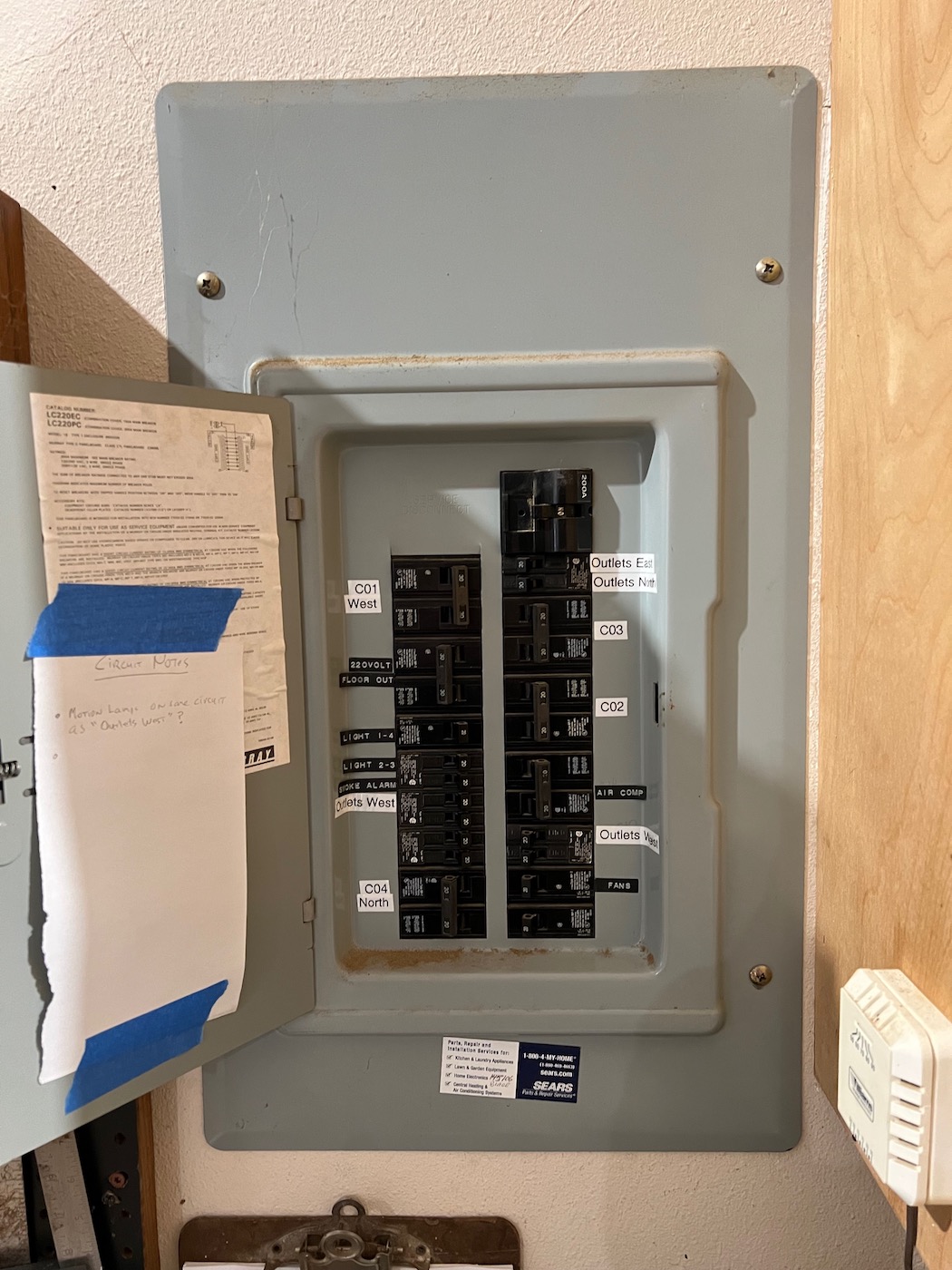
#2 - 200 amp panel inside garage, just behind the meter box outside. Garage panel inside garage
#3 - Meter for the house. House meter

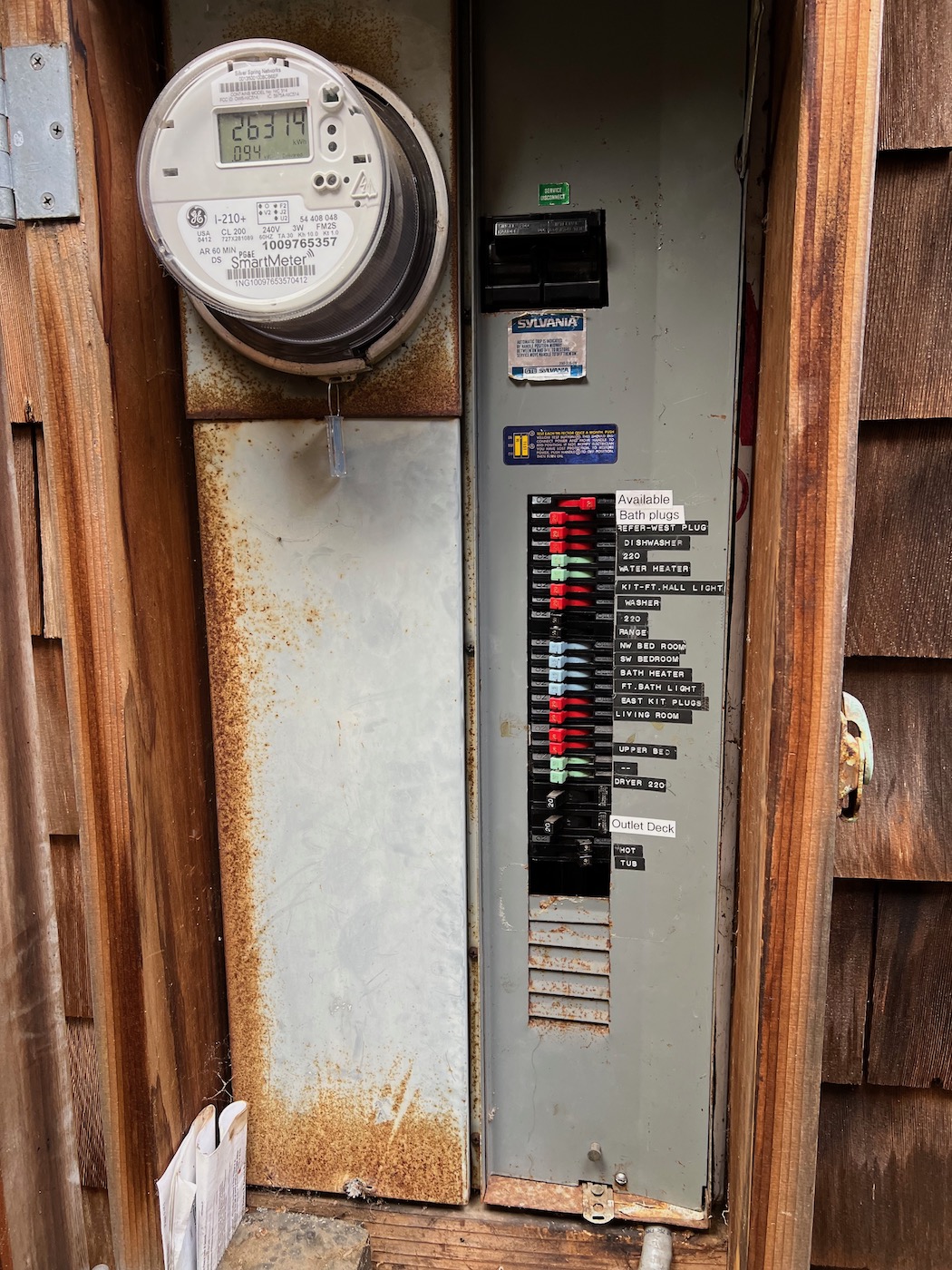
#4 - 200 amp panel for the house. House panel

A few responses to some of the points raised:

  1. I do not want to place new house panel indoors. On the other side of the wall is a bedroom. I want to leave it outdoors to minimize any wiring changes.

  2. A 20 space garage panel is totally adequate for my needs. Only one of the 220volt circuits is in use (EV Charger - 30 amps). All of the others are overkill for my purposes as this is no longer someones shop for a business.

  3. I do not need any power in the shop during an outage. Doors are operated manually so it is really just lighting but this can be tolerated during an outage (BTW - this is CA and I just had a 5-day power outage - others in the area went 10 days no power). I could use a Goal Zero power station to power lights and some 110 volt circuits if needed.

  4. Any full-on battery backup system (e.g. Tesla Powerwall) would strictly be for the house.

  5. While a single 400amp meter split into 2 200 amp feeds (to garage and then to house) seems ideal, if the load calcs work out I would be fine with a standard 200 amp service to cover both structures, as long as the sub panel for the house can hold all circuits I currently have.

Thanks!

FreeMan
  • 48,261
  • 26
  • 101
  • 206
DJHess
  • 11
  • 3

4 Answers4

4

The Zinsco panel on the house has to go!

That thing is a fire hazard due to an inherently defective bus design. It cannot be "fixed" with new breakers. (similar to Stab-Lok). Part of your plan needs to be to replace that panel with a new panel. That will segue nicely into your plan to feed the house from the garage.

Also note, when building enclosures like that: Panels require a working space of the width of the equipment but at least 30 inches, 6'6" tall, 36" deep (stand-back distance), and kept clear at all times. The shrub needs to go. The enclosure is a problem because it sticks out too much compared to the front of the panel. Really it's allowed 0" beyond the surface of the panel, but most inspectors will cut you slack on just the thickness of the door. In this case that would mean an oval opening for the meter head (less if you hinged it on the other side). Alternately, you can make the enclosure large enough to fully enclose the working space - its top over 6'6" from the ground, and >30" wide. Then with the door(s) open, the working space is inside the enclosure.

Narrow service equipment like this is no longer made. Fortunately, you don't need a meter head here, and most panels are <14.5" wide. (to fit in a stud bay).

If you want to put your panel indoors, that's a good idea to keep it out of the weather - AFCI and GFCI breakers fail faster in the weather. Though there must be a disconnect switch outdoors per NEC 2020.

The garage panel ain't great either.

Many Home Depots have a hot dog vendor in the lobby. Somebody really, really wanted hot dogs, because they scrimped on the panel and got a 20-space, which is laughably too small for a shop as busy as yours. This is a false economy: spaces are cheap, running out of spaces is expensive. One should always buy an embarrassing excess of spaces.

Obviously you're making do right now, but you might think about upgrading to a 40-space panel for the shop at some point. Once your new service equipment is installed with a main breaker outside, this task should be DIY-friendly since it will be possible to fully de-energize this panel.

You are only allowed one supply per building.

That is, you can only have one set of power cables feeding from the garage to the house. Put this rule in the back of your mind, because it's going to come up in a minute.

Note this does not apply to generators, you often need to run redundant generator feeds due to where the interlock is located.

"400A service" is commonly built as two 200A panels

400A service is a size of service which does exist for residences. Owing to the blistering cost of a single 400A breaker, almost all 400A services are wired as a 400A meter feeding two main breakers feeding two panels.

That means if we were wiring this in 1979 when battery systems and vehicle-to-home was a fantasy in my mind, we would simply install a bog-standard 400A service at the garage, feed two 200A panels with 2 main breakers right there, and then send one of the 200A feeders straight to the house and Bob's your uncle.

However, your aspirations for batteries throw a monkey-wrench in all that. The problem is - this requires very special service equipment which is readily available at 200A, but exceedingly costly or more often, nonexistent at 400A.

But I'm going to guess that you can "live with" your shop's power being mostly out during power outages.

So it really boils down to the NEC Article 220 Load Calculation.

This is the official NEC-sanctioned procedure for determining how much power a building needs. No other procedure will suffice. We have an endless stream of novices here who "invented" a load calculation method on the fly and say that oughta be good enough. Nope, NEC Article 220 or stay home.

Such a Load Calculation should be done on the house to determine the ampacity needed to serve the loads there. We dearly hope and pray that it is less than 200A, but based on what you say I suspect it is substantially less than 200A - almost certainly with room to spare for the 30A EV charging and probably some other stuff to boot.

Next, you need to do a Load Calculation on the shop. And really this is there so you can evaluate whether you can squeeze house and shop into a single 200A service, or whether a 400A service will be called for with 200A for house+battery and the other 200A for the various shop requirements. I gather the shop doesn't need to be on battery and you can defer your substantial projects til AC power returns?

My guess at a likely setup.

With cost very much in mind, I suspect it'll work best to have a 400A service, with two 200A panels at the garage (bear with me).

  • One 200A panel feeds the shop exclusively and is not on battery backup. It powers "loads you can live without" such as all the shop machines and heaters, and everything but some lights.
  • The other 200A panel is a "Ranch Panel" which means a panel with a limited number of breaker spaces (typically 8 for four 240V things) and then and thru-lugs. The thru-lugs carry full 200A power to the house, to feed a 200A panel there as normal.

The 8 breaker spaces are to make connections to the battery system. Shop loads such as critical shop lighting could also be placed in this panel, however they'll need to be added to the Load Calculation for the house when confirming that this panel is big enough. If you wanted a simple mechanical interlock for an old fashioned generator, this is the place to put it.

Depending on how the battery system is designed, it may require that it charge off the panel it's wired into - but that is not entirely necessary. If the manufacturer exposes the needed contacts, the battery could actually charge from the SHOP panel, thus battery charging would be on the shop's Load Calculation not the house's.

Wires from the garage to the house.

Honestly, I can't guess how these wires are routed. I can tell you this - when you convert to this system, you will need a fourth ground wire added. The house panel will, after all, be a subpanel. This ground could be retrofit but that'll still require trench work. One interesting idea I've had is to use RMC conduit - costly but only needs 6" of cover, and the RMC itself serves as the ground. Now you have an empty conduit to run telecomm lines :) Telecomm can't go in the same conduit as power lines, but a ground isn't a power line!

Conductor that leads from the garage to the house is not visible anywhere so it must be underground to get to the house.

Well, that's a real wildcard. Just because you badly need it, doesn't mean it actually exists. It's quite possible, even probable, that the supply to the house is routed in a completely useless direction. You should probably pencil in the cost of a new feeder from garage to house.

At the least, we know the old service wires are at least as old as that StabLok panel. It doesn't owe you anything.

Harper - Reinstate Monica
  • 313,471
  • 28
  • 298
  • 772
1

Removing a meter and restructuring the electric from that source must be approved and designed by your electric utility company and approved by your local building authority. Contact the utility company first to see if this is viable.

RMDman
  • 52,615
  • 3
  • 36
  • 113
0

Assuming you make it past the power company hurdle at all...

The panels can stay the same*, (A subpanel can always be larger than or equal to the supply to it) but if you don't change the setup to have (and perhaps you do have, but you are calling it a cutoff switch) a pair of 200A breakers from the meter box, you'll be limited to 200A total rather than 400A total. You might need to change to a class 320 meter with a pair of 200A breakers there, if both meters are class 200 (suitable for 250A since they are classed at continuous load - thus, the 320 is suitable for 400A) - discuss options with the power company.

200A total may not be a problem, depending on your load calculation.

*I see a Sylvania sticker (not well stuck, though), but that house panel reminds me too much of "Stablok set-your-house-on-fire" panels - someone that knows those better can identify - if so, you want to replace before it manages the burn your house down trick.

Ecnerwal
  • 235,314
  • 11
  • 293
  • 637
0

First: You should get a qualified electrician to verify whether or not your panel needs to be replaced due to the brand and age that it is. https://pennaelectric.com/is-your-zinsco-panel-safe-what-to-do-if-you-have-one/#:~:text=Zinsco%20is%20one%20of%20those,fuse%20to%20the%

Second: Make sure you understand the rates that PG&E are offering. I think maybe you are misunderstanding what they are offering? If you contact them they can discuss your usage over the last 6 months and advise you of their best plan. You might not benefit as much as you think you will from doing all of that conversion. It might not outweigh the expense of the conversion. Having a separate meter allows you to be on their EV-B rate which might work out best! https://www.pge.com/en_US/residential/rate-plans/rate-plan-options/electric-vehicle-base-plan/electric-vehicle-base-plan.page?

Third: If you do go through with making one of them a sub-panel be sure to separate the grounds and neutrals onto separate bars which are not connected. https://diy.stackexchange.com/questions/110701/how-do-i-convert-an-existing-electrical-panel-to-a-subpanel#:~:text=You%20need%20to%20ensure%20the%20only%20bond%20between%20ground%20and,ll%20have%20to%20be%20removed.

Could you supply your house with the battery backup power similar to how a generator supplies back up power? https://www.youtube.com/watch?v=I_fxXGb8t_k

SOHR
  • 355
  • 2
  • 4