9

I need a 1/4" x 1 1/2" x 80" steel flat bar. I will omit the details of what I need it for because this question is basically asking which composition yields a stronger steel.

www.discountsteel.com has a wide variety of steel bars, but I am not sure how to read the ratings regarding tensil strength and hardness. Here are all the products:

Stainless Steel
Cold Rolled Steel
Hot Rolled Steel

If you click the ASTM material Specifications tab at the bottom of the pages and scroll to the bottom, you will see mechanical data for which I have the following questions:

First off, what is "minimum tensil strength"? The stainless steel 304 has a minimum of 75, but the hot rolled and cold rolled appear to have ranges of 58-80 and 55-70 respectively. Why does stainless have a single number and the others have ranges? Why does it says minimum? Does a higher number mean stronger steel?

What is minimum yield strength?

Second is the hardness scale which uses the Rockwell scale which I've looked into a bit. The stainless rating for 304 is 88, but the rating for hot-rolled is B76. For cold-rolled, it seems to be broken into two: Hot rolled is B67-B80 and cold drawn is B80-B90. This confuses me even more because this looks like the steel is cold rolled hot rolled? Why is the stainless rating just 88 while the others seem to be a range and use the B scale? Does stainless just default to a scale since it's just represented by a raw number?

Tester101
  • 133,087
  • 80
  • 327
  • 617
oscilatingcretin
  • 5,932
  • 53
  • 99
  • 114

2 Answers2

14

OK, a few definitions:

Yield strength is the amount of force required to cause the steel to yield, which means permanently deform (i.e. permanently stretch).

Tensile strength (a.k.a. "ultimate strength") is the amount of force required to cause the steel to actually break. This will be equal to or greater than the yield strength.

Minimum just means that the steel will be at least that strong.

Hardness is a measure of how resistant the steel is to scratching and denting. For structural usage it's probably not important, but would be important if you were looking for a durable finish, e.g. a workbench top or a tool bearing point.

Stiffness (you didn't ask about this, but it's another way of looking at the strength of a material) is a measure of how much something deflects when you put a force on it. Steel alloys tend to be pretty similar in this regard.

As you can see, "strongest" doesn't really have a specific definition, it depends on what you're looking for.

Here's an analogy for the difference between yield and tensile strength: Imagine you have a spring. You pull on it a little, and when you let go it returns to its original shape. This is "elastic deformation", and no damage has been done. Now you pull hard on the spring and it doesn't return to it's original shape anymore. The material has yielded and you have "plastic deformation". This may or may not be considered "failure", depending on the application. Now pull really hard and the spring breaks. That's the ultimate strength. Clearly the spring has failed now.

As for the ranges: "steel" is a non-specific name for several alloys and it can be made in several grades, hence the ranges you've found. The material is usually designated with an alloy number. "Cold rolled" and "hot rolled" are methods for shaping the steel, and don't really tell you anything about the strength.

I should also point out that all of these properties that I've mentioned are for the steel material itself. If you want to know the behavior of an actual piece of steel, you need to know both its material and it's shape.

Hank
  • 14,213
  • 10
  • 46
  • 48
11

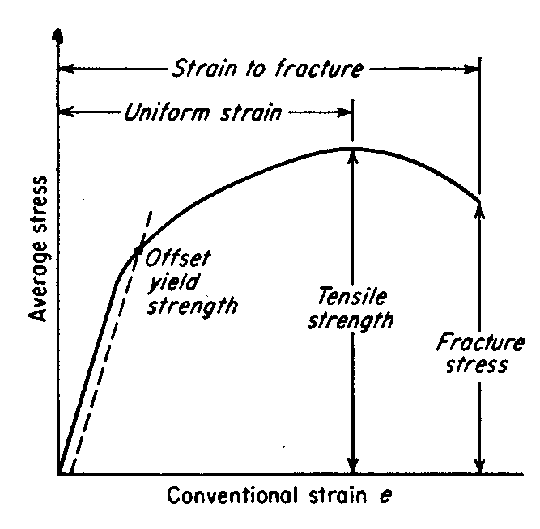
All steel has a Young's Modulus of 200 GPa (29 000 ksi) (This is the slope of the straight part of the graph) . Ultimate Strength runs from 300 - 400 MPa (peek of the graph), and the Yield is usually around 200 MPa (Where straight becomes curved).

In a test machine, you can stretch and shrink a steel bar up and down that straight part of the graph forever (Well, fatigue will kick in). But once you get into the curved part, unloading will follow a different path (See dashed line).

For structural purposes Yield strength is the limiting factor. In other words, you want your design to be limited entirely to the elastic (straight) region of the Stress/Strain chart. If you go into the plastic region, you're permanently deforming the material. (Although aircraft designers go well into the plastic region for reasons of weight). enter image description here
The only reason to buy Stainless Steel is because you need the stainless property (i.e. finish work). It's far too expensive. For most purposes, normal rust protection measures are sufficient (Such as proper paint covering and maintenance, or even chrome plating for finished surfaces). Stainless steel has a lower Young's Modulus, and will deform more at low loads. However, this "Stretchability" makes it much tougher (but not stronger!). Think about snapping a dry twig vs. a green one.

Hardness is irrelevant for structural purposes. It becomes a factor in tool making and machine design, but not for simple load bearing applications.

EDIT:

Stiffness/Elasticity.

First we need to define strain as (Length of deformation)/(original length). This is a dimensionless quantity, but you can use mm/mm or in/in if you like to think about it that way. You could also think of it as %stretch/100 (That is, measured as PerUnit rather than PerCent -- base of 1 rather than 100)

Now we define stress as applied force over the cross sectional area. Think about it. The more force, the more stretch. The thicker the bar, the more resistance to stretch. So Stress is a combination of these two factors.

The deformation equation is Stress = E * Strain, where E is the Young's Modulus, or Modulus of elasticity. It has units of pressure -- Commonly expressed in GPa (Kn/mm^2) or Kpi (Kilopounds-force per square inch).

So a 1 mm^2 wire will double in length if loaded with 200 Kn of force -- Actually it will break well before that.

Bending:

This is complex, and we need to figure out the second moment of the cross sectional area. For a rectangle, this is I = bh^3/12 where b is the horizontal dimension, and h is the vertical dimension. This assumes that the load is downwards. If you're loading horizontally, then define vertical and horizontal in terms of the force direction.

Now we need to construct a loading function. This is a mathematical function that defines the force at every point on the beam.

Integrate that function. The result is the shear function.

Integrate it again. The result is the Bending Moment Function.

Multiply it by 1/EI (Young's modulus * the Moment of Inertia) This factor takes into account the Material Property, and the Geometric property.

Integrate it again. The result is the Deflection Angle Function (in Radians)

Integrate it again. The result is the absolute deflection function. Now you can plug in x (distance from origin) and receive the deflection in whatever units you were working with.

Michael Karas
  • 67,833
  • 7
  • 68
  • 153
Chris Cudmore
  • 14,169
  • 7
  • 61
  • 91