I guess this comes under option 3.
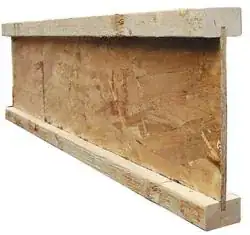
For 20 foot material these days, talk to your local suppliers about I-joists. Probably the most structurally efficient way to span that with wood, and they won't be terribly crooked. A decent suppler will be able to run load calculations to find a size to suit your use under local codes, if you tell them how much insulation you plan to pile on there.
As for the sloped end cuts, I have linked in the comments and will re-link here one specific manufacturer's detailed information about the effect of that on their product, and ways to reinforce it. Other manufacturers may or may not have similar documents, but you'd need to find the documentation applicable to I-joists you choose, or choose I-joists that have such documentation available - or you may need to abandon the plan of putting them on top of the plates and support them with brackets hanging down, or a ledger beam. Honestly, that should all be baked into what a good local supplier will select if you provide them with full documentation of the roof constraints. I've added emphasis to three points in the quoted text.
There are situations where architectural geometric restrictions of the cornice detailing require that the attic ceiling / floor joist be cut at a slope to match the sloped rafters. NDS-2005 (National Design Specification for Wood Construction) addresses sloped end cuts on dimensional lumber. These provisions do not apply to I-Joists. The bearing and shear capacity can be seriously compromised with this type of sloped-end cut on an I-Joist.
International Beams has tested sloped-end cuts on IB I-joists. As a result of these APA- witnessed tests, we have established maximum end reactions for unreinforced and reinforced sloped-end cuts. Table 1 (U.S. ASD) and Table 1a (Canadian LSD) with illustration 2 provide
reduced end reaction capacities for a range of
unreinforced sloped-end cuts for up to 16” deep IB I-joists. Shallower
slopes without reinforcement have significantly lower capacities. When
the special 2x6 stiffeners indicated in illustration 3 are installed,
the allowable end reaction is increased, as indicated in Table 2 (U.S.
ASD) and Table 2a (Canadian LSD). For steeper sloped cuts, the
reinforced end reaction capacity with the 2x6 stiffeners approaches
the full capacity of the IB I-Joist.


