6

I got some cheap aluminum windows for an outdoor room project, but I'm not sure what hardware to use to mount them. The windows have a nailing flange built in, but I don't want to use steel screws, or anything else thats going to cause corrosion super quickly. Can I just use aluminum screws to mount the windows to my wood framing? Is there a certain grades of stainless that will not cause corrosion with the aluminum?

Looking for suggestions.

Edit: My main concern is the aluminum (anode) and stainless steel (cathode) effect which from what I understand could severely weaken the window frame since its aluminum.

Thank you!

J. B.
  • 85
  • 1
  • 6

9 Answers9

7

One of the major national manufacturers, suggest the following for aluminum windows:

1 3/4" galvanized roofing nails or #8 x 1 1/4" pan head or washer head (stainless steel recommended) screws. Fasteners must penetrate at least 1" into framing

I prefer screws as they hold better and can be removed without damaging the window.

I checked the installation specified and there was no suggestion for a dielectric break between the fasteners and the window. I would suggest using a house flashing tape product if you are really concerned, but the fasteners should not be exposed to the elements and this is not a significant concern in this particular case.

UnhandledExcepSean
  • 10,074
  • 5
  • 39
  • 47
6

Instructions for the ones I installed did not suggest there was any problem with using standard steel screws. Remember that galvanic reaction is mostly an issue when the metals are immersed in liquid, and most windows' mounting hardware stays dry most of the time.

keshlam
  • 33,603
  • 5
  • 56
  • 110
4

Get rust free screws.

SS or zinc screws do not rust.

Galvanized is risky, since it is just iron covered with thin coating

Al screws do not hold (to soft)

If you are worried about galvanic currents, use a plastic washer as insulation between the screw and the Al frame.

isherwood
  • 158,133
  • 9
  • 190
  • 463
DIY75
  • 20,686
  • 3
  • 23
  • 47
4

Without an electrolyte (salt), galvanic corrosion will be minimal. The aluminum windows on my house are attached with zinc screws. They are fine after 35 years. A small amount of rust, but they will likely hold for the life of the window.

If you live near salt water, different story, my sailboat had significant galvanic corrosion on the aluminum where the stainless brackets were attached with stainless screws.

Mattman944
  • 2,256
  • 3
  • 13
  • 19
1

IF you don't want to use aluminum screws, galvanized is probably the next best option. Zinc and aluminum alloys are fairly close on the galvanic series, so the risk of corrosion should be minimal. Stainless steels are less compatible

user28910
  • 546
  • 2
  • 5
1

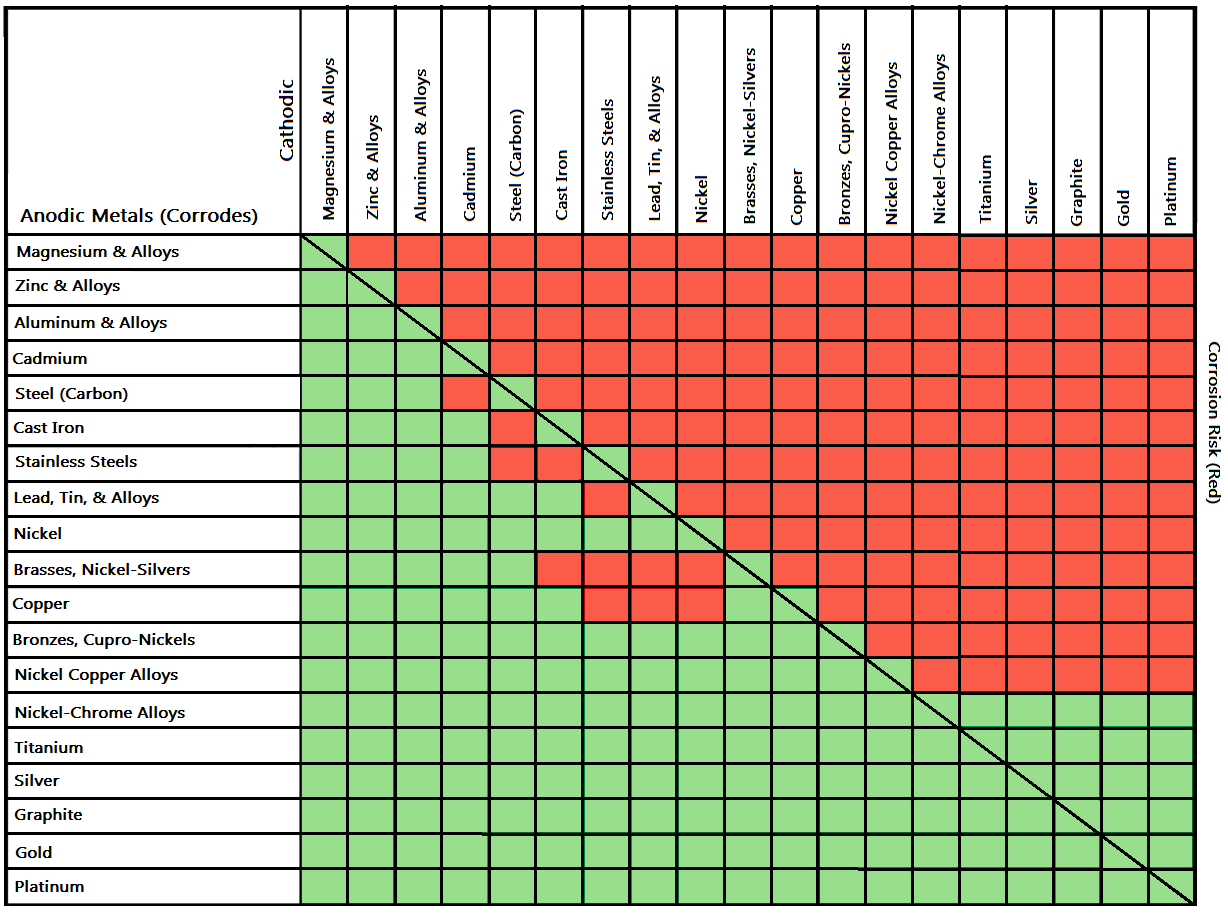
If you look at a metals compatability chart you can find the answer.

enter image description here

https://www.monarchmetal.com/wp-content/uploads/Galvanic-Corrosion_2.png

Looking at the chart your only sure option appears to be screws made of aluminum. Or screws not made of metal (plastic) or coated in plastic.

user4574
  • 181
  • 2
0

Looking at it from another angle - use pop rivets. Even if they're going into a wooden surround, they'll hold, and since they're alu themselves, there's no corrosion problems. That's of course if you don't see them being removed too soon, but why would you?

Tim
  • 5,501
  • 14
  • 31
0

Relative mass matters. There is much more aluminum than stainless steel in your setup. It would be much more problematic to have aluminum screws in stainless steel windows.

DKNguyen
  • 370
  • 1
  • 7
-1

Use normal screws and don't worry about galvanic corrosion. It is over-hyped risk as that is not an applicable risk for your scenario. Rainwater is a bad electrolyte and doesn't facilitate galvanic corrosion as good as your theoretical scenario. Any effort spent on overengineering just to mitigate a nearly non-existent risk could be better used to shield windows from other factors. I'd expect non-galvanic corrosion from bird excrements falling on the windows to be hundreds of times more destructive than having dissimilar metals. If it ain't broken, don't fix it.