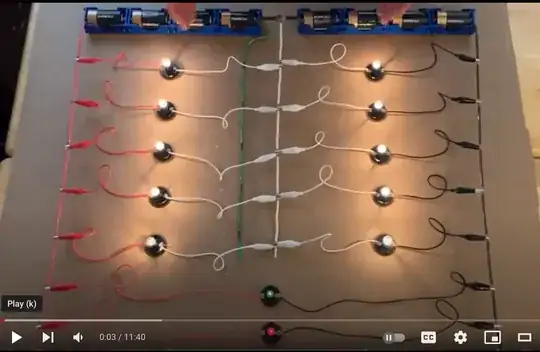
A properly installed MWBC does not work that way!
In any 240V/120V 2-hot + neutral circuit, from your entire house to a subpanel on down to a 15A MWBC, the neutral carries the difference between the hots.
On a pure 240V circuit (e.g., water heater), the hots are equal and the neutral carries no current at all, which is why in that type of circuit you don't even have to have the neutral wire.
On a typical 240V/120V appliance, such as a clothes dryer or oven, the hots are almost equal and the neutral carries very little current. For example, a dryer might use 20A on both hots for the heater and 3A on one hot + neutral for the motor and controls. In this case, one hot would have 20A, the other hot 23A and the neutral 3A.
In fact, at the very large level (building size) there is an expectation that loads will be balanced and the neutral wire will carry a lot less current than the hot wires, so that in some cases on very large circuits the neutral can actually be smaller wire than the the hot wires. That doesn't apply with circuits inside your home (including subpanels, etc.) but it does apply in some larger situations.
So that brings us to MWBC. An MWBC uses two hot wires that must be on different legs/poles of your panel and a neutral wire. If it is a 20A circuit then you could have many different loads running. For example, let's say it is a kitchen countertop circuit. You could have:
- Appliance 1 (e.g., toaster) 1500W on hot A/neutral: Hot A 12.5A, hot B 0A, neutral 12.5A.
- Appliance 2 1200W on hot A/neutral: Hot A 0A, hot B 10A, neutral 10A.
- Appliance 1 and 2 at the same time: Hot A 12.5A, hot B 10A, neutral 2.5A.
How does this work? The hots are out of phase with each other. They really return on the same neutral at the same time, but they effectively cancel each other out.
Related to this, the power used by your home (whether by the utility or an energy management system) is measured only on the hot wires, not the neutral wire.
Of course, if an MWBC is not installed properly then indeed you can have double current on the neutral and some serious problems.
The old problem with that was allowing MWBCs to have the hots connected far away from each other. That allowed for a good MWBC to suddenly become a bad MWBC because one of the breakers was moved for some reason. That was fixed by requiring handle ties or double-breakers for MWBCs.
Then along came tandem/double-stuff/half-size breakers. These brought the problem back again because if you replaced a pair of regular 15A breakers with 4 half-size breakers (for example) in order to add two more 15A circuits, if the original pair was an MWBC then you need to make sure they become either an inner pair or outer pair (and handle-tied) to keep the hots on opposite legs.
Problems can also occur with old fuse panels. I found one when doing a heavy-up. The problem had existed for at least 30 years, but fortunately never resulted in an overload and fire.
If you are not sure if an MWBC is OK, the easiest thing to do is to check it with a multimeter. If the voltage between the two hots is 240V (or 208V) then you are fine. If the voltage is 0V then you have a problem and need to get it fixed.