9

I am working on building a deck. Per the city permits office, I need 2 of my concrete footings to be 18 inches in diameter and 36 inches deep. Unfortunately, I just cannot find an 18 inch diameter concrete form tube. I have called around to all of my local stores and checked online--they all indicate "out of stock."

I'm wondering if there is any kind of reasonable method to building one's own concrete form tubes. Any thoughts or recommendations?

gnicko
  • 6,251
  • 2
  • 24
  • 42
HelpinKC
  • 133
  • 1
  • 4

3 Answers3

16

There's really nothing magic about tube forms. They're just a receptacle to shape the concrete until it sets. Anything with enough strength and moisture tolerance will do the job. Get creative!

A few options:

  • Buy larger (24") tubes and run a circular saw lengthwise to slice them. Overlap the edges and screw them back together with sheet metal screws or similar from the inside, with a board on the outside as a screw anchor. You might use some wire rings for extra support, or backfill before pouring.

  • Use something like 1/8" hardboard and do the same. Again, consider strapping for extra support, especially for stands of more than say 3 feet.

  • Use a rectangular form. You can probably go with the same cross-sectional area in a square configuration. 1/2" plywood or OSB with lumber reinforcement frames would do fine. Check with your inspector before pouring if you do this as they may require a certain inscribed diameter rather than an area.

  • Build a barrel. Stand up whatever lumber you have on hand in a hexagon or octagon or decagon and wrap it with strapping or tie wire.

  • Just dig a hole. Way back when we didn't even use cardboard tubes. They're most useful when there's an above-ground portion that you want to look nice. Dig accurately, though because a slight oversize results in the need for significantly more concrete.

Whatever you decide, be aware that concrete is heavy, and while it's being poured it exerts a lot of hydraulic pressure. Plan for that.

isherwood
  • 158,133
  • 9
  • 190
  • 463
11

Form tubes are mostly a convenience. They make the concrete look nice, make it easier to accurately calculate the quantity of concrete that must be ordered, and reduce the over-use of concrete which drives up material cost and runs the risk of shortage during the concrete placement.

If your soil holds its shape well then you don't necessarily need any form, at least not for the portion of concrete going below soil grade. Excavate the hole carefully, and slightly larger than the required size, then fill it up with concrete. If the concrete should rise higher than soil grade, build a wood form on top of the soil to contain the concrete up to the required elevation. This obviously won't work for a soil like beach sand which flows readily into a hole.

It may be the case that only the base of the footing is required to have an area of 255 square inches (area of an 18" diameter circle), while the column rising upward could be narrower. If so then you could (for example) dig a 16x16 square hole or an 18" round hole, fill the bottom portion to some depth completely with concrete, and use a smaller diameter tube rising up from there to the finished level. Your concrete would be shaped similarly to what's achieved when using the Bigfoot Footing Form. "Some depth" should probably be equal to or greater than the width of the hole -- at least 16" for the 16x16 square hole; minimum 18" high for the round hole.
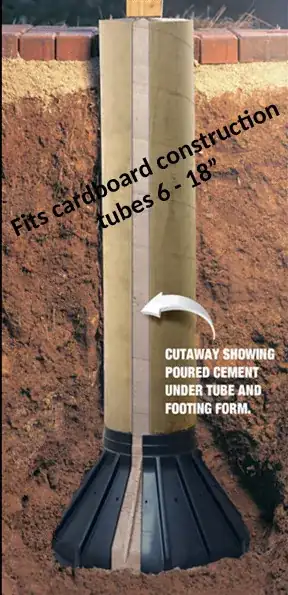
Bigfoot footing form

Greg Hill
  • 35,866
  • 42
  • 91
2

I have a round pillar in my house under an upper storey concrete slab. Instead of getting formwork to construct the pillar (in my country typically steel forms rented, bolted together, and removed once set), the builder simply bought an appropriate length of fibre cement pipe of the desired diameter and filled up with concrete. Left in place obviously, and it looks a bit neater than formwork might have (smoother outer surface).

There's obviously a couple of trade-offs, some locale-dependent, e.g. cost, availability, building code, work required, time, etc. that might or might not make this a viable option for you.

frIT
  • 551
  • 4
  • 6