10

I am completely renovating a 2 bedroom home, where the two bedrooms are wired together on a single 15amp breaker.

I spent most of the day yesterday painting one bedroom while running a portable AC on max setting in the other bedroom. After I finished painting, I began replacing the electrical components when I observed the following:

  1. The receptacle was noticeably warm to the touch (presumably from my 11amp AC running all day on the 15 amp line)
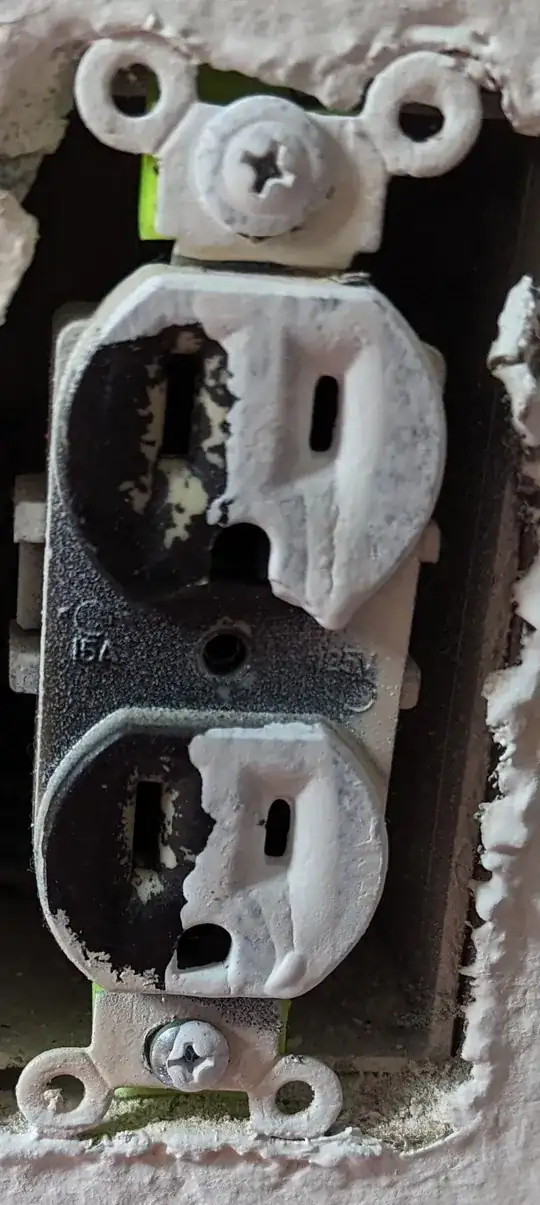
  2. ALL of the outlets and switches appeared noticably "blackened" or burnt. Here is a picture of one of the outlets. Ignore the right side that was painted white - I painted over it since I knew I was replacing it. You can see what looks like the original color inside the left prong socket enter image description here
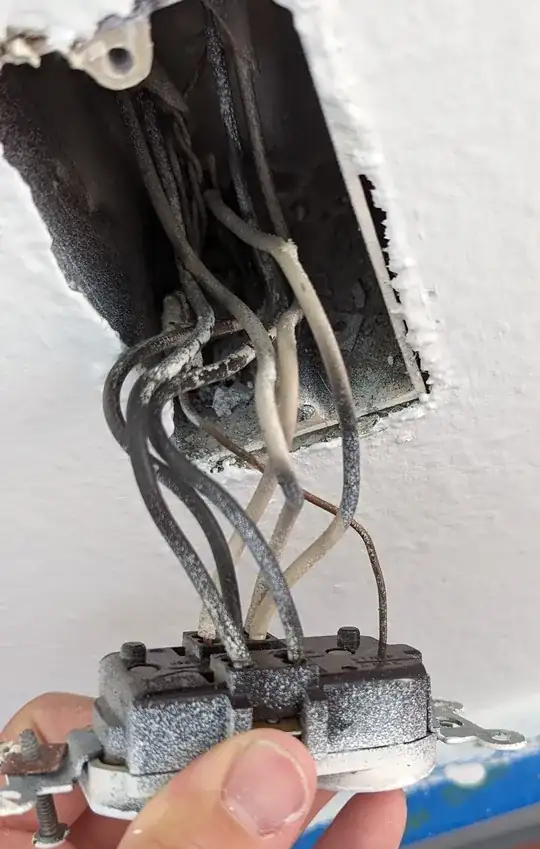
  3. Some of the insulation of the neutral wires also appear blackened: enter image description here
Is there something fishy going on with this room that I should be worried about, or is it just the case of some really old outlets going bad? None of the other outlets in the home look like the one pictured above, and presumably they were all installed at the same time.

these are the outlets I am installing enter image description here

Machavity
  • 26,498
  • 8
  • 44
  • 100
Luke
  • 225
  • 2
  • 6

4 Answers4

22

I see a beige receptacle, with a factory black coating which has been worn down by repeated plug insertions, with white paint on it covering the "worn down" telltales on the right side. Not seeing anything jumping out at me on the receptacle.

On the wires, I see heat stress on two neutrals, but not down their entire length. So this tells me they were pressing against a different wire that was suffering thermal stress. Since backstabs are notorious, it was probably there. Certainly a black wire, since black insulation hides the discoloration. I would not worry about the neutral wires but wrest/twist out each wire out of the backstab. Why not just cut with a wire cutter? Because you want to be able to do post-mortem inspection of each wire end for burning, arcing or spalling damage. Can't do that if you cut.

If you see a wire end with visible arcing/overheat damage, cut it back a little bit until you get to copper less obviously annealed.

Also inspect for any aluminum wire. That's not a problem per se, but will need to be handled special (if we want to apply the lessons of the past so we don't have a problem).

Your receptacle there has 3 wires per side. That clever receptacle with Wago lever-nuts for terminals seems to support only 2 wires. Either pigtail, or use the $3 spec-grade receptacles which have "screw-and-clamp" feature allowing 2 wires under each screw (so 4 per side).

Harper - Reinstate Monica
  • 313,471
  • 28
  • 298
  • 772
14

The "blackened" on the face out the outlet looks more like paint rather than charring, from these pictures. Charring/soot would not normally be so even, especially across the part of the yoke between faces, and does not usually flake off so cleanly, while paint does. If it was spray paint, that might also explain the blackening on the white wire, even though that "looks" more like soot/char than the face of the outlet does in pictures. Smell it - does it smell burnt?

The backstab wiring is to be avoided, and often at fault in cases of actual charring and overheated outlets. Don't repeat that mistake. Never use backstabs - back-insert "screw and clamp" is good, (insert wire(s) tighten screw to hold) backstab (poke wire in, won't pull out, nothing to tighten) is bad, despite UL continuing to list the things. Side wires that wrap around the screw (only one wire per screw in that case) are also fine. Torque the screws to specification in either case.

Ecnerwal
  • 235,314
  • 11
  • 293
  • 637
7

When I replaced a problematic receptacle, the damage was not most obvious to the wires, but on the receptacle itself with melting in the back of the receptacle. Some of the wires in the backstab sockets had come loose and had started arcing inside, and causing the breaker to trip repeatedly.

Looking at the front and back of your receptacle, I see no obvious damage, if the wires had started arcing, it obviously had just started, and the black marks you see is not scorching as you imagine. Instead you would see twisting, melting, and yellowing deformations around the places where the wires stab in the back as they heat up.

Unfortunately for most people the heating of the socket is usually the first sign that there is a problem because this kind of damage is not visible from the front regardless, so it is good that you are being proactive. Backstab sockets are notorious I hear for becoming loose and causing problems with age.

Here is the back of the receptacle

Here is the front of the same receptacle

As you can see the front damage looks nothing like the black marks on yours. There is some blackening around where the prongs were, and if you had it in your hand, you would notice that there is some physical rounding as well as discoloration of the back of the socket.

Chthonic One
  • 231
  • 1
  • 3
3

I would replace it, with one that does not use backstab connections. Two of the white wires show discoloration, similar to wire that has gotten hot. Connections in these back stab terminations will eventually work loose causing the resistance increases. If there is a load it will start to warm up, more so as it gets older. The wiring is such that even though nothing is plugged into this unit there are feather down the line that probably have a load.

Gil
  • 7,112
  • 1
  • 7
  • 21