The idea of the pairs is that the socket isn't only a socket. It acts as a bridging connector, so that one wire comes from the source and the other one, of the same color, is the "source" for the next socket.
That is called daisy-chaining. There are specific codes that describe how long that chain can be.
Should you now randomly discard one wire, then either the next sockets in the chain won't work, or this socket and the following ones won't have power or ground protection (the green-yellow one).
You must fix each pair securely in each clamp. Those solid wires are a pain to fix properly in those clamps. Should you provide a bad contact (not torquing them to spec, or missing a contact) then you have either
- The risk of a glowing wire (you'd better not have a wooden house or old wires without fire retardants), or
- a risk of missing protection, during accidental contact with tension aka. risk of electrocution.
Also, the green-yellow wire is holy: you must fix it to the ground clamp, not another one.
Assuming you are using a "Schuko"-receptacle: that receptacle is unpolarized. The black and blue ones can be connected interchangeably, always nonmixed, on the remaining connectors.
Shown here my collection of found bad contacts. Note the blisters in the transparent clamp and wire insulation.
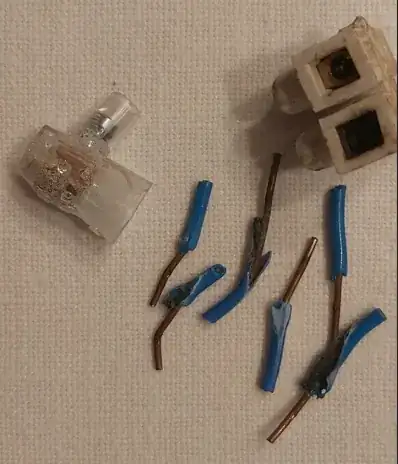
 As you can see, it's two blues, two browns and two yellow/green ones wired in six different bolts.
 Featuring just three bolts.


