11

I have a detached garage, which was unfortunately the setting for a recent bike heist in my neighborhood. I would like to start locking the garage door at night. The door is a normal metal clad exterior door for humans. However, when performing my nightly routine, I would prefer just to look out my window and have some assurance that I, or someone else in my family, did indeed lock the door, without having to trudge out in the snow to verify. The garage is about 50 feet from the house.

My initial thought was to have the locked deadbolt switch on an exterior light fixture. I wasn't able to find any ready made product online, but perhaps my google fu is poor? My current thought is to repurpose a momentary, normally open switch, and position it so that is pressed when the deadbolt is closed, perhaps one like this:
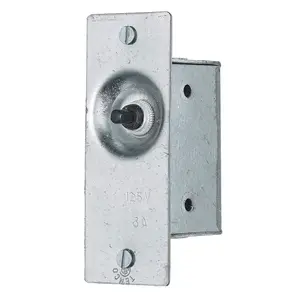
Switches and Lighting Controls, Door Jamb Switch, Normally Open, 3A 120V AC, With Box

  1. Does this seem like a sensible idea?
  2. Can a momentary switch be pressed all night long?
  3. Do y'all have any better ideas? I would like to constrain the topic to solutions which turn on a light, or a similarly low tech indicator, I don't really want to have to find my phone to determine if the door is locked. Also, if possible I don't want to have to replace the deadbolt.
Sophie Swett
  • 273
  • 1
  • 8
lollipopman
  • 121
  • 1
  • 6

7 Answers7

13

I am sorry your bikes were stolen, that's awful.

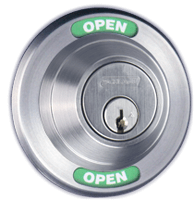
I think your plan is sound if fully considered (electrical safety, structural soundness), but burying that switch in your door frame doesn't sound like a fun project. If it would work for your situation, I would look for an indicator lock.

Image of a keyed deadbolt indicating "OPEN" in green

I know you don't want to replace the deadbolt, but I am seeing these available online for ~$50 and that definitely looks like the path of least resistance to me. Some deadbolt manufacturers offer retrofit kits too.

I went looking online expecting to find a digitally indicated deadbolt and everything I found was some version of a battery eating smart-lock that connects to your network. What a world!

However, that search did help me find some people who have already done what you are doing.

  • This person glued a magnet to the end of their deadbolt and use a reed switch to indicate when it's closed. This is similar to your solution but it keeps you from having to alter the door frame, which I think is a big plus.

  • This person used a tilt-switch on the deadbolt handle. Assuming you want a wired connection, the wire would have to route over the door hinges. Ben Voigt suggests using an optical beam sensor on the door frame instead, I think that's a good idea.

  • This person (in the comments) checked for connectivity between the deadbolt and the strike plate. This seems iffy to me, but what do I know?

MackM
  • 259
  • 1
  • 16
7

Does the idea of an indicator lamp seem sensible? Sure; as a scheme for monitoring the state of something at a distance this has been implemented countless times.

Yes, a momentary switch may be pressed semi-permanently. "Momentary" means only that the switch doesn't latch into a position; it does not imply anything about the duration-of-pushing or the intended use of the switch.

It might be possible to package this switch into a junction box in a wall cavity adjacent to the door and apply a wood dowel or other rod so that the dead bolt pushes the rod, which pushes the switch.

If you're willing to branch off into the world of low voltage electronics you'll discover a whole world of physically smaller mechanical switches and also other detection techniques. Hall effect sensors detect magnet fields without physical contact (and are used for detecting dead bolt extension in some smart door locks!). Various kinds of optical interrupter modules exist too. And of course, there are roughly ten billion different kinds of mechanical push, lever, roller, and other switches which you might be able to embed into the door jamb. Your own custom circuit could be powered by a 5V USB "device charger" power supply, perhaps using a simple LED shining through the window as the indicator visible inside the house.. Though many of us here at DIY enjoy low voltage too, such a project is likely a better fit at electronics.SE than here at DIY.

Greg Hill
  • 35,866
  • 42
  • 91
7

Googling for 'mortice lock with switch' turns up https://www.adiglobaldistribution.co.uk/Product/DA223 which is precisely what you're asking for, except that it will need an external relay or similar to turn on a (mains-powered) lamp.

However, I'm a little concerned about the amount of woodwork that might be necessary to embed a switch into a doorframe: any cavities etc. would weaken it.

An alternative approach would be to get a traditional mortice lock and to fasten a low-voltage microswitch onto or into it such that you could slide it back into the recess in the door with minimal "heavy engineering". This would obviously require a relay or something somewhere, but would be much safer than having non-standard mains wiring and would also allow you to "tap into" the substantial range of low-voltage accessories intended for burglar alarms.

Finally, avoid any modern "smart switches" controlled from your 'phone etc. These are often lumped into the "Internet Of Things" or "IOT" category, where the "S" in that acronym stands for "Security".

3

Assuming this is your usual style of deadbolt (turn the knob/key, the bolt shoots into the strike plate hole), you could glue a magnet to the tip, and install a (normally open) reed switch in the door frame—bore a hole on the inside of the frame, near where the magnet would be. Might need to bore some additional depth into the strike hole for the additional length the magnet would add. But you could then rig up an LED indicator light using the reed switch (assuming you have electricity in your garage).

Edit: based on Michael Karas's comment, perhaps one could simply bury a basic pin switch (rather than a reed switch) at the end of the bolt bore.

Huesmann
  • 6,282
  • 1
  • 15
  • 29
2

My first thought was that such a system would result in your light being on all day, when it's difficult to see and thus serves little purpose. You'd want a system that only activates at night, and at that point it'd be simpler to get a smart lock. You can use services like IFTTT to link smart devices together, and create a routine that turns on an indicator light if it's (say) between 6PM and 5AM and the door is unlocked. For an indicator light that doesn't broadcast the lock status to thieves, plug a nightlight into a smart plug inside your house. Some smart locks can even automatically lock if left unlocked for X amount of time, which would eliminate the need for an indicator.

There is a type of lock called a "key retaining" lock that prevents the key from being removed while the lock is unlocked. You'll primarily see these on padlocks and cabinets, but they make them on deadbolts as well. Instead of a light, glance out the window and see if there's a big obvious key hanging out of the door.

If you do try to build a light like you describe, there are a couple of things to keep in mind. First, be very careful that you're not weakening the door frame in the process. You aren't necessarily any better off if you end up with a door that can be easily kicked in. Consider an indirect sensor like an optical beam that goes across the door and is or isn't broken based on the position of the deadbolt knob, an infrared sensor that reflects off of a shiny sticker on one side of the knob, or a camera inside the garage that can see the door.

Also, I recommend that you do all of this with low-voltage lights and wiring. Switching a normal mains-powered light like this could present a safety issue if something comes loose and there's a short to the metal deadbolt (and then to your hand). Plus, it might be hard to meet code requirements regarding serviceability without cutting a junction box into your wall in a place where it compromises the door frame's integrity (you likely have several king studs beside the frame). A low-voltage solution would let you use all manner of small DC limit switches that could be installed with minimal collateral damage to structural members.

bta
  • 2,123
  • 7
  • 15
1

Buy a tall button switch (not a toggle, but hold-type) and install it inside the door frame, so that the button protrudes into the cavity that the deadbolt itself goes into. If you have issues getting the tolerance right, you can add something flexible like a spring or a piece of foam on top of the button.

The button should then be wired so that it turns out the porch light.

For example, you could wire it in series with the normal switch, so that you would leave the normal switch always on and the deadbolt would complete the final opening in the circuit. However, this would require the whole thing to be 120V-safe, which may be hard to do inside a door jamb.

Instead you can use a low voltage switch that wirelessly controls the light. This way the stuff inside the door would be all low voltage. There may be a (more expensive) LED bulb that comes with this already, so you won't have to do any wiring at all (other than putting the switch inside the frame).

You could also use a low power LED as your indicator, instead of the porch light. The indicator does not need to provide adequate lighting, it just needs to be visible. So you can use a low voltage, battery powered light installed outside the garage.

gomennathan
  • 554
  • 2
  • 5
  • 14
1

What's your budget? I don't know if 50ft is within range, but I suggest a wireless/bluetooth deadbolt. These can run down to about $60 USD, and the go dramatically up from there. The positive is that you don't have to look outside. Just go on the app on your phone and see if the locked. If not, then press the lock button on the app instead of trudging outside.

gns100
  • 111
  • 3