23

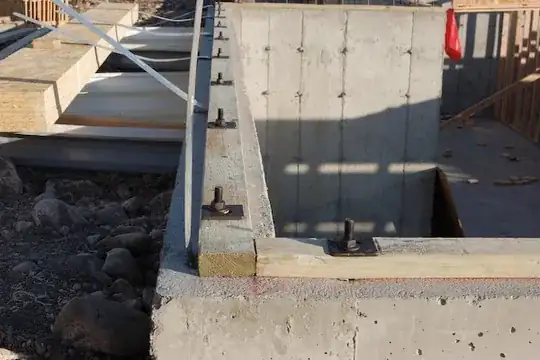
My new house is being framed. I saw that the frame extends 1-2" from the foundation:

Click photograph for full size
enter image description here

The builder told me it happens often and the city inspector will catch it if this is a problem.

Is this OK? Should I ask a 3rd party inspector to check on this right now?

DMoore
  • 50,637
  • 16
  • 93
  • 208
Derek C.
  • 231
  • 1
  • 2
  • 4

6 Answers6

23

No, it's not ok. For one thing, by the time the city inspector looks at the fully framed building, it will be a little too late to fix it. Secondly, the builder's attitude seems very questionable. Either his framing crew or the concrete sub messed up. At the very least their job is not done in a workmanlike manner. They shouldn't wait and hope things 'slip' by the city inspector. A good contractor with personal integrity just wouldn't allow something like this to happen in the first place, IMHO. Or if this was truly not a big deal, he would take time to explain why this is ok.

Niall C.
  • 20,909
  • 19
  • 95
  • 135
Vitaliy
  • 1,607
  • 1
  • 10
  • 12
12

OK this is easy. The answer is NO.

The construction has issues:

  1. There are no bolts for the sill plates.
enter image description here

2.The sill plates should be spaced on the slab so that wall plus exterior finish meets slab. It looks like this house is getting brick or thick stone given the 3 inches or so from the edge.

I am not sure about your situation. You are having a house built. If it were me I would not pay this person another dime. He should know this stuff if he is building a house. He shouldn't be unsure of this. If he is putting concrete nails in this (which I think is only code if you live in a shed) then what else is he doing?

To fix this situation everything needs to be ripped out. He is going to have to use a hammer drill to drill down into the slab to install anchors. The holes for the anchors need to be on center of your framing. I am not sure your builder could handle this. Also drilling down anchors is really a half-ass way of doing this (in my opinion). These are not as strong as anchors poured in and tend to wiggle.

Get your building inspector out not a 3rd party that could be as bad as your builder. I would also ask the inspector for local code regarding anchoring post-pour. I would personally look into my builders credentials. If I continued using the builder I would make sure the city understands your lack of confidence and that they should be looking at everything closely.

DMoore
  • 50,637
  • 16
  • 93
  • 208
2

My answer about the construction is that it depends: In New Zealand for instance, you MUST have the bottom plates beyond the edge of the slab (as some of yours are) for weather-tightness reasons. The cladding is often then run down past the level of the slab.

The idea is that the framing has a waterproof layer (a.k.a "building wrap") then an air gap to the outside cladding. If water gets through any flashings (particularly around joinery) then it runs down the air gap and out through drain holes. By overlapping the slab, the water drips off rather than sitting around your bottom sill plates and rotting them, as it would in the answer given above. Another answer implies that this overlapping has some effect on earthquake stability, I would suggest that wall cross-bracing is more important. Indeed New Zealand is a high-risk earthquake zone, as witnessed by the recent Christchurch earthquakes.

My answer therefor is that there may or not be an issue with what has been done, but there is definitely an issue with the builder not knowing!

2

No, this is not correct. When the slab was poured, the architect should have specified on the blue prints that 1/2" all thread rods should be placed every so many inches (I don't recall what the US Building Code states at the moment, but I think mine was every 18 or 24 inches when I built my room addition). You are then supposed to take a washer and a nut and attach the bottom plate to the concrete foundation. Finally, you will probably require Simpson Strongtie's to attach the studs to the top and bottom plate to resist shearing forces. Again, this may differ depending on the wind rating in your area (it's required in Florida). The city inspector will probably inspect at slab preparation, framing (including sheathing and insulation and electrical and windows), then final inspection. That's the gist of it. I would imagine this wall will slip over time. I wouldn't trust that framing. Call Mike Holmes!

1

As per answer above , the overhang is very minimal and if done to keep framing square then yes it is fine ,,,In fact it is very common as it is people building these things not precision machinery ( someone could have tripped or concrete pump hose could have hit forms when pouring ) Regardless in all building codes there is a min bearing amount which in this case could be 3 inches.... The hurricane straps do seem cheesy but who knows where it is being built and what seismic and wind loads are required ? Simpson or Hilti hit with epoxy and threaded rod is as strong if not stronger than cast in place anchors so no issue there , Usually i would say to ask and not critisize until it is known why it is framed liked that ( perhaps a steel post is to be cut in after instead of wood , again common ) But i will admit that the framing looks a little sloppy without knowing facts and the framers should be watched carefully over next few hours and possibly booted if sloppy work ....Just an FYI my company has built aprox 2,000 homes .. Multiple 3 and 4 storey buildings as well as extremely high end custom work... This no big deal at the moment picture taken but watch carefully

0

MASA mud sill anchor straps @ 40" oc when nailed to appropriate vertical framing and shear plywood....is equivalent to 5/8 x 12 anchor bolts A 48 " oc. But it looks like they are missing some straps. The gun fired nails are temporary to hold the mud sill in place. Also a drilled and epoxy anchor bolt, at a depth of 4 inches, installed per manuf specs...is Code legal and equal to the same size traditional anchor bolt. Study the load testing if you need to be convinced. It looks like the slab is not square...but the framing is square...made up for by overhanging the slab edge. This is done quite often, But, I consider anything over 1/2 inch to be excessive...the concrete should be built up with stucco with wire reinforcing shot into the concrete.

kdale
  • 1