3

I'm planning an electrical installation at home and need to know what speaker cables to lay.

So far, neither the speakers nor the stereo amplifier have been selected, but I know that:

  • The room is approximately 33 square meters large and has a high ceiling of 2.9 m.
  • The stereo floor-standing speakers will be 8 m and 11 m from the amplifier.

Does the thickness/type of cable matter in this case?

FreeMan
  • 48,261
  • 26
  • 101
  • 206
dzieciou
  • 221
  • 1
  • 3
  • 8

3 Answers3

20

Yes, it matters. It's very important for full-range speakers (ones with deep bass), and much less so for bookshelf satellites.

Wire gauge and length affect the damping factor. In simple terms, this factor decides whether a speaker diaphragm, once it's set in motion, is free to bounce (at low DF) or only moves as the music permits. It's calculated as speaker impedance divided by (amplifier impedance+cable resistance).

Damocles' answer addresses minimum gauge for tolerable voltage drop, but if you want good low-frequency sound, you also need a high damping factor. Low damping factor results in bass blending together into a loud hum - like cheap party speakers driven too loud (though there it's due to poor diaphragm rigidity). High DF allows high-quality speakers, ones with rigid diaphragms, to produce firm brief punches, resembling a live drum.

DF=50 is considered the minimum for stage music. DF=20 is acceptable for public venues, like a cafe, where music is just background. Studio and home hi-fi sound aims for a DF of 50-100 or more. Metal and honeycomb woofers work best at very high DF, for paper it's less critical.

11 meters is a longer speaker cable run than most home setups. Using 4 mm² wire (11 gauge) and 4 Ohm, typical of floorstanders, will only get a DF=40. What I do in such situations is either get an even thicker wire - 6 mm² will do DF=55 - or double up widely available 4 mm² wire, to get DF=75.

The best way to double up, if you can't get 6-8 mm² wire, is to take two 22 m runs of 4 mm² wire (equal length for both speakers), find the middle, and braid the doubled-up cable. Strip insulation in the middle and connect the cable to the amplifier, without actually cutting it in half. Solder banana connectors to the other end, rejoining the cable. Needless to say, today, with online shopping, buying 8-9 AWG (6-8 mm²) cable outright is much easier than doubling up.

Don't worry if it's not the best-known brand; that only has a minor effect on sound, which some even question, while the impact of the damping factor is profound and well-measured.

In professional audio, to provide consistently high DF no matter how long the wire run, the speakers are usually active, i.e. the amplifier is inside the speaker cabinet. You might want to consider this option too, but 11 m is still OK for thick wires.

Toby Speight
  • 481
  • 3
  • 11
Therac
  • 351
  • 1
  • 5
12

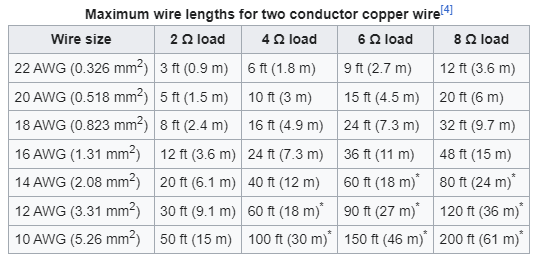
The potential issue with a long run of thin wire is high resistance leading to signal degradation. A typical speaker is rated between 2 and 8 ohms, so as long as the resistance of the wire is small in comparison you'll be fine. The resistance of a wire is a product of its intrinsic properties (gauge and material) and its length. Wikipedia gives this chart as a guide:

enter image description here

Since you haven't selected the speakers yet, you can prepare for the worst-case scenario and assume 2Ω. (They will probably be 8Ω in the end though). Then measure the distance of the cable run, and consult the chart.

Sort of Damocles
  • 520
  • 2
  • 11
7

Stop by your local home improvement center, electrical supply house, home audio store, or other place that sells wiring and pick up enough "speaker wire" to make the runs you need.

Also, make sure that the wire is rated for in-wall installation. There are certain insulation materials that are rated for in-wall use, many are not.

Unless you're an audiophile who claims to be able to hear the sampling rate of a standard CD and finds it irritating, your speaker cable (even though delivering an analog signal) won't be significantly degraded on an 11m/33ft run.

It's probably more important that you keep the speaker cable away from any mains voltage electrical wiring than the actual wire you use for the audio signal.

If you have a couple of options for wire gauge and the price difference isn't significant and it makes you feel better, splash out a little extra cash for a heavier gauge.


Funny, this is getting down votes, but it does answer the OP's question. His question is about the length of the run, not the purity of the audio quality. As a matter of fact, the OP specifically stated that he wasn't particularly worried about quality loss:

@FreeMan I'm definitely not audiophile, 0,001% loss in quality is not an issue for me.

It seems everyone's voting this down because it's not the "audiophile purist's proper answer". Well, go spend $100/foot on expensive wire that makes you feel better.

This is 100% correct for the OPs desire.

Oh noes, people don't like me and I've lost some pointz, whatever am I to do??

FreeMan
  • 48,261
  • 26
  • 101
  • 206