6

We've recently moved into our new apartment with an electric water heater, but it has a 47L capacity.

Unfortunately, we've found we can't manage back-to-back showers, nor can my partner manage a single longer shower to wash her hair, without the water going cold. We understand the heater is of a smaller capacity, but we don't think we're having particularly long or high pressure showers! It's difficult to even fill our small bathtub with hot water. Not a plumber, and this is our first apartment, but from what I understand some combination of turning up the thermostat and adjusting the thermostatic mixing valve could give us longer hot water usage?

I read the manual from Rheem, and they state a few times that adjusting the thermostat is something that should be done by a tradie, particularly they recommend "an electrician" a few times. Now we're moderately handy at DIY, and have ignored warnings like this before to do things like reverse fridge doors etc., but the fact they recommend a sparky instead of a plumber is causing us to take pause. We really don't want to pay someone to come out, but electricity is not something you want to take chances with. I'd assumed that as long as we cut all the fuses (they're unlabelled, so going to have to pull them all!) it should be a relatively smooth job of:

  1. Open thermostat panel
  2. Lift insulation, find knob
  3. Turn to increase temperature (or find that the temp is already high, which means we'll have to look at a new thermostat or something along those lines)

Basically, I'm asking whether this is an ass-covering warning from Rheem for the 1/10,000 people who might try to cut a power cord with scissors, or if this is a genuine warning because of a very high chance of electrocution?

Thanks so much for any help or advice!!!

isherwood
  • 158,133
  • 9
  • 190
  • 463
Jack
  • 61
  • 1
  • 2

3 Answers3

8

You absolutely should turn off the circuit breaker (or fuse, if your house is that old) supplying the heater before making adjustments - indeed, before opening the cover at all.

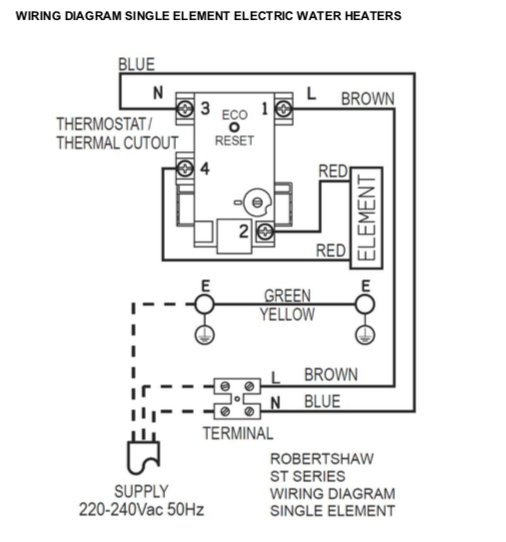
Thermostat diagram

Image source - PDF manual from page linked in question

The wire on the top right will always attempt to kill you if you touch its exposed screw terminal. The one just below the thermostat dial will attempt to kill you if the element is on, such as when you have just turned up the thermostat, mere millimeters away from it. No scissors required!

The manual also states:

Only adjust the thermostat setting when the isolating switch is switched off at the switchboard.

Which is additional insight that the power must be off when adjusting.

Other than that, you have the right idea. Turn the breaker (and/or "isolating switch") back on after securing the cover.

If the thermostat is already at maximum, it's unlikely you can replace it with one that goes hotter. You'll have to look into a larger tank (or much more water conserving shower regime) at that point.

Ecnerwal
  • 235,314
  • 11
  • 293
  • 637
6

Common US electric water heater thermostat adjustments are no big deal and don't require an electrician or even shutting off power. But this is a model designed for the Australian market and either due to local regulations or other design or market-based issues, it does not have a simple user-accessible thermostat. Which means adjusting the thermostat does require turning off power and partial disassembly of the unit. But I don't think adjusting the thermostat will help all that much. Also keep in mind that any faucet, showerhead, etc. that does not have an anti-scalding mixing valve presents a serious danger for burns with higher temperature settings.

If the problem is that one of the heating elements isn't working then you do need to shut off power.

But I'm pretty sure the problem is simple capacity. 47L is 12 gallons. That's OK for washing a few dishes. Possibly enough for one shower. But that's it. The web page describes it as:

Its compact size makes it the perfect choice when replacing water heaters underneath the kitchen bench, in cupboards, or in the laundry.

and I think those are all good uses. Showers and baths in general are a bad match for a water heater such as this one - it is just too small for that. And even worse for an entire apartment - e.g., kitchen + bathroom + laundry.

Typical US water heaters for an entire house are 40 or 50 gallons. If you have only a couple of people and dishwasher heats its own water and laundry doesn't need hot water then you can make do with less. But 47L? That's what you find as a point-of-use heater for one kitchen sink or a half-bath, not for showers and baths.

If you have physical room for it and are allowed to do so, replacing with a larger water heater is the best solution.

If anyone suggests an on-demand water heater, that has its own problems. An electric on-demand water heater capable of providing enough hot water for an entire apartment will typically require far more electric power than is available in the apartment. Upgrading the electric supply, if it is even possible, will generally cost a lot more than installing a larger tank water heater.

In the US, "apartment" typically means rental, which means you can't do any of this work on your own and you can't even hire other people to make any changes without permission from the landlord. If you actually own the apartment (US equivalent is typically a condominium) then you should be able to replace the water heater with a larger one. Typically the work (plumbing and electrical) will need to be done by licensed professionals - the exemptions in many areas for DIY work are for single-family homes where the risk of damage to other people/property is minimal.

manassehkatz-Moving 2 Codidact
  • 139,495
  • 14
  • 149
  • 386
1

Just so you are aware, it is illegal in Australia to make changes to fixed electricals. If there is an issue your insurance will certainly be invalidated.

I think this is overbearing, but one should be aware of the risks - hot water is a higher powered device (i.e. here 3.6 kW - a fan heater is ~2.4), so the risks are e.g. overheating/fire due to a high resistance on a connection.

That said, usually you can adjust the thermostat via a control knob - which does not require electrical work.

isherwood
  • 158,133
  • 9
  • 190
  • 463