22

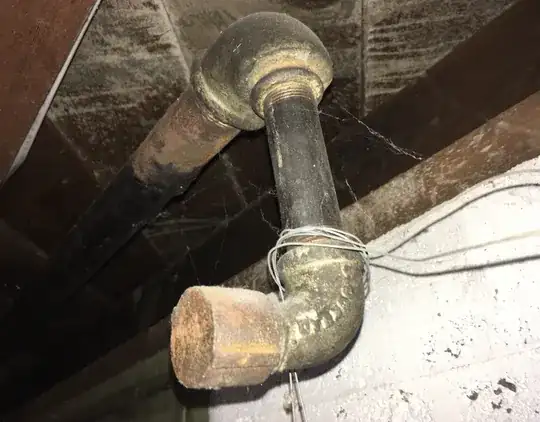
I have a mystery 1¾" cast iron pipe (outside diameter) in my basement. It's ugly and rusting, and I want to remove it. I want to know what's in there before I start opening it up, but I'm out of ideas as to what it could be.

It has a black, rubbery (and oily in some places) coating along most of it. It comes in through the foundation in the basement below the outside grade, goes up to the basement ceiling, then runs along the wall for about 12 feet. Then it reduces into short 1¼" pipe that's capped off. The house is in Oregon as was built in 1930.

It's too big to be a water line or gas line (and the local gas co says there has never been gas at the house), and too small to be drain, waste, or vent.

I also don't believe it's an oil fill pipe. There used to be an oil tank in the opposite side of the basement. The old oil tank had a copper fuel line running to the old oil furnace. It has had oil since at least 1959, and was probably coal before that. I removed both the tank and furnace. There aren't any other (buried) tanks on the property either.

That leaves ... ? I don't know what. I'm certain it's not fuel oil related, which is probably the worst thing it could be (followed closely by a 1¾" water line under full city pressure). Is there a safe way to open up this unknown pipe so I can get rid of it?
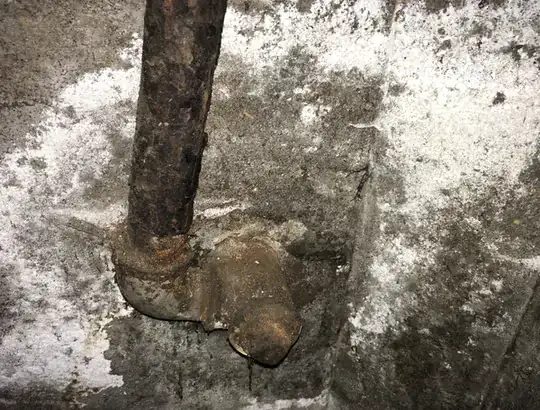
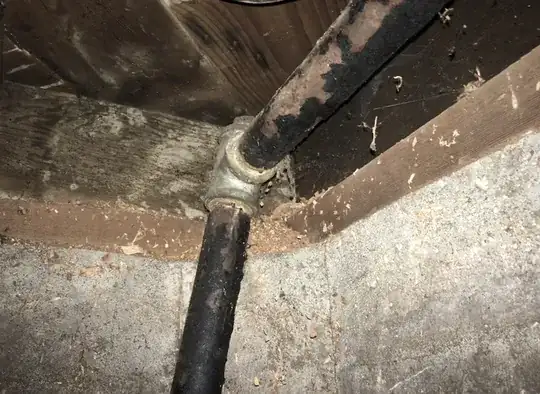
Pipe comes in through the foundation Then runs up the wall and takes a right along the ceiling 15 feet later it is reduced to 1-1/4 inch and capped


Update: Thanks for all the responses.

I'm intrigued by the idea that it might be coal gas. The house is in NE Portland. I know there was coal gas in Portland, so maybe it's possible. The pipe enters on the street side of the house.

It's around 3 feet below grade on the outside, and I believe I have enough room to dig it up. That will at least tell me if it's capped off on the outside, or if the pipe goes off in some other direction, or connected to a big oil tank that was missed by the tank locator people. If nothing else, I'd rather try to open it outside - better to have coal gas, oil, or whatever leak out all over the front yard than in the basement.

I've also called 811, maybe the gas co or someone will be able to help identify it (though I think they don't find abandoned pipes, just active ones).


Update again: This was a gas pipe. I finally got the gas company to admit it after being told repeatedly and emphatically that it didn't exist and that there was never gas service at my house. (I told them that I was going to remove the pipe with a cutting torch...and engineer showed up at my house about hour later and helped me cut the pipe out).

It's for an old "low pressure" gas system, which is why the pipe is so big. It was in service at my house (with no gas meter) until about 1950, when it was suppling a kitchen stove. It may have also supplied a furnace (that was later switched to oil).

At some point about 25 years ago, the NW Natural re-lined all the old gas pipes in my area, and since my house didn't have service at the time, they disconnected it at the pipeline. But the previous homeowner just left 12 feet of pipe in the basement hanging down from the ceiling and blocking a window.

Seth
  • 357
  • 2
  • 9

4 Answers4

32

It is most likely a coal gas delivery pipe.

Coal gas was in common use in parts of Oregon in the 1930's. If your house is in a town or city it was probably fitted for coal gas when it was built.

The pipe is noticeably larger than a modern natural gas pipe because coal gas had a considerably lower caloric density than natural gas, so a correspondingly larger volume was needed. Also, coal gas was usually supplied at what we would now consider an anemic pressure, so large pipes were needed for an adequate flow rate.

The pipe was coated with a rubbery tar meant to prevent rust and to seal up any small leaks. Coal gas contains carbon monoxide so even a modest amount can be lethal.

Your current gas utility has no record of this pipe or the network that it was part of because they never delivered coal gas and never used this pipe. When they installed natural gas service they just capped the coal gas pipe and abandoned it.

See if you can find historical records of a coal-gas (aka town-gas) utility at your location. That may tell you when the pipe network was capped off and abandoned at the supply end.

A. I. Breveleri
  • 14,929
  • 1
  • 27
  • 47
12

It's fuel or water. You seem to have ruled out all the obvious ideas. Unfortunately, one of your guesses is wrong, and the easy answer is buried with a long-previous owner.

I can't tell you what it actually is, but I can give some suggestions on how to investigate:

  • If it's a street-side wall, that's a clue to water or gas. Could be the water service line and water meter were replaced. If so it's probably disconnected.
  • Could be the gas company is wrong. They have no records of serving your house, that doesn't mean there was never gas.
  • You say there are no oil tanks. Did you hire the tank-finder person? If not, you could do that. Not too expensive and a lot easier than digging it up.
  • Dig it up and trace it. You don't have to trench, use signal tracer to find its direction and post hole digger in critical places to confirm.
  • Map all the underground utilities 360 degrees around your house. Keep watch of the street and neighbors' yards. Whenever you see underground utilities being marked out, add them to your map. Do this for several years, and eventually you will have an accurate map of all utilities including ones that may have once served your house but no longer. This might show you how water or gas once entered your house.
jay613
  • 49,543
  • 6
  • 70
  • 201
8

Supplementary to other answers which suggest probable reasons that the pipe exists:

When you're ready to remove it, rather than going directly at it with an angle grinder, first drill a small hole so that if anything comes out you can quickly plug it with a screw.

For softer metals, I would recommend using a self-tapping screw as the stand-by filler, but that won't bite in cast iron. You might be better using something like brass, so that the screw itself deforms to the hole. You don't need to worry about ever needing to remove it.

A possible alternative that I've not tried would be a blind rivet, but that requires a much larger hole and there's no guarantee that the pin will remain in place once pulled, so you'd need a self-tapper of the pin diameter as well.

Toby Speight
  • 481
  • 3
  • 11
4

Consider the angles of the pipe. It looks like they are rectangular? And they are running at the ceiling... if it is an influx pipe, it leaves gas as the only candidate, doesn't it? Also the cap is a hint to that.

Influx of a liquid like oil or water would not run up into the house (well, water has to actually).

If it is some outflux pipe for a liquid, it has to be mounted with a gradient to ensure water or oil flowing inside (considering there was a influx from inside the house through this pipe to some tank outside). And outflux for a gas does not make much sense.

Did you try hitting it with a crowbar or something and hear the tone it makes? Does it "ching" (connected to some tank) or is it "dull" (probably dead end)?

Is it possible to dig a hole on the outside wall at this position? Maybe this gives clues to where it led.

Maybe they had an isolated, external, (overground) fuel/gas tank in the garden (is there enough space outside?) and therefore the gas provider does not know about it.

Antares
  • 141
  • 4