6

I have heard many people here recommend, sometimes very strongly, not to use backstab outlets, switches, etc, or at least not to use those connections if screw connections are available. Reasons given is that those connections do not hold up well over time, become intermittent or develop high resistance, etc.

But, are they really that bad? Reason I bring this up is that I just pulled the switches from a 3-gang box that has been in place for over 40 years (the condo was built in 1983), and they all used back stab connections. And as far as I know there has never been an issue.

Here's a picture. The screw terminals are on the far side of the switch and not visible in this picture.

So are backstabs really that bad?

Picture of switches

nobody
  • 7,701
  • 3
  • 36
  • 47
SteveSh
  • 7,107
  • 2
  • 15
  • 31

4 Answers4

12

Backstabs are really bad when used with high currents.

The inherent higher resistance in the backstab connector promotes heating when under load. Heat promotes oxidation. Oxidation worsens the contact resulting even more heat. Heat also reduces the spring force, leading to more resistance and more heat and so on - all the way to losing the electrical connection (the good case) or starting a fire.

In a switch that powers only a few lightbulbs, the heat produced in the contact is simply not enough to start the above sequence and the backstab is good for decades.

fraxinus
  • 3,817
  • 8
  • 15
9

Yes ...Backstabs are bad.

I am biased, because I had to waste time hunting down an odd problem with my microwave. The cable to the outlet in the cabinet was run to another outlet in a different cabinet used for a trash compactor. The wires were backstabbed into the back of that outlet.

The whole thing caused my micro to run for about 5 seconds, then lose power. Wait 5 minutes or so and the power came back.

Backstabs are a known issue, so why take a chance. Just spend the extra two minutes and put wires under the screws.

RMDman
  • 52,615
  • 3
  • 36
  • 113
8

Just because you have not personally noticed an issue in your particular unit does not mean it's a good practice.

Backstab connections, in general, have looser connections than using the screws. A loose connection can cause heat and arcing - neither are good.

Here's another anecdotal take for you - my condo is 12 years old and all my outlets only support backstab connections. Several outlets were so loose that the plug had to be jiggled for the device to get power. I replaced them all and no longer have to worry about them melting or starting a fire due to a loose connection.

As others had said - spend the extra two minutes per outlet/switch and use the screws. If the outlet/switch does not have screws, they are cheap - like $6 for a 10 pack.

James
  • 467
  • 4
  • 16
7

There's one major rule in electrical work this violates: movement.

Voltage is a measure of how much "electrical pressure" there is. A 1.5v battery is harmless to the touch because your body isn't a great conductor at lower voltages. But at higher voltages (which includes 120v) there's enough pressure that it will jump gaps. We call this arcing, and arcing is how you turn electricity into fire (i.e. spark plugs and combustion engines).

Backstabs are quick and easy, but they are notorious for losing the physical connection. Why? I'll borrow an image from this answer
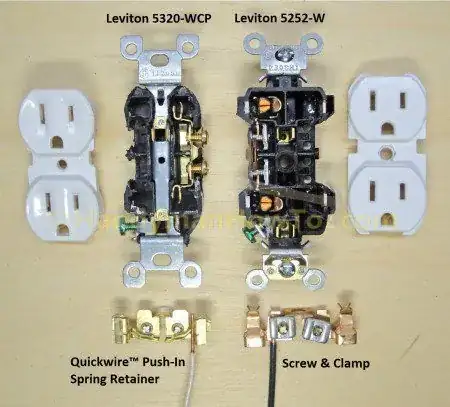
backstab breakdown

Note what holds the backstab. This is a modern backstab, with what amounts to a brass claw. I've seen some old ones use nothing more than a glorified spring. This can provide a poor mechanical connection, especially if the device was moved a lot (i.e. an owner pulling them all out to take a picture for a DIY site...). Every movement of the wire can weaken the connection. So, as long as you never move the device, and you don't have a lot of big temperature fluctuations, you can be fine. But do you really want to trust a folded piece of metal in a device designed to be as cheap as possible to hold up?

You'll note the premium outlet next to it. It uses what I call a "side stab". The goal of "stabs" in general is to not go through the hassle of making a shepherd's hook and wrapping it around a screw (which has its own headaches). That system, despite being frustrating, will at least tell you when you failed because the wire pops out from underneath the screw. Side stabs are even better because you put the wire under a plate and then screw the plate down. No headaches with bending wire and making sure it stays in place.

Machavity
  • 26,498
  • 8
  • 44
  • 100