12

What are some devices that could slowly lower and raise roughly 200 pounds roughly 2 feet?

I have been looking at hydraulic equipment, but they are all designed for tons and i do not need the ability to lift that much. I would like the device to be small, lightweight and self sustaining. I do not want to have to charge, fill with liquid, check for leaks, replace after a year... stuff like that. I want to install and forget.

I need it to be able to slowly lower and slowly raise.

My goal is to have a device that can lower and raise a desk.

prolink007
  • 221
  • 1
  • 2
  • 5

6 Answers6

4

Sorry to revisit an old thread, but having recently been pondering the same thing I have settled upon a solution that fits my setup.

I have an ikea mikael desk with glass top - it has full width wooden sides rather than legs and weighs a total of 30+ kg unladen (see https://farm3.staticflickr.com/2438/3857538226_ab3914ea19.jpg). With monitors etc on board it comes in at around 50kg.

I decided to use gas springs, the type you get on cars/campervans. I bought a pair or them for £23 (about $35) from fleabay which have 25kg lift and a stroke of 290mm.

These will be attached to the sides of the original desk and to a wooden bar which will sit on the floor, parallel to the sides. I also stumbled on an adjustable clothes rail (like http://www.amazon.co.uk/Premier-Housewares-Double-Hanging-Wheels/dp/B008VB2PPS) which has 4x adjustable length bars. I was given this and it has sat in the garage for a while. There are cheaper versions which should do just as good.

The 4 adjustable bars are made up of 2x poles which slide over each other, and a small locking mechanism which clips across. This mechanism won't hold much weight, maybe only 10kg max per lock, so wouldn't do to hold the whole desk up. The larger of the two poles attaches onto the original desk at the top and near the bottom and the locking mechanism sits underneath the join, with the smaller one attached to the new foot running parallel with the original side. One adjustable pole will be near each corner. The gas spring will run from the new foot to the original side and assist in lifting the desk - which should have an effective weight of only a few kgs now.

The extendable poles should keep everything running smooth and even, allowing the desk to lock at whatever height is required, and unless there is a lot of weight on the desk I should only need to lock the front, easily-accessible ones.

With a few bits of timber which I had lying around, the whole project should cost me in the region of £25 or so - if you were to buy everything new it may be £50. It's very much designed for my current setup so may not be suitable for all!

If wanted I can post a few photos on completion, maybe a video of it moving. I can imagine that most people have managed to solve their problems by now though!

Tom
  • 41
  • 1
3

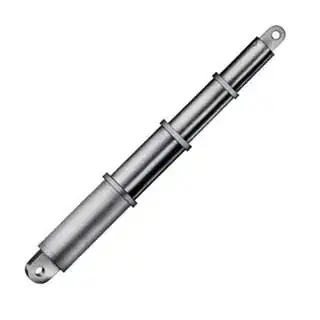
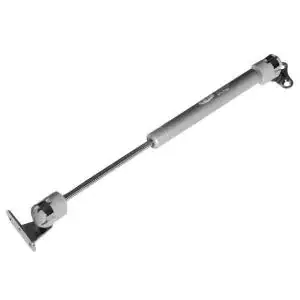
What about pneumatic lifts, something like this?

gas lift

You would need additional hinges and attachment points, and might need a bigger version (at least a pair), but the approach might work.

Note that these are generally used with a rotational hinge, but you might be able to combine it with some other hinges or levers to raise something straight up as well.

SUPPLEMENT (in response to comment questions)

One end of the lift is attached to a stationary object, like a wall, and the other to a platform that can move, like a hinged shelf. Usually there is a stop at least at the lower range of the platform. The lift is like spring that is under compression. You lift the outer edge of the platform and the gas lift provides an assist (reducing the weight). If it is perfectly balanced, the lift will hold the raised weight in place. Or it can be latched when it reaches its upper limit. Some gas lifts are adjustable in the amount of lift they provide. Going down is the same. Your hand pressure overcomes the resistance in the system and the lift slowly lowers the weight.

SUPPLEMENT 2

An alternative might be a pulley system, like this bike pulley setup

bike pulley

This system has a 4:1 advantage, so a 200 lbs. weight would feel like 50 lbs. You would probably need two systems for stability, and the effective weight would be 25 lbs. of pull needed to lift 200 lbs. This, of course requires that you can find very strong anchor points in the ceiling, bolted into the framing, not just the finish material.

bib
  • 33,975
  • 10
  • 68
  • 102
1

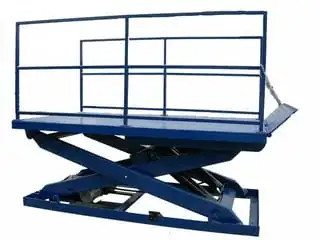
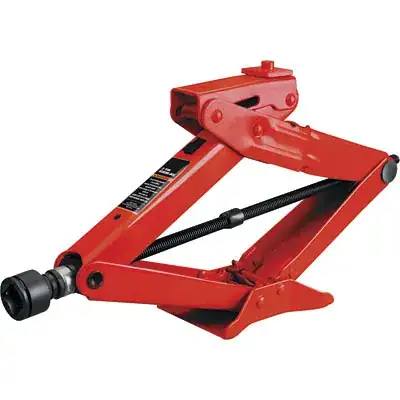
A scissor jack may be your answer.

scissor jack

Tester101
  • 133,087
  • 80
  • 327
  • 617
1

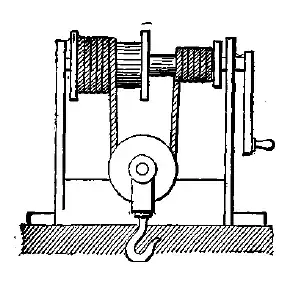
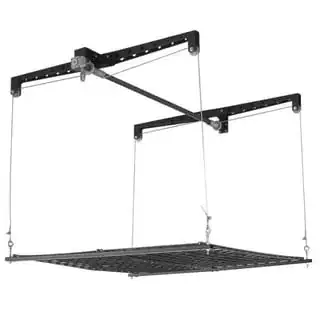
If it's OK to suspend it from the ceiling, perhaps something like this cable-lifted storage rack can be used:

enter image description here

Niall C.
  • 20,909
  • 19
  • 95
  • 135
user2813274
  • 219
  • 2
  • 8
0

I had exactly this problem and solved it with some of those quick grip clamps (that might be a trademark, mine were made by Irwin, but there are many equivalents). I reconfigured it to be in spreader mode. The bar sticks out on one end, so you can either point them up and use the clamps in pairs, or put it under the center of the desk with the bar pointing down if you set it on a sturdy box taller than the protrusion.

I liked this method because I didn't have to buy anything I didn't already have. I used to to raise my desk surface (fully loaded with 3 monitors, 2 computers, and 1 heavy UPS) 17 inches while I adjusted the supports. To do it safely I took turns raising each end, and adjusted the supports in small increments as often as possible to prevent any disasters.

skiggety
  • 561
  • 4
  • 18