5

I wanted to know if it was okay to cross the wires on outlets that appear to be set up in series. What I mean is on the first outlet in the series, from the cable coming from the electric panel, the black wire goes to the bottom screw and the white goes to the top screw and the other cable going to the other outlet, the black wire goes to the top screw and the white wire goes to the bottom screw? The black wires are both screwed into the copper side and the white wires are both screwed on the silver side.

I don't like to touch anything electric but my spouse decided to change almost all of the receptacles in the house while I was at work. I had to correct some issues and now things work as they are supposed to, even the sockets that are connected to light switches. I'm proud of my work and what I've learned, but I realized that I put the receptacles back in the wall without checking if I crossed the wires on some of the receptacles. My family is sleeping and I don't want to wake them but I also don't want a fire to break out during the night. I called an electrician to come and certify the work or fix what's wrong but until then I'm pretty stressed.

nobody
  • 7,701
  • 3
  • 36
  • 47
JayFou
  • 299
  • 1
  • 9

4 Answers4

14

With ordinary duplex receptacles, it doesn't matter. The top and bottom of each side are connected together electrically, unless the connecting piece between them is deliberately removed, which is generally done only for "half switched" receptacles (so that the switch controls one receptacle, such as a switch for a plug-in room light or a garbage disposal, and the other receptacle is always on) or for Multi-Wire Branch Circuits (MWBC).

There is one very important exception: GFCI. With GFCI, the top and bottom are independent. One set of connections is for line (i.e., incoming power) and the other is for load (providing GFCI-protected power to another receptacle). In that situation, if you "cross the wires" then you will be violating code, as the neutral and hot wires would not be paired correctly. However, if you did that then you would find that the GFCI would either immediately trip or simply not work at all.

FYI, for ordinary receptacles you can also pigtail the wires - i.e., connect the two black hot wires together with a third short black wire (the pigtail) and connect the pigtail to the receptacle. Do the same with the white neutral wires. Everything will work just fine - if crossing the wires was a problem this would be a problem too. But most people just use the second set of screws to avoid the small bit of extra work of making pigtails.

manassehkatz-Moving 2 Codidact
  • 139,495
  • 14
  • 149
  • 386
7

If, by what you mean by "crossed the wires", you mean switched black (hot) and white (neutral), then yes, this is a problem. Not in the sense that you'll burn the house down but in the sense that someone could get shocked you have an old appliance with a problem or in some other circumstances.

This can easily be checked without opening up the outlets. Purchase a three-light outlet tester, such as this at Home Depot (just an example). These can be purchased at any hardware store or large department store. Go to each outlet and plug it in. If it indicates "hot/neutral reversed", then you did switch wires, either in that outlet, one feeding that outlet. Fix these as soon as possible.

Note that if an "open Ground" is reported (missing or disconnected green/bare wire), then the tester will not be able to detect reversed hot/neutral. In fact, a missing ground would make a reversed hot/neutral even more dangerous. Fix this too.

DoxyLover
  • 14,216
  • 2
  • 30
  • 56
5

Picture is worth a thousand words. And I understand your confusion..

Electricians often describe outlets as wired 'in series' when what they mean is they didn't use pigtails:

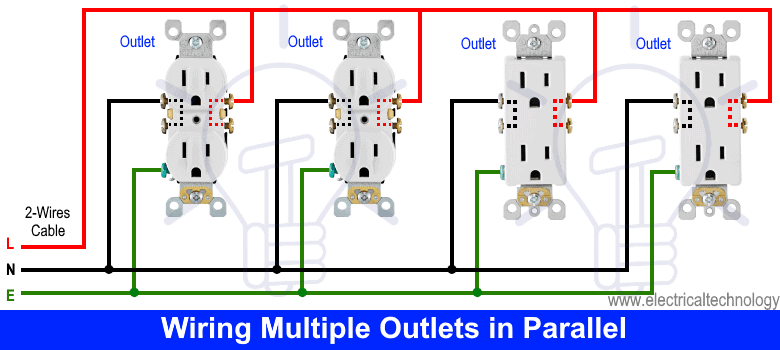
This is a bunch of outlets wired in parallel IE with pigtails :Outlets in parallel Figure 1

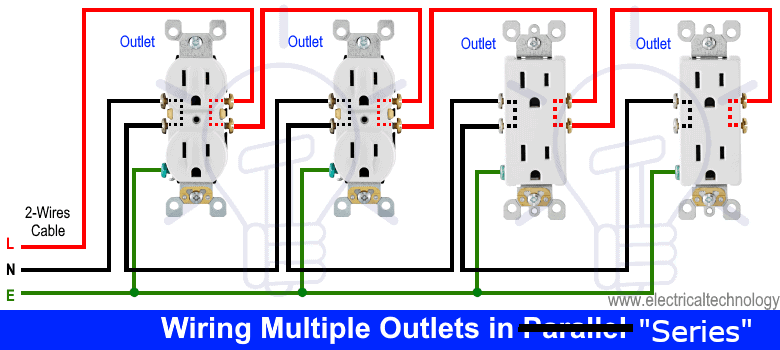
And is functionally the same as this wiring in 'series' which is still in parallel, just not using pigtails, and instead using the outlets to connect the wires. You can swap red wires around with other red wires, or black with other black no impact on performance (assuming you aren't using GFCI): Outlets in electricians "series" Figure 2

It can cause all of the outlets connected to this circuit to stop working if one of the outlets goes bad/is removed... But that is only because the outlet is being used to connect the red to red and the black to black as opposed to using a pigtail... It is much faster to wire this way, and is almost as good as wiring in pigtails (though it does make it harder to figure out which outlet went bad.)

NOTE: it doesn't matter which wire goes to which screw as long as load is connected to load, and neutral to neutral. They metal strip electrically connects the wire and makes this circuit identical to the top one (with pigtails), as long as none of the outlets break/you don't remove the metal tab.

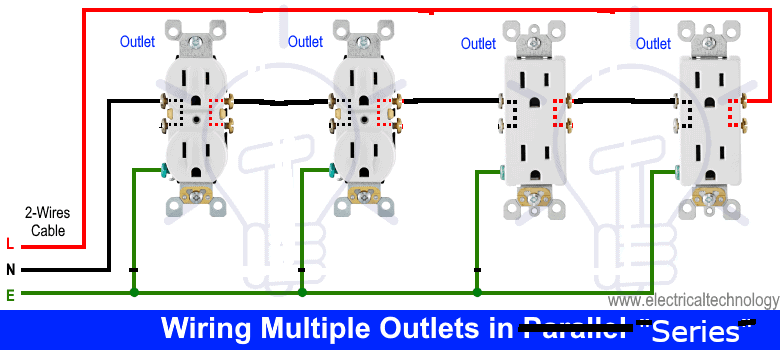
This is what non electricians (but CS/CE/EE, and or anyone with experience with electronics) think you mean when you say 'series'. This one is bad and will not work: Bad wiring, power must flow thru all outlets to work. Figure 3

Power has to flow thru each outlet before it is available for use by the next outlet. This means that you need something plugged into each outlet for it to work, and all of the devices will have less than 120V. This is bad, don't do it.

As long as you wired your outlets like Figure 1 or Figure 2, with neutral to neutral, and load to load you are good to go.

Questor
  • 1,281
  • 3
  • 8
3

Receptacles (AKA "outlets") are never wired in series. Unless you have a duplex receptacle wherein the bridge between the top and bottom screws has been removed, it is totally arbitrary whether any given wire is attached to the top or bottom screw.

kreemoweet
  • 4,598
  • 16
  • 17