We live off the grid and have just installed 26 220V 1.2W LED lights. We are using 220V as the batteries are some way from the house and and thick copper wire is expensive. Everything works on the inverter except the LED lights. We can only use 6 and then the inverter trips out. With everything turned off, adding 1 bulb at at a time and measuring the current, everything is fine until we add the 6th LED light and the current reading starts going crazy, up and down very rapidly until the inverter trips. What is happening here?
Asked
Active
Viewed 1.3k times


7 Answers
5
This is almost certainly from using a "modified square wave" - MSW - inverter rather than a "true sine wave inverter" - the power conversion circuits in AC LED fixtures expect a sine wave input, and the way they behave when fed MSW input is upsetting your inverter.
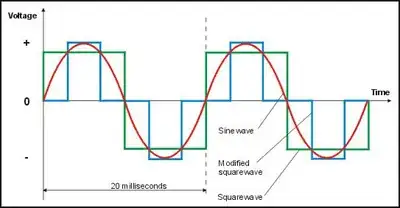
One possible solution, short of "buy a new inverter" (a rather expensive proposition, especially for true sine) would be to feed the light circuits (only) though a small isolation transformer. The inverter power would feed into one side, and you'd feed the lights a much better approximation of a "true sine wave" from the other side. It should be a bit oversized for the load, since the MSW input will cause some heating of the transformer that a normal sine wave would not. However, the load is so small that almost any isolation transformer will be a bit oversized for it. Find the minimum size by looking at the VA (not W - power factor matters, a lot, here) rating of your lamps, and then run a fudge factor for MSW input of about twice that rating.
Unless the VA is absurdly bad for a 1.2W device, something like this for roughly $50 ($40.76 plus shipping) will probably work. You'd also need to mount it in a safe enclosure, provide circuit breakers or fuses, etc...

Ecnerwal
- 235,314
- 11
- 293
- 637
3
It is most likely related to the inverter that you are using. Some inverters are sensitive to the kind of load that you put on them, and LED bulbs could easily present that kind of load. The inverter might be better behaved if you give it a better load - like a nice 50 watt incandescent light - along with the LEDs, though that obviously runs your batteries down much more quickly.
A UPS would work if it were always on, but there aren't that many that work like that, and they tend to be expensive.
Another approach is to take the 220VAC and use it to charge a 12V battery in the house, and use that to run 12V lighting. Obviously more of a hassle because you'd need separate lighting circuits, and you'd need to find a 12V battery charger that your inverter would be happy with.

Eric Gunnerson
- 2,977
- 14
- 10
1
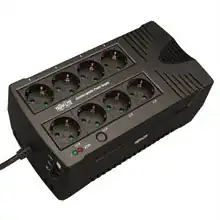
As a temporary fix, I would use an appropriately rated UPS (sized for future computer needs, not just for this LED situation (which is nominally only 31.2 W))
The UPS will cleanup any transients, and depending on "mains failure time", can supply backup power to facilitate an orderly shutdown or bridge switch-overs between mains and batteries
One company that has European UPS products is Tripp

HerrBag
- 12,225
- 1
- 21
- 37
0
Sounds like you're running into trouble with the light's forward voltage drop At 220v and 26 lights, you've got 8.5 volts per light. How many actual LEDs are hooked in series inside each light, what's the drop of each, and what other weird circuitry is hidden within the base?
Ignoring those questions, the fix for voltage drop problems is to wire sets of the lights in parallel. Try two lines of 5, and see if that works.

Wayfaring Stranger
- 3,415
- 1
- 18
- 17
0
You are using only one cycle (led lamps uses only one direct current (one way conduction) and that's what activates overload protection) you are using a signal integer and your integer thinks that you will consume around the same amount of current on positive and negative cycle, but you admit the power he sent to feed (lets say) the positive cycle and reject the power produced for the negative cycle, so he doesn't understand what do you want, try to state which polarization they use connecting a diode in series, then connect one half of lamps in +- direction and the other half -+ direction
You could also connect a rectifier bridge on the overall led´s line


0
Led lamps don't use squrewave power source which your inverter gives you. Change you bulbs to cfl or get a pure sine wave inverter.

Martin
- 1