11

We're hosting a LAN party (several computers, 50+) and I had some questions about power draw; I hope this is the right place to ask.

Currently, we're assuming each PC will draw an average of 3.5 amps. We have several 20amp circuits, so we're putting 5 PCs on each 20amp circuit.

How concerned should we be with extension cord quality? Our plan is to run two 16/3 cables from each circuit, and run about 3 PCs per cord. Should there be any issues with this? Would going with 14/3 cables really be any better?

We considered going with single 12/3 cables and running all 5/6 PCs from that single cord... but given that the max listed amperage on these is 15A, that doesn't give us the amount of power consumption we're going to require.

Tester101
  • 133,087
  • 80
  • 327
  • 617
ctote
  • 710
  • 7
  • 20
  • 33

3 Answers3

4

Extension cords need to be chosen according to the length and load. The following chart will guide you to the correct gauge to choose for any one extension cord. You might choose several different gauges in order to save money, properly configured you won't need to put 12awg wire everywhere:
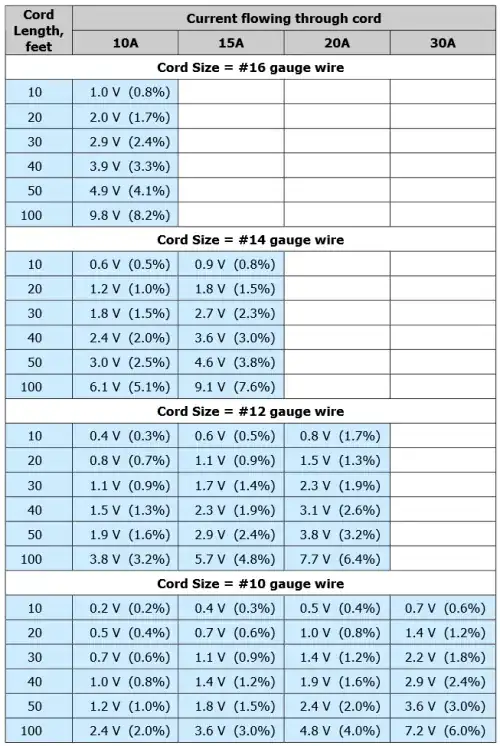
Table, current, cord length, and cord size

To carry 20 amps any distance, you'll need 12awg cable. You could use one 50 foot 12awg cable to carry the current to a table, then three 16awg cables to carry the current to one or two computers each.

You might find it cheaper, however, to run two 14awg wires in parallel from one outlet than to run one 12awg wire.

Keep in mind that while some cable calculators and tables will indicate that 16awg can handle 20A, the cable will heat up, and if you've properly secured it to the floor using tape or channels with other cables running parallel, the heat buildup can be significant and dangerous. Particularly with long runs.

You should also consult with the hotel - many of them have requirements for extension cord use in conference areas, and in some cases you will be required to use their cables and installers in order to meet their safety and load planning requirements.

If you pay attention to the chart you'll note that each cable size and load include a voltage drop. You'll also realize that due to the wiring at the venue you'll see a voltage drop at the outlet as well. This will result in a lower voltage at each computer than 120V. However, as long as you keep your voltage drop below 10%, and the venue is wired correctly producing a less than 10% drop to the outlet under load, then it is unlikely that your computers will experience any problems. Most computing equipment that uses AC power has a universal power supply that accepts a wide range of voltage, often down to 90VAC. It will be a rare computer or peripheral that will have problems with the voltage drop presented by a suitably rated cable.

Adam Davis
  • 3,363
  • 3
  • 27
  • 37
0

I seriously advise against attempting this in what, is assumed to be, a domestic residence on single phase power. Very few dwellings have an incoming capacity over 100A. I agree with the post re current draw per computer, it seems a very low estimate. Do consult your local utility provider. The issue of extension leads is secondary to the current demands on the in house installation.

derek
  • 49
  • 2
0

You could try first to load up the sockets/receptacles you intend to use with appliances that overall will demand the same power all your computers will need. Make them as equal as possible.

See if breakers trip. As someone else has said it may be that all or a number of your 20 amp sockets are using the same breaker. In which case it won't work.

If you have 50 computers drawing 3.5 amps each that is 50 x 3.5 amps = 175 amps.

175 Amps @120 volts is 21 KWatts. Quite a lot of power. So plug appliances into the sockets you have available equally.

If you have 10 sockets try to load them up with 2.1 KWatt loads. This is equivalent to 2100W/120V = 17.5 amps load each.

I really expect you will get trouble- they will most likely cause tripping because some sockets will be using the same breaker.

At least you'll know.

If all should be well use the excellent chart given elsewhere on current carrying capacity and voltage drop.

Niall C.
  • 20,909
  • 19
  • 95
  • 135