I built a hidden bookcase door using 1x10 boards with a pivot hinge with a 573lb weight load. The frame and case are square, case is level and swings with no problem empty. As I add the books the free side bottoms out on the base of the frame. I have rechecked that all hinge plates are tight, frame is secure, and case levels back out once weight is removed. I have torn it down and rebuilt, no wiggle in anything. Due to the base of the frame I can’t install a castor, so what am I missing?
8 Answers
Your wooden bookcase — and the frame bearing the load of the hinges — will bend under load, and become a different shape than the way you built it. This is unavoidable physics. You have to work with it.
You could rebuild the bookcase to be much stiffer, so that the bending is not significant. This will require more wood (or perhaps metal) and make it heavier. (Perhaps a diagonal steel cable like is used to support wooden gates, strung across the back, would be a cheap improvement? I don’t know whether that will be any better than the full wooden back you already have.)
Or, you can simply shave a bit off the bottom so that it swings freely. In principle, the optimal solution is to construct and fit it so that it is closer to being square when loaded than when unloaded, but that may be difficult to achieve.
- 4,263
- 33
- 31
Build a steel frame first.
[For this answer I'm taking "I can't use castors" as a given, even though you probably could find a way. ]
Have you ever seen those street performers defying gravity? You wouldn't expect a human body to do what they appear to be doing. Their magic is steel. And I wouldn't expect any normal construction technique using 3/4 inch boards to hold 500 pounds levered 3 feet away from a fulcrum with no flex. It's wood! I don't know how you built them and I don't care. It's not possible.
You need some kind of metal reinforcement. You could use diagonal bracing, cables for tension, steel corner brackets, and various other things.
But this isn't just 500 pounds -- it's a door being swung open and closed by humans. It needs to be WAY stronger. You should build a rigid steel frame, designed for 5000 lbs, attach that to the hinges, and you should be able to load it with 500 lbs of weight and the climb on yourself and ride on it without any flex. THEN you can add shelves to the frame, any way you want.
- 49,543
- 6
- 70
- 201
Add a big diagonal brace inside the frame.
Ideally it would be from the bottom pivot diagonally-up to the moving upper corner, and would be in-line with the pivot. Also it would be inside the frame to transfer load while in compression.
You might get away with adding bracing behind the back panel, but how it attaches to the frame will govern whether it works for you.
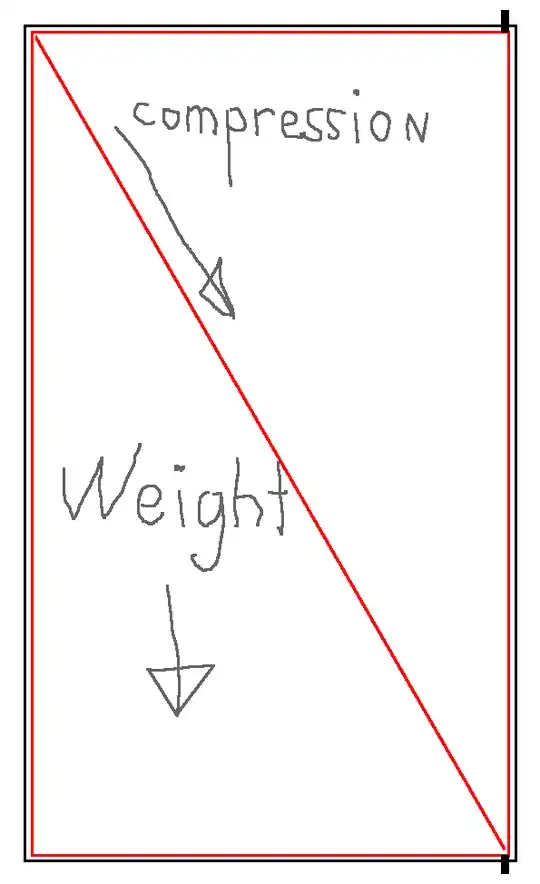
If you just nail a brace on the back, it will only be the sheer-strength of the fasteners helping, which won't last.
Look at photos of gates.
Another option that MIGHT work is replacing the back panel with something much more substantial like 18mm or 3/4" plywood, as long as its inside the frame not tacked on the back.
For both options, remember that everything will settle over time. You may want to "preload" the unit by making it slightly out of square when empty so that it settles into position over time and with the weight of the load.
Finally, there may be a benefit to moving the pivots to a central point rather than at the edge. But this likely leaves insufficient space to get around it.
Alternative ending, have you considered not storing your books here? Make this a display shelf for china and the kid's artwork and tea-towels? That would reduce the weight.
- 11,950
- 2
- 26
- 79
The shelves are not mounted to the back strongly enough.
When weight is added they sag at the weakest point, which is the corner opposite the hinge. You need to strengthen all the mounting points. Perhaps add brackets supporting the shelves and anchoring to the back.
The back should be 3/4 plywood minimum. If you have anything less it will be a problem.
- 52,615
- 3
- 36
- 113
Reckon it's not enough for a good answer, but might be important.
Point your attn to the pivot axis being in front plane of the bookcase - away from the back (which is the structural support for the rectangular shape). Once the books are added, there's little to oppose their weight along the front (face) plane - the frame will start to sag into a parallelogram. Diagonal bracing added to the back certainly helps, but won't fix the issue completely because of the offset between the structural plane (back) and pivot axis. I'll add a picture if needed, but i'm sure you can visualize it in 3D.
Ideally you'd want to minimize that offset, but that won't let the recessed shelf to swing out open. So to me it seems that solution is not only in strengthening the backwall, but also in adding rigidity to the outermost rectangular box of the bookcase. And that may be hard to do without adding more weight (e.g. metal frame) or redesign ((.
- 401
- 3
- 12
When I built mine, I added a roller to the bottom of the un-hinged side of the book case. It only engages the frame when the door is shut. I'm not loading it with hundreds of pounds of book either. It's only 24" wide by about 5' tall. It holds my entire DVD collection... no sagging.
Criggie has it right. Pay attention to the location of hinge pins. Watch this for a VERY good explanation. https://www.youtube.com/watch?v=s18JHq7gBhA
- 86
- 2
I would try casing it around the outside with a 2x6 then mount your door to that. Just make sure you fasten it well to the wall.
- 1
- 2
Would things be any easier if you had two narrow doors, hinged at either side, and meeting in the middle, perhaps with rabbets to allow a bit of play?


