In my apartment, I have a 4 wire 240V receptacle for a dryer where the neutral is not connected, only the 2 hots and ground. Is this configuration permitted for a dryer circuit? An electrician and maintenance person have both said the circuit is fine, but the electrician did point out that there is no box for the receptacle. How can the dryer get the necessary 120V to operate the panel and the other small parts in the dryer?
Asked
Active
Viewed 5.4k times


5 Answers
5
Here is a highlighted image of a random electric dryer schematic.

Click for larger view
Notice that all the control circuits are 120V components, and that basically only the heater is 240V. Extending this image further, we can see how the dryer connects to a 120/240V split-phase system using a 3 wire cord.

Click for larger view
Due to the nature of the 120/240V split-phase system, the grounded (neutral) and grounding conductors in a dedicated single appliance circuit are basically the same. The dryer will work just fine whether the N terminal is connected to a grounded (neutral) conductor, or a grounding conductor. However, connecting a NEMA 14-30R device in this way is nonstandard, and a code violation.
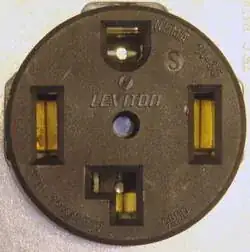
NEMA 14-30R
In the case of a three wire circuit, a NEMA 10-30R device should be installed.
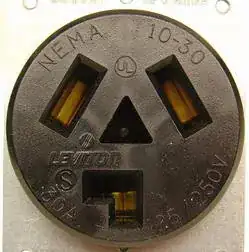
NEMA 10-30R
When the wiring is connected to the proper device, the third wire in the cable becomes a grounded (neutral) conductor, and the code may be satisfied.
If you read point number three of the exception to section 250.140 of the National Electrical Code, you'll find that the neutral must be either insulated, or part of a Type SE cable. If this is not the case, your installation may still be a code violation.
An uninsulated, normally current carrying conductor running through your walls is typically a bad thing. Which is why this code exception is only valid, if the conductor is insulated.
tl;dr
Connecting a dryer in this way will work, but is a potentially dangerous code violation (according to the National Electrical Code).
If the receptacle is not of the self-contained variety, and is not in a box. That is defiantly a code violation (NEC 2011 406.5).
Extra Information:
If a proper 4 wire cable existed, the schematic from above would look something like this...

Click for larger view
If I've missed anything, or haven't explained something properly. Feel free to ask additional questions, or point out mistakes in the comments below.


3
Tying neutral and ground together at the dryer is an obsolete and dangerous technique. It means you need one less wire, but if anything goes wrong with that wire, the chassis of the dryer becomes electrified. There's a special exception (NEC 250.140) that allows you to connect a dryer this way. Legal or not, this is a terrible idea. However this is the conventional advice - you do this bad idea using a NEMA 10-30 connector.
However you are much better off connecting a NEMA 14-30, with separate neutral and ground, and removing the neutral-ground tie jumper from the dryer, and supplying that from a GFCI breaker.
Where do you get neutral? When a dryer is connected with SE cable, people often assume the bare wires wrapping around the conductors are the ground. In the past, this has been used as neutral (with no ground at all). Here's the thing. It is legal to retrofit grounds. (it is not legal to retrofit neutrals).
So if there is a bare wire in the cable and it's legal to use it as neutral since it is SE cable, your best bet may be to continue using it as a neutral. (Make sure to wrap it with tape so it can't short against the ground or the box). And then retrofit a ground using some cheap, common #8 or #10 bare ground wire from the hardware store, and run that back to the panel via any reasonable route.
Now you have 4 wires in the panel and can connect the 14-30 normally.

Harper - Reinstate Monica
- 313,471
- 28
- 298
- 772
1
I disagree with O.P. Neutral is NOT basically the same as ground and should NOT be connected to ground (see 1 bad exception below). Also: NEC's circuit never include the appliance circuit (you never expose people to the inside of an appliance - if the appliance has a legitimate NEC ground and you connect to that: then your right).
If you have no ground (3 wires total for a 240 single phase needing 4 wires total), you have no ground: it's that simple. The neutral connects to the neutral bus NEVER the ground bus in the panel (USA typical home - you do have to check with your power company for ). see the folowing about typical power company neutral ground wiring and note some special buildings do NOT use the system even on the same power company: https://en.wikipedia.org/wiki/Earthing_system
In most areas neutral ground are NOT the same potential difference voltage (0 on average but spikes or PROBLEMS are at different differences - but more important is ground is a shortest path return to earth that trips the breaker and connections to neutral to that causes un-natural current).
See also: https://en.wikipedia.org/wiki/Floating_ground , noting none of NEC's grounds are perfect 0 potential to surroundings or to 0 at any or all times. It's just not NEC's circuit diagram to do this.
- The one "bad exception" is that decades ago some municipalities did allow hot appliances to treat neutral and ground the same but it is NOT the safest thing to do. It's your choice if your replacing, if doing new work 4 total wires are likely required. They did this because of cost of copper and back then less people had money to consider the safety added.
Where does the ground wire go in a 3-prong dryer cord configuration?
I wish I could tell you if running 14awg 14/2 tied or 10/1 awg to add the extra ground to the panel will be successful in the end: you might well have an inspector that insist all 4 wires be in one straight jacket no matter how well ohm balanced you are and that you remove it and start over. Your doing old work so adding a ground might cause inspection failure depending on the (municipality).
One more thing OP. BONDING. Any metal or water you normally may touch (dryer, metal conduit) while using the drying should have the SAME GROUND (in the bad/wrong case: same neutral) (this is done in pools and is why you see lights in a pool but aren't shocked in water or by ladders, and never ever using neutral). Don't extending this "bonding" to "true grounds". If you have any true ground nearby one might touch (bonded or not): you really should install the 4 wire - only sain thing to do.

0
Are you sure it's not two hots and a neutral, with the neutral also serving as the ground?
It is not allowed to connect the neutral to the casing of most appliances; however, the NEC specifically makes an exception for dryers:
250.140 Frames of Ranges and Clothes Dryers.
[...]
Exception: For existing branch-circuit installations only where an equipment grounding conductor is not present in the outlet or junction box, the frames of electric ranges, wall-mounted ovens, counter-mounted cooking units, clothes dryers, and outlet or junction boxes that are part of the circuit for these appliances shall be permitted to be connected to the grounded circuit conductor if all the fol- lowing conditions are met.
- The supply circuit is 120/240-volt, single-phase, 3-wire; or 208Y/120-volt derived from a 3-phase, 4-wire, wye- connected system.
- The grounded conductor is not smaller than 10 AWG copper or 8 AWG aluminum.
- The grounded conductor is insulated, or the grounded conductor is uninsulated and part of a Type SE service-entrance cable and the branch circuit originates at the service equipment.
- Grounding contacts of receptacles furnished as part of the equipment are bonded to the equipment.
If those four conditions are met, it is allowed to attach the neutral to the casing.
See this question for more information on grounding a dryer with three-prongs.
However, you specifically stated that it's the grounding conductor that's connected to both ground and neutral. If that's true, the above exception would not apply, since the outlet box (presumably?) would have both ground and neutral running to it.

BlueRaja - Danny Pflughoeft
- 3,544
- 10
- 38
- 60
-2
I'll bet that the dryer's cord has the ground wire connected internally to neutral and also to ground. In fact, this is how 3 wire 120/240 appliances were wired up until rather recently (2002 if I recall correctly).
Unless the breaker is a GFCI, which is highly unlikely for a dryer, the non-separate ground and neutral is a minor issue. Technically, it is probably not to code. However, that could readily by fixed by replacing the receptacle and cord with a three wire and feigning the previous state of the art.

wallyk
- 12,399
- 3
- 24
- 51