Ground only needs to be large enough for whatever circuits it protects based on ampacity of the circuits. See NEC NEC 250.122:
- Up to 60A: 10 AWG copper or 8 AWG aluminum
- Up 10 100A: 8 AWG copper or 6 AWG aluminum
I find it extremely hard to believe you have need for anything larger than 8 AWG copper, and very likely 10 AWG copper is sufficient (i.e., if you don't have any circuits in here larger than 60A).
The other key point is that unlike hot and neutral wires where you essentially add them up to make bigger things (but with panels in the middle, etc., not just splice to 20A circuits together and connect to a 40A feed), with ground the idea is that at any given point in time it will carry enough current to properly trip the largest circuit involved - but not everything at once. That's why you only need a single ground wire if you are feeding two circuits together through a conduit, and it is also why you can retrofit ground for one circuit by running a ground wire to a ground wire on an entirely different circuit.
In your case that means:
- Replace any grounds that are larger than needed and easy to replace (I understand the reluctance to mess with the 140' wire) with 8 AWG or 10 AWG as appropriate. If no circuits involved are larger than 60A then do 10 AWG everywhere.
- If necessary, daisy-chain the wire nut groups. A 454 Blue can handle 5 #10, 1 #6 + 2 #8 or 2 #6, among various combinations. So you might be able to get your revised wiring all onto one Blue. But if not, assuming you actually need to have 5 wires (but some of them smaller than they are now), connect the 3 smallest wires to one wire nut, the two largest to another wire nut, and use one more wire to connect the two wire nuts - i.e., largest will hopefully be 4 #10.
And if all else fails, use a panel accessory ground bar as Harper suggests.
All of this would be so much easier with a metal box (ground directly to the box) and even easier (but not practical now) with metal conduit (because then you wouldn't need any ground wires).
And now from a comment "I am using metal conduit - Rigid 1-1/4 for the old circuit, EMT 1/2 for the new". That changes things a bit:
- Replace the box with a metal box. Then your conduit can be used as ground directly to the metal box. But even if you want to continue to use separate ground wires...
- Any ground wires go to the box instead of to each other.
- No need for separate wires to grounding bushings.
Which means instead of 5 wires to connect together, you have anywhere (your choice, assuming the conduit is properly installed and metal all the way back to the panel) between 0 and 3 wires, and each of those wires (if > 0) connects to a ground screw directly to the box (no accessory bar needed).
If weatherproof is needed, something like this box from Home Depot:
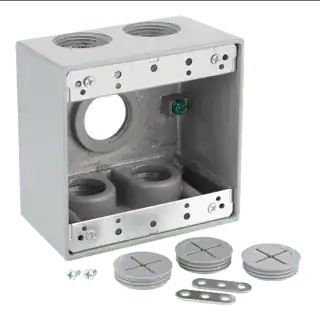
Or is there some advantage to a plastic box here that I don't know about?


