6

So, as it stands now I am hoping to build a hot tub from lumber. I've done ponds and makeshift pools and such, but this I want to be a lasting thing. It'll be framed and then lined with a thick rubber.

The hot tub will be rectangular or square, on a professionally poored concrete pad. I don't think I'm worried about weight of the tub pushing onto concrete, correct me if I'm wrong. I plan on using lumber in the 2x4 to 4x4 range. But could go bigger.

My concern is would the weight of the water put to much force pushing out? Thinking like either 6'x6'x3'. Or 8x8x3'. Maybe a 5'x10'x3'. I may increase depth to four foot.

Any of you guys see an issue with the weight of the water if I fully frame and support the outer structure? Or anything else?

Tester101
  • 133,087
  • 80
  • 327
  • 617
Matt Taylor
  • 61
  • 1
  • 1
  • 2

9 Answers9

10

You need to calculate the outward force.

Assume 8' x 8' x 3' hot tub, filled to the top.

3 ft of head * 0.424 * 1(specific gravity of water) = 1.302 psi

That's the pressure at the bottom. Obviously the pressure at the top is 0. If I were to sketch the pressure gradient, it would be a triangle, so we can easily calculate the average pressure as 1.302 /2 = 0.651 psi.

That pressure is acting over an area of 8x3x 144 = 3456 si.

So the outward force on the side wall is 0.651 lb/si * 3456 si = 2250 lbs.

For tipping purposes, take this force to be acting as a point load at a height of 1 ft from the ground (Centroid of the pressure gradient triangle).

So, whatever you build will need to support an outward push of 1 ton on each wall. You might be able to get away with it using some sort of steel banding, but I wouldn't consider it with just lumber -- your corners are going to rip apart.

Look into buying a pre-formed fiberglass hot tub liner. That will support the outward forces, and all you have to do is build the appropriate frame to support it.

Chris Cudmore
  • 14,169
  • 7
  • 61
  • 91
7

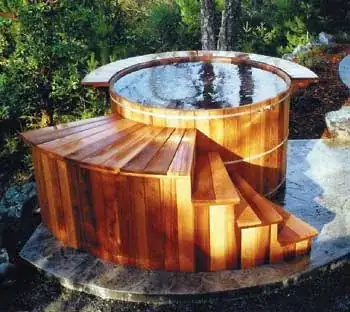
As others have pointed out, a square timber-framed hot tub is going to be a structural challenge. You're essentially building an above-ground pool--and you'll notice that they don't make above-ground pools in a square shape... mostly because it's nearly impossible to support the water along the long edges.

The solution is to go round. Then you can use steel banding to evenly support it all around. This is nothing new. Hot tubs have been made out of barrels for a long time. Google "barrel hot tub" for lots of examples. Modern versions use cedar slats.

enter image description here

isherwood
  • 158,133
  • 9
  • 190
  • 463
DA01
  • 24,586
  • 30
  • 82
  • 153
4

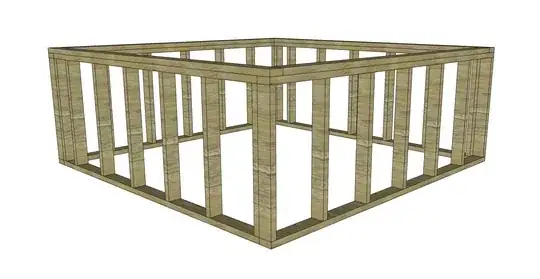
If you're simply framing up a hot tub.

Hot Tub Frame

It's not likely a structure like this will contain the water, since the water will not only be applying force downward, but also outward in all directions. Some form of banding would be a start to increasing the strength.

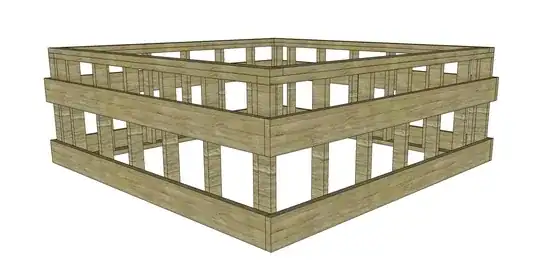
Hot Tub Frame with Banding

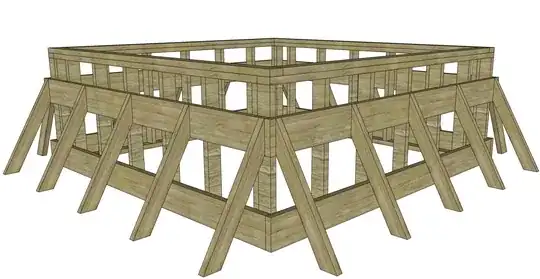
The banding may not be strong enough to overcome the forces, so bracing may also be required.

Hot Tub Frame with Banding and Bracing

I'm not sure of the number of bands or braces required (I'm no structural engineer), but overkill might be best in this instance.

Some Numbers

Model outside dimensions: 8' x 8' x 3'
Model inside dimensions: 89" x 89" x 36"
Model volume: 165.020917824 cubic feet ((89x89x36) x 0.000578704)
Amount of water held by model: 1234.521486241344 gallons (165.020917824 x 7.481)
Weight of water held by model: 10,297.3052722176 pounds*1 (165.020917824 x 62.4)
Pressure against sides: 0 psi at top, 1.302 psi at 3 ft depth, avg 0.652 psi for a total force of 1 ton against each side.

**1 Weight of water is force in the downward direction only, this is not the force pushing against the sides.*


After a bit of research and a better understanding of the problem, I've come up with Lumber Framed Hot Tub™ V2.0

Lumber Framed Hot Tub™ V2.0

Notice I've moved the bracing lower, and added bracing on the bottom to add strength to the corners. Also notice the overlapping top and bottom plates, which should also add strength to the corners.

With the bracing, it has a total footprint of just under 9' 9" square.

Tester101
  • 133,087
  • 80
  • 327
  • 617
3

I've done it. Just do three horizontal bands around the outside of 2 x 6 on flat, not on edge. So the nominal 2" dimension faces are vertical and the nominal 6 inch dimension faces are horizontal. Overlap the 2 x 6's at the corners and thru-bolt them with 3/8" bolts, with big washers -- 4 bolts to each corner of each tier of 2 x 6. Then build your stud walls inside these bands. The corner connections will be strong enough because you have an area of 5 1/2" square of overlapping 2x6 at right angle to each other, held by big bolts. The spans will be strong enough because the outward forces will be restrained by the 2 x 6's oriented as they should be -- with their 6" dimension opposing the load. The other respondent who did sketches was on the right track, but then went off course when he/she put the horizontal members on edge, so that their weakest dimension (nominal 2") was given the job of holding back the water pressure. Put them on flat and it will work. If you want to be more conservative, use 2 x 8 and run 4 tiers around the tub. Anyway, mine worked and we enjoyed it several seasons. The basic idea here is that the strength of a beam is proportional to the square of its dimension that is in line with the load. That's why floor joists are on edge and not on flat. Here the load is horizontal pushing out, so you need to turn the framing 90 degrees to oppose it.

2

I see free hot tubs on craigslist every week. 1/4 of them the ad says they work. Why not use the free shell, motor, heater, controls and custom make the outside.

Justin K
  • 1,401
  • 9
  • 9
1

Build the sides of the tub in the same fashion as a wooden boat. There are many theories, one I like the best is T&G with dove tail joints. The boards run horizontal with the bottom boards fitting into a routed notch on the bottom wall boards. Steel angle iron cable supports are fixed at each corner in the places, top, middle and at the bottom of the board directly above the lowest wall board. Affix cables and bring to tension. I have built three like this from less than $400 of lumber at home depot, using 2 x 6 and a water depth of 46". They leak a bit at first but if your joints are quality the boards will swell against the cables and it self seals.

The first one took four days to build, my third one took 7hrs from the pile of lumber delivered on a lumber truck. I use a skill saw, portable shaper I adapted from a delta shop model, a portable table saw and the usual hand tools.

A 2X6 X8' easily can handle the 1.5 psi load and much more. The cables aren't necessary add the last one I built was filed about a week before the custom stainless Maine cables and corner cable rests arrived.

These are fun to build and the design opportunities are very rewarding. It is an inexpensive

0

Why not leverage the roundness of traditional hot tubs for the strength needed? That is, building out a round flat surface 6" below the top of the tub (i.e. co-planar with the bottom of the tub) would not only give you a place for drinks, etc., but would allow you to use a steel band and get the same strength a round tub gets from one. This removes corner strength concerns as well as along the length of the sides (the sides have the widest part), and adds function also.

Daniel Griscom
  • 6,319
  • 33
  • 33
  • 43
Brian
  • 1
0

If you use a preformed fiberglass tub, the force is not out, it's down. The hot tub has many irregularities (i.e., seats, hand grasps, etc.) in the side that make it very strong. Set the pad where it needs to be so that the lip of the hot tub is at the same finished deck height. Your choice of lumber is now based on the deck.

Chris Cudmore
  • 14,169
  • 7
  • 61
  • 91
Richard Raustad
  • 782
  • 1
  • 5
  • 10
0

I know about structure calculation and for an optimal stresses distribution over this tub structure, avoiding such complicated framework, reinforcements, bands... you only have to double the number of vertical studs and reinforce de border beam (a 4x8 should be enough). Ensure that lower beam is anchored to the concrete pad, and pad is reinforced with a rebar mesh.

That's it.