9

At my house in central Texas, where temperatures can persist at 86 - 110 degrees Fahrenheit, one side is always hot, no matter how long the A/C runs. That attic space is considerably hotter than other locations.

Attic ventilation includes:

  1. twenty-two 16x8 soffit vents
  2. two 10' runs of plastic ridge vent
  3. three stack vents

For better or worse, the ridge vents do not have a filter underneath and are covered with shingles.

According to the web, such as this website, 20' is the minimum requirement and the 22 soffit vents balance appropriately.

Will it help to install additional ridge and soffit vent? or will that disrupt current circulation?


UPDATE: The ridge vents are actually 8 ft. long (not 10') and only 5 ft. of that are actually exposed. 1.5 ft. on either side of the ridge vents are covered over by shingles.
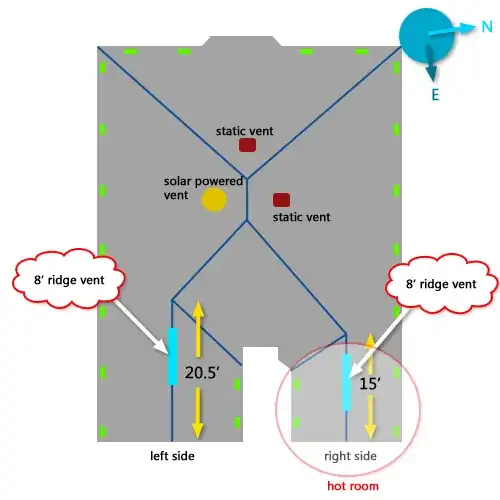
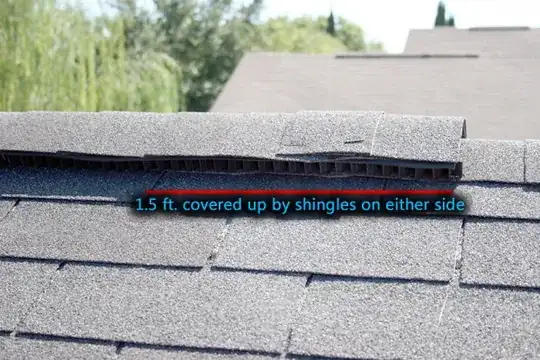
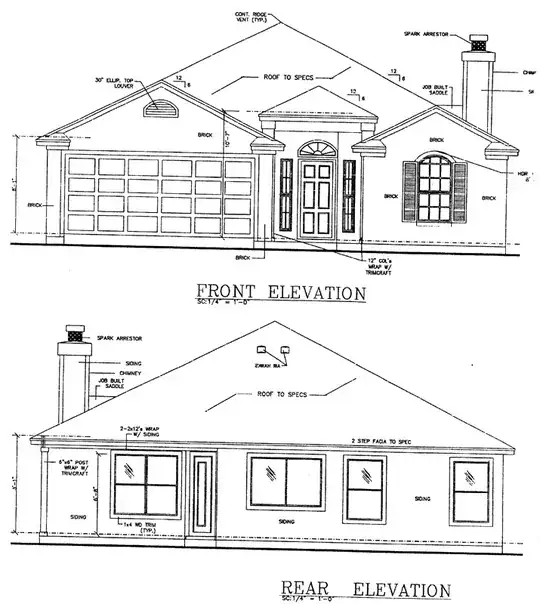
house top view ridge vent photo house elevation

TugboatCaptain
  • 1,240
  • 5
  • 14
  • 22

5 Answers5

5

With the solar-powered vent and two static vents being so close together, I wouldn't be surprised if the the solar-powered vent (because it's powered) is pulling most of it's air from the two static vents. You might be able to check this by using toilet tissue, feather, incense smoke or something to determine air-flow direction through the static vents while the solar-powered vent is running.

If the net effect is that air is being pulled in, then none of those vents are doing as much as they should to cool the attic. Some of the air through the soffit vents is being exhausted through the solar-power vent, to be sure, but the static vents aren't helping.

If I were going to make changes, I would consider the following, in order of preference...

  • Remove and seal up the two static vents. This alone would cause the solar-powered vent intake to come completely from the soffits and thus pull hot air out of the entire attic area underneath.
  • Remove the solar-powered vent and install a ridge vent the entire length of the ridge next to it. As this makes venting totally passive, it might not be enough for your climate. Depending on size and efficiency, the solar-powered vent without the static vents may move more air. If still not enough, I would think more CFMs of air could be vented using a line-powered unit, but haven't researched it.
DocSalvager
  • 223
  • 3
  • 10
4

The point of attic ventilation is to keep the air from getting trapped in what's called the "cold zone" (an ironic term when you're in Texas but there you go...). If an attic cannot breathe well, moisture will get trapped, and lead to term structural deterioration.

Temperature isn't a concern - the attic isn't an insulated area - so as long as your insulation itself is adequate, it doesn't matter how hot/cold the attic gets.

So basically - it's not really possible to over-ventilate your attic. More airflow = better. There's a minimum amount because less than that much ventilation is a bad thing, but there's not a max because more ventilation can't do any harm.

The Evil Greebo
  • 25,971
  • 16
  • 91
  • 125
4

Agree with @DocSalvage and his thinking - you definitely should remove/seal the static vents.

You could also have a problem in that the solar powered fan is so powerful that it draws in air from your ridge vents, which like with the static vents during a summer day would be very hot air. You should get up in the attic and see if you can tell how/where airflow is occurring.

Here in Texas, as with most places, you want to maximize your ventilation. You could install as much ridge vent as you have space for and adjust the number of soffits to match (and definitely don't consider the entire size of the soffit vents as the clear airspace - account for mesh or openings on the soffit vents). But it would seem from your diagram that your roof is not ideal for passive/convective venting.

Assuming your solar fan is powerful enough, it's going to be doing a lot more exhausting, and at a better location in your attic, than the ridge vents. Most likely your biggest issue is not enough soffit venting.

Eric
  • 141
  • 2
2

Too much ventilation is only when the extra vents introduce the chance for extra moisture. Living in Texas you want your attic to be as close to the outside temperature as you can get. If your attic temp is at 100 F then your temperature variance will be low and may be completely negated with decent insulation.

I would take the temperature of my attic during a hot day. I lived in Fort Worth when I was younger and did a lot of roofs while working through college. The attics can get to 130-140 F. In warmer climates we have had a lot of luck with large gable vents. They do a great job letting the warm air escape (not so great at overall circulation unless they have a fan).

Also a lot of people complain about a hot attic and their ridge venting is blocked by insulation or the vents are dirty. With blown-in insulation you really need to clean the vents after and then about a year later.

I would also look at the color and materials for your roof if your attic is hot. Changing from black shingles to off-white can reduce temperatures by as much as 15-20 degrees in an attic. There are more expensive options that can have a greater impact.

As far as ventilation, the only time I have read about over circulating is in colder climates where there are measures to use sunlight to warm the attic during winter months. Your house in Texas would by all means function better (temp-wise) with no roof and 3 feet of insulation if it weren't for rain, wind, animals...

DMoore
  • 50,637
  • 16
  • 93
  • 208
2

Yes, it is possible to install too much ridge vent.

Passive attic venting systems are now designed so that they intake air from the soffits and expel air near the ridge. This is normally done without power by using the fact that hot air rises.

If there is too much venting near the ridge, a lower pressure will develop in the attic, and air can be sucked into the attic from the conditioned living space.

Vents are normally rated by the amount of "net free area" they have. One aims for equal net free areas at the soffits and the ridge. If there is a large difference, it's better to have the "extra" area at the soffits.

Your powered fan will be specified with some minimum intake area.

As long as things are balance between intake and exhaust, it's a good system. The more ventilation, the better.

Pigrew
  • 3,435
  • 2
  • 24
  • 30