11

My American house was built in 1942, and much of the wiring is still knob-and-tube wiring (2-wire, no ground). Over the years new modern wiring has been added to the house, but we still have some KnT wiring for the ceiling lights, and a few branch circuits, etc. We are planning to replace the KnT wiring when we have the budget to do so. I have replaced many of the receptacles on the KnT circuits with GFCI receptacles to provide added protection, which is recommended.

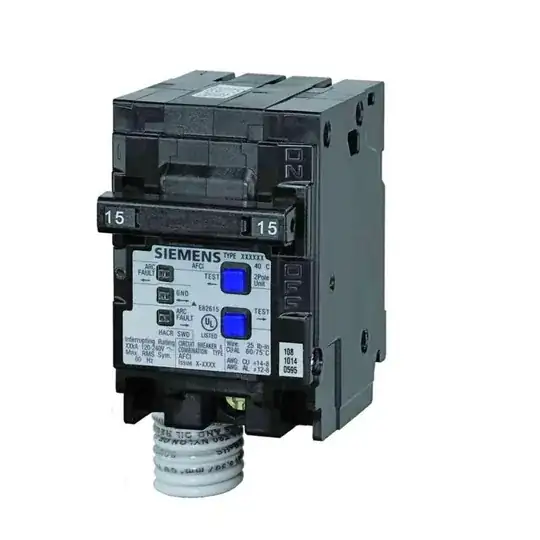
I have seen AFCI and GFCI circuit breakers which plug into the service panel, and they are reasonably priced at $30-50 per breaker). Would these AFCI or GFCI circuit breakers provide any protection on old, knob-and-tube wiring?

Stefan Lasiewski
  • 918
  • 6
  • 13
  • 25

5 Answers5

9

Arc-Fault Circuit Interrupter (AFCI)

An arc-fault circuit interruption device is designed to detect dangerous arcing within the protected circuit, and open (turn off) the circuit to prevent damage caused by the arcing. It does this using special circuitry to analyse the electrical characteristics of the circuit, looking for characteristics that match specific pre-programmed values. If the AFCI detects suspicious goings on, it opens the circuit.

AFCI breakers are typically combination devices, meaning they also provide similar overcurrent and short-circuit protection to a standard breaker.

Installing a combination AFCI breaker on a circuit containing knob and tube wiring would be a great idea, and could potentially prevent a fire.

Ground-Fault Circuit Interrupter (GFCI)

Ground-fault circuit interruption devices are designed to detect ground-faults, and open (turn off) the circuit when a ground-fault is detected. They work by using a current transformer (CT) to detect current imbalances between the ungrounded (hot), and grounded (neutral) conductors of a circuit. This blog entry might help you understand how GFCI devices work.

GFCI breakers are typically combination devices, meaning they also provide similar overcurrent and short-circuit protection to a standard breaker.

Installing a GFCI breaker on a circuit containing knob and tube wiring, probably won't provide any benefit. GFCI devices are designed to prevent electrocution, not to protect the wiring.

Combination AFCI GFCI Circuit Breakers

Circuit breakers that provide AFCI, GFCI, overload, and overcurrent protection are becoming more widely available. If you can find them for your panel (and afford therm), these would be the best option.

Tester101
  • 133,087
  • 80
  • 327
  • 617
5

While Tester101's answer was OK when it was written, the situation has changed now. CAFCI/GFCI dual function breakers (Square-D calls them DFCIs) are now widely available online through the big-box stores' websites; in fact, the green box nearest to me has the QO DFCI I linked in stock!

Of course, any electrical supply house worth their weight will be able to order in anything from the Eaton or Square-D catalogs, DFCI's included.

One caveat, though: DFCIs are not yet available in two-pole configurations, so shared neutral circuits without a ground wire are stuck with a CAFCI for now. (It's one of those cases where perfect Code compliance is literally impossible at the moment because the parts needed to do it just don't exist yet.)

ThreePhaseEel
  • 87,685
  • 36
  • 144
  • 243
4

An AFCI is a great addition to K&T wiring. While the conductors in K&T are separated by large distances, and even studs, they do come together at junction boxes which are often metallic. An AFCI adds a layer of peace of mind to the situation.

Be sure to measure your K&T wire to determine gauge. It can take slightly more current than the modern equivalent at the same wire size, but to be safe stick with the modern values. You'll probably need a 2-pole (not tandem) AFCI, as K&T was often wired with a shared neutral. Two pole AFCI for knob and tube wiring Fora more complete writeup of K&T retrofit see https://diy.stackexchange.com/a/20279/5960

Note: when I replace a fixture in a K&T circuit I address the metal box weak point with some new loom, slipped over the wires as they come into the box. The old loom, which could easily be 50 to 100 years old, is sometimes but not always brittle. I'll also pull out the wire and wrap the exposed area with friction tape. This is the only point in the entire K&T system that even needs insulation.

Update March 2018: I now use shrink tubing to strengthen the insulation when changing a fixture on old wiring. It just slips over the old wire, and I shrink whatever section of it my heat gun can reag.

Harper - Reinstate Monica
  • 313,471
  • 28
  • 298
  • 772
Bryce
  • 11,057
  • 18
  • 77
  • 120
2

Your best best, if you can't do both, is AFCI breakers -- after all, AFCIs are designed to protect wiring from arc-faults, which start fires, and Knob-and-Tube era homes are vulnerable to this. And then GFCI receptacles -- GFCIs are designed to protect humans from shock.

As of NEC 2014 (adopted 2015-16 most places) you can now retrofit grounds, and the ground wires do not need to run with the paired hot and neutral. You can ground to any grounded point as long as it chains back to the same service panel, or the grounding electrode system from that panel. The entire run/chain of ground wire must be large enough for the job.

Harper - Reinstate Monica
  • 313,471
  • 28
  • 298
  • 772
-7

You will probably find that installing an AFCI breaker will be very annoying. Many electricians don't like them because they go off very unreliably. For example, if you run a vacuum cleaner, or a sump pump, those could trigger the AFCI circuit even if there is no arc fault. I believe it is code to install AFCI breakers in new electrical work, but many electricians were replace them back with regular breakers after inspection, because of how annoying they are.

If you have already replaced the older outlets with GFCI, that's about all you really need to do.

steve8918
  • 95
  • 1