3

I've got some limited field experience as an electrical helper, but no real classroom experience yet. (saving up for school)

I am of the understanding that the neutral wire carries electricity back to a breaker panel.

I generally wire switches, as instructed, as follows:
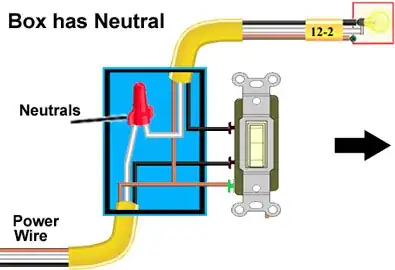
enter image description here

However, this doesn't make sense to me because if the switch is in the off position, how does the power return to the breaker panel? I assume it can't be flowing through the neutral because the path to the device is interrupted by the switch, thus the circuit is not complete.

Does it flow, instead, through the ground? I've been told that the ground should never have current unless there is a severe fault, at which point there is a problem that needs fixing.

Isn't the ground the only way the electricity would return to the breaker panel in the above wiring scheme?

crush
  • 215
  • 3
  • 4
  • 10

4 Answers4

9

The switch opens (turns off) the circuit, at which point electricity is not "flowing" through the circuit. The electricity flows to the first terminal on the switch, and then just sits there. Think of it like a closed plumbing valve. When the valve is closed, water flows to the valve, and then just sits there. Once the valve is opened, the water can then flow through the plumbing.

Tester101
  • 133,087
  • 80
  • 327
  • 617
6

It doesn't flow. When the switch is off (open) no current is running in that particular circuit. While there is a high potential on the black hot line at the switch, that is not part of a flowing current until the switch is closed and the current then flows through the fixture and then back to the panel through the white neutral wire attached at the fixture (and incidentally joined in the switch box).

You seem to think that current must be flowing at all times. That is not the case.

bib
  • 33,975
  • 10
  • 68
  • 102
6

In addition to the other good answers I would add that you are making the common beginner mistake of confusing current with voltage. There is certainly voltage on one side of an open (that is, off) switch.

In your "water" analogy, voltage is the pressure in the pipe and current is the rate at which it is flowing. If you shut a valve on a pipe then the pressure stays high on one side, drops to zero on the other side, and therefore the flow out of the pipe stops.

The neutral is like the drain of a sink. There is never any pressure in a drainpipe but surely there is flow.

Some useful facts that you should assimilate deeply into your brain are:

  • The current through a circuit that does not branch is the same at every point in the circuit. Again, think of the water analogy; the amount of water flowing past a given point per second is the same everywhere, provided that the pipes do not branch.
  • This means that if the current is zero at one point in the circuit, it is zero everywhere.
  • It also means that if there are two points on a circuit with different currents, there must be a branch -- typically current leaking to ground, dangerously -- somewhere.
  • Again, do not confuse current with voltage. The voltage need not be the same everywhere, and in fact is not.

Also you should make sure that you understand the two fundamental relationships between current, voltage, resistance and power:

  • current is voltage divided by resistance. This should make sense. Moving a lot of stuff requires either a very slippery pipe, or a lot of pressure. An open switch is essentially a point of extremely high resistance. (Of course even an open switch will conduct electricity if the voltage is high enough; hit it with a bolt of lightning and see what happens.)
  • power (watts) is current (amps) times voltage (volts). Again, this should make sense. Power is the amount of energy being consumed per second. If you're moving a lot of stuff at high pressure then you are consuming a lot of energy very quickly. If you;re moving absolutely nothing (zero current) at any pressure, you're consuming zero energy.

So now, see if you can answer these questions:

  • Suppose we hook up two hot wires of the same voltage to two different light bulbs of the same wattage, and connect both light bulbs to a single neutral wire. What is the relationship between the current on the neutral and the current on the hots?
  • Is this dangerous? Explain why or why not.
Eric Lippert
  • 1,310
  • 9
  • 13
-1

The neutral is a the completion of a circuit back to the power source/transformer. It meets up with the ground at a main bond in the first electrical enclosure downstream of the meter or main disconnect. It also is performed in a separately derived system via a transformer installed to change the voltage desired for circuitry. If you have 480 volts a/c and want 120/208 you set a transformer fed with 480 and on the secondary you have 120/208 volts requiring a main bond on the secondary for fault situations to that power source. That transformer has now become a separately derived system. This bond brings the equipment grounding conductors, grounding electrode conductors, lightning protection conductors, and neutral together to form one path back to the power source to allow for any ground faults to facilitate the proper operation of tripping a breaker or blowing a fuse. This main bond only should happen one time at the service entrance of a house, building, etc. on the load side of the main service disconnect. From there on out the grounding conductor(green wire, bare wire, all metallic eqipment to be grounded) and the neutral are to be strictly separated. If another panel is installed downstream from the main panel, then in that panel the grounding (greens, and bares) are isolated from the neutral/grounded (whites and grays). Ground rods and your other supplemental grounging electrodes are in place to dissipate major overvoltages from power company line surges and lightning strikes. THEY ARE NOT INTENDED TO PROTECT PEOPLE AND EQUIPMENT FROM LINE TO GROUND FAULTS! If your system is not bonded and a fault occurs, then you have a very dangerous situation. There is no place for the fault find its way back to the power source and create fault current situation to trip the breaker and or blow the fuse. Basically this fault is like a snake waiting to bite if the condition presents itself because the breaker has not tripped or the fuse blown.

Matt
  • 1