15

After much research, I have a lot of conflicting advise about the need to add a vapor barrier before installing the backer (hardy / cement) board for my bathroom shower.

The "expert" at Home Depot, and another guy on youtube seem to think this is a very good idea, and even suggest sealing it with roofing tape. (The guy on Youtube tapes it directly to the sill of tub.)

However, when I asked about the tape and how far down I should go at Lowes, they told me they'd never hear of anyone doing that, and that it didn't seem like a good idea. Likewise, Ask This Old House only recommends putting down caulking on the sill before applying the backer board, and then again after before adding tile, and then caulking a 3rd time under the tiles before grouting.

Should I add a vapor barrier between the frame and the cement board? Why or why not?

virtualxtc
  • 2,647
  • 9
  • 34
  • 50

9 Answers9

9

You should NOT place a vapor barrier BEHIND the backer board.

Where, pray tell, would any such collected vapor/water go?

Answer:There's nowhere proper for such moisture to egress.

The current best practice is to place waterproofing OVER the backetboard and just UNDER the tile. Thin sheet membranes like Kerdi or NobleFlex are examples . Paint on membranes can also be used, such as RedGuard or AquaDefense.

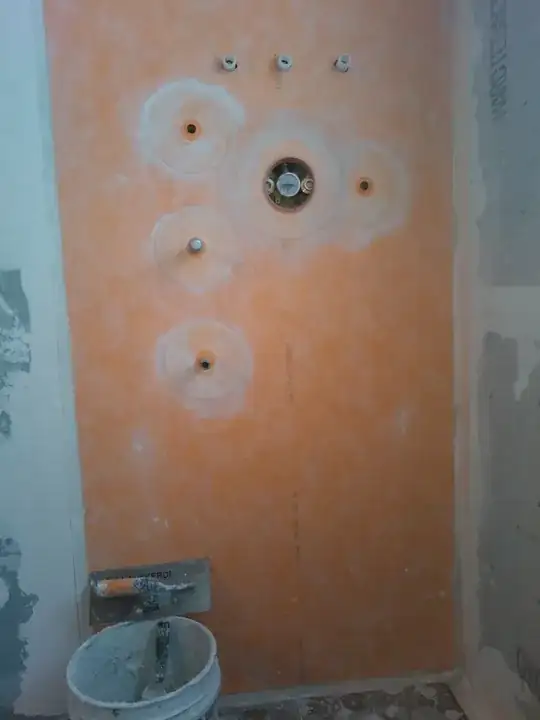
This a is a recent job I completed illustrating Kerdi over Hardibacker.

Kerdi membrane over Hardibacker

enter image description here

HerrBag
  • 12,225
  • 1
  • 21
  • 37
8

I called USG,the maker of Durock cement board Next Gen, and they advised using no vapor barrier so that the wall cavity can breath and allow any moisture to evaporate. Their online instructions/diagrams show no use of a vapor barrier.

user28237
  • 81
  • 1
  • 1
2

Follow manufacturer's instructions first and foremost. Also in places with hot humid climate vapor barrier on the inside wall causes more trouble than it fixes.

https://www.jameshardiepros.com/getattachment/98adb0c7-1bd1-49e7-a9d4-a8275d29ae4a/HardieBacker-Installation-Guide-English_Spanish-HB1710.pdf Note on page 4 "vapor barrier if local codes require."

https://codes.iccsafe.org/content/IRC2015/chapter-7-wall-covering R702.3.7 in regards to where a vapor barrier goes in wet rock.

leading to:

https://codes.iccsafe.org/content/IRC2015/chapter-7-wall-covering R702.7 note vapor retarders on the interior face are only specified for climate zones Marine 4 and up.

Ending at:

https://codes.iccsafe.org/content/IRC2015/chapter-11-re-energy-efficiency#text-id-9849023 N1107.1 note what climate zone you are in will determine local code.

These are all the dots your building inspector needs to connect to make said determination.

Note* Most wet board manufactures also require Hot Dipped Galvanized nails or equivalent. (this is missed by most inspectors even)

2

You should, so that any moisture that gets behind the cement board runs into the tub or shower instead of into your wall cavity (causing rot or mold/mildew).

If you overlap the moisture barrier with the raised lip around the tub, any moisture has only one path to take due to gravity -- down the barrier and into the tub. I usually use thick-mil plastic sheeting, overlapped in shiplap fashion (overlapping, laid down from bottom to top -- like shingles).

Do caulk between the tub and tile, but leave small gaps for any water runoff down the sheeting to escape. I always take a level to the tub base to see where the water would run to if it had the chance, and place my holes appropriately.

You'll staple the sheeting to the framing -- don't worry about these minor penetrations of the barrier.

Ethereal
  • 855
  • 6
  • 13
2

plastic behind cement board with waterproofing is essentially suspenders when you already have a belt. the waterproofing is also a vapor retarder so if the red guard or kerdi product is continuous, lapping corners and all, the plastic will be unnecessary.

if you think of tile like exterior cladding, it would make sense to leave an open hole in the sealant in line with a vertical joint in the grout. porcelain and ceramic tile is impervious (some soft specialty limestone or sandstones are not), so any water that migrates does so in the grout joints (which crack on occasion as you know). it should then hit the waterproofing and migrate down (however slowly) to the "weep" in the tile joint around the lip of the tub/shower. ideally, you would install the vertical tile over vertically troweled mortar, which effectively provides little paths for the water to drain within the wall. EIFS manufacturers have tried and tested this strategy such that it is their only warranted water management technique.

this is why you eventually see black mildew stains in the grout around the base of the tile - because the water is stuck back there. the redguard product is a vapor retarder which means the steam (water vapor) from the shower won't migrate thru the substrate, it will hit the waterproofing and, assuming it condenses on the colder surface migrate down along the same path noted above. in most instances, the tile is colder than the cement board, so the vapor condenses on it first and stays on the exposed surface. rather than continuous plastic sheet.

as compromise, I would suggest a 6" high strip stapled above the flange and lapped over the flange and under the edge of the cement board is an adequate solution to prevent overflow situations. probably unnecessary on a tub, but possibly on a shower pan. then waterproof the walls, install the mortar with vertical troweled grooves, set the tile, wait, install sealant under each tile, stopping at each vertical joint for a small gap, plug the gap with a spacer before grouting, then fully grout, remove the spacers, and clean the tile. the holes will look a bit odd at first, but will serve their purpose.

this comes from me, an architect, who spends a lot of time thinking about how to keep water out of a building. I was told once "think like water" and you'll figure out where to let it out.

no flange provides a different challenge. i'm about to rebuild my own shower with a tile floor and am thinking thru these exact details before buying anything. thanks for talking about it and making me think like water for an interior application.

1

This is a much-delayed answer, but in case it might be useful to others, the first consideration needs to be the manufacturer's own testing and resulting instructions. Most of the answers above contradict what the cement board manufacturers themselves recommend, so if you use them, you're on your own. This includes applying various sealants between the board and the tile which Hardiebacker, for example, does not recommend for interior installations.

If you are working in new construction and have a building engineer involved in the design or construction phase of the project, it may be worth asking whether the wall design will be primarily drying to the interior or exterior. For example, if the cavity is going to be filled with sprayed-in, closed-cell foam, any moisture that gets into the cavity may have nowhere to go and the engineer may recommend an alteration to the manufacturer's instructions for typical installation in order to suit the particular circumstance.

Sealants do break down over time and if you're worried about bulk water eventually making it back through the joints in the board (where you do want to be leaving small gaps to allow for movement in the wall without cracking or dislodging your finish work), you can always use asphalt roofing felt behind the board, overlapped as on the roof, which can be used to redirect the water to the sill but which is not a very effective vapor barrier.

Also, make sure you're using the right thickness of board for the application. I have seen folks try to use nom. 1/4" board where nom. 1/2" board was specified by the manufacturer for the application.

1

I've set tile for decades, the old school method of lath, cement plaster and the tile. We always installed some type of moisture barrier under the lath on the wall beforehand it used to be 15lb felt, 60 minute paper, aqua bar paper etc. The cement plaster could be as little as 1/2 inch thick to over an inch. I can't see any harm in putting a vapor barrier under backer board,but your going to put hundreds of fasteners in it anyway, puncturing it everywhere. Most tiles today are large format and are vitrious (waterproof) and are the first defense against moisture. If water is getting in back of the tile, there's an installation issue. I've torn out many old showers and surrounds that were installed in traditional ways and seldom seen any water under the tiles except perhaps a shower pan

Steve K
  • 11
  • 1
1

Lowes recommends installing a plastic vapor barrier behind the backer board in addition to a paint-on barrier between backer and tile. Source.

a coder
  • 174
  • 7
-1

http://www.cityofsanmateo.org/DocumentCenter/View/200 gives some fairly good guidance. There are several kinds of backer boards. If it's a cement board, you need a vapor barrier, because cement retains moisture, which means the wood next to it is always damp.