4

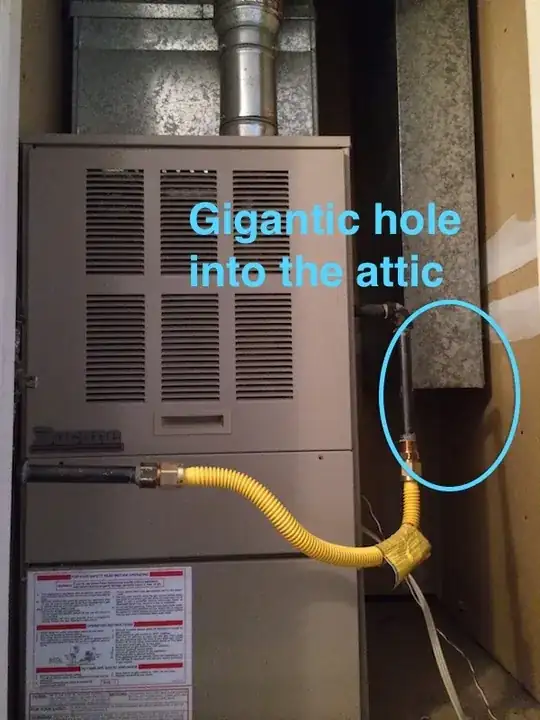
So my interior furnace closet has a huge duct in it that connects the closet to the unconditioned vented attic right above it. Needless to say, this is a huge air leak into the conditioned part of the house and a major source of air infiltration into the house, especially today when there were 60 MPH winds. I'm no HVAC tech, but this seems highly problematic. If it's a duct designed to pull in outside combustion and dilution air, it represents a gaping hole in the conditioned thermal envelope, as the furnace closet is not even remotely insulated from the rest of the conditioned space.

The furnace is a huge 125,000 BTU model that's grossly oversized for the house's 1,100 square foot interior. Is that why it requires this huge duct to pull in outside air? There's such a volume of air coming down through that duct into the house when the furnace isn't running that I think it's even passing through the furnace filter and through the return air plenum which is right below the furnace.

What are my options here? Am I stuck with adding weatherstripping to the furnace door and sealing up air leaks from the furnace closet into the rest of the house? The return air plenum itself is a big air leak...
enter image description here

iLikeDirt
  • 12,685
  • 18
  • 57
  • 98

2 Answers2

5

All right, I found a manual for a nearly-identical unit and cross-referenced what it says with applicable sections of the 2012 International Fuel Gas Code. Now I feel like I have a much better idea of what's going on.

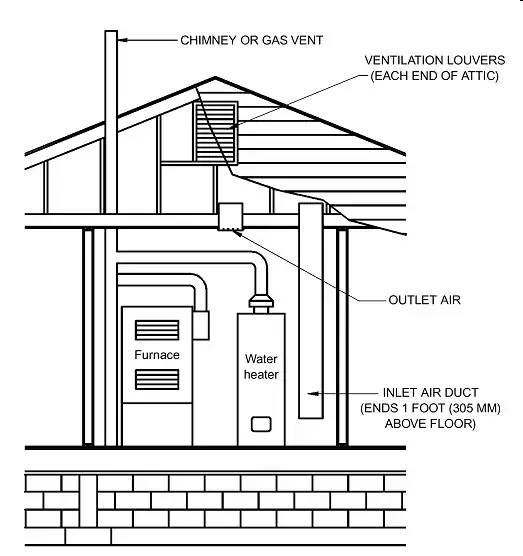
The huge duct is supplying input air for combustion and dilution through the attic, which is code-approved and is sized correctly. There's a hole in the ceiling of the furnace room that I didn't even notice; it's for the output air. It all corresponds perfectly to this illustration in the code:

enter image description here

The alternative is to get the air partially or wholly from inside the conditioned space as long as the building envelope's tightness isn't 0.4 air changes per hour at 50 pascals of pressure or better, which my house most certainly is not (that's Passivehaus-level!). In this case, I would need 50 cubic feet of interior airspace per 1000 BTUs of all interior gas-fired appliances. The furnace draws 125k (waaaay too high), and the gas range is capable of drawing 54k when the oven and all the burners are firing. So the worst-case scenario is that I need 8950 cubic feet (or 1118 square feet) of interior space when all these appliances are in use. I don't have that; the whole interior is only 1100 square feet, and I can't even count bedrooms and bathrooms that have doors, reducing the amount of square footage I can use for combustion air purposes to 650, or 5200 cubic feet, or a maximum of 104,000 BTUs worth of gas drawn by interior gas appliances. Even downsizing the furnace, I will still likely exceed that, and the deficit will get worse as I air-seal the building envelope.

So I have to keep the existing setup, which is all kosher with the code and perfectly safe. And I'll never get carbon monoxide poisoning. So that's good.

The question becomes how to offset the energy penalty of having two huge penetrations into the conditioned space where outside air can flow. I'm thinking that my best option is going to be separating the furnace closet from the rest of the house as much as I can. There are huge holes and thermal bypasses which I'll be sealing up, and if possible, I'm going to add insulation to the stud bays separating the furnace closet from the rest of the house. In essence, I'll turn it into a mini-unconditioned-space within the conditioned space.

iLikeDirt
  • 12,685
  • 18
  • 57
  • 98
2

I have no way to check the specifics of your unit, but to the best of my knowledge, your furnace MUST have venting to allow the unit to get air. Usually it is a specific minimum amount of grill cut into the door to the furnace room, or into the wall(s), never into the unconditioned space of an attic. The last one I dealt with, the venting was accommodated by the ceiling and walls, all with the approval of the building inspector. You may not need to appease a building inspector, you are correct in your concerns. Your model number of your unit should find you a manual online if the unit does not have the installation guide with it. It has been understood in the trade, or to my understanding, the manual for the unit is ALWAYS kept with the unit. This is for future work done by other techs to have a handy reference. This manual I speak of will or should have the minimum venting requirements in it.

Jack
  • 38,117
  • 2
  • 30
  • 66