20

Since the arrival of our newborn, we have been using the stove to boil water in order to sterilize the nipples, bottles and rings.

Which got me thinking, is it more economical to start off using hot water to help accelerate the boil or are we better off bringing the cold water to a boil?

EDIT: This question is was to satisfy my curiosity more than anything. I used the fact that I need to constantly boil water to sterilize baby related items as an example, this is not the first time it crossed my mind (preparing pasta for example).

Handy Man
  • 960
  • 1
  • 7
  • 17

10 Answers10

23

It might be slightly more economical, but it also might be slightly worse for your health. Hot water dissolves plumbing (pipes, valves, fixtures, etc.) much faster, and what it dissolves is in the water.

Lead is specifically of concern, particularly with homes prior to 1986 and with infants. There's a NY Times article that sums it up nicely with sources.

Jason
  • 569
  • 2
  • 5
  • 16
15

Economically, the difference is irrelevant. Let's say you need to boil one liter of water. The specific heat of water is about 4.2 joule per gram degree Celsius. Meaning, for every gram of water that we want to make hotter by one °C, we must supply one joule of energy. A liter is 1000 grams, and let's say the cold water starts at 15°C, and we want to go to boiling, 100°C.

So, we need to increase the temperature of 1000g of water by 85°C. The energy required is: 1000g * 85°C * 4.2 J/(g °C) = 357000J = 357kJ

Now, my last natural gas bill I used 1900 cubic feet gas for $24.56 (USD). That's 1.29 cents per cubic foot. One cubic foot contains about 1000kJ of energy. Thus, natural gas energy costs 0.00129 cents per kJ.

Next, we must account for efficiency. 90% or better of the energy of gas is available as heat with simple combustion, but if you put your hand around a stove it's easy to feel that a lot of that heat is not going into the water. Actual efficiency is going to depend a lot on your stove and your cookware, but let's just say the efficiency is 5%. That raises our energy requirement to 357kJ / 0.05 = 7140kJ.

We can then calculate the total cost: 7140kJ * 0.00129 = 9.2 cents. This is such a tiny cost that any discussion of savings is purely academic.

Even so, using hot water from the tap won't save very much. Let's just say you have a magic water heater that makes hot water for free. It isn't boiling, though: an oft-recommended temperature is 120°F or 49°C. Taking our previous assumption of cold water being at 15°C, that means the water heater has raised the temperature by 34°C, leaving the stove to raise it another 51°C. So, given a magical water heater, at best your costs can be reduced by 40%. Of course, this doesn't take into account:

  • All the water you run waiting for the tap to become hot is wasted hot water, which just sits in the pipe when you are done.
  • Water heaters are not magic. (typical efficiency is between 70% and 98%)
  • In addition to the energy required to heat the water to boiling, it takes quite a lot of energy to get the water to continue boiling, which must be done at the stove.

All of these things eat away at the efficiency improvement of using the water heater. If your heater is not especially efficient and the pipe to the faucet is long, it might be less efficient to start with hot water.

If your goal is efficiency, best would be to improve upon the 5% efficiency of water heating at the stove. This can be done by adding a heat exchanger to the pot, which is common on camping cookware:
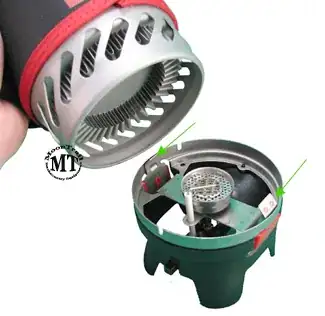
enter image description here

I have also seen, in one of those expensive cooking stores in the mall, a pot with heat exchanger of more traditional kitchen-weight construction.

Phil Frost
  • 1,207
  • 1
  • 10
  • 16
9

Economically, yes it costs less to start with hot water. However, you should use cold water anytime you need potable water.

Hot water tanks are generally pretty filthy. If you were to drain your tank, you would probably be disgusted to see what comes out. Cleaning your hot water tank is something that every home owner should do, but very few do. Also, if the temperature of your tank is not hot enough, some bacteria might be able to survive and grow.

You should talk to your doctor if you haven't already about sterilization and what methods are acceptable for your circumstances. In a higher risk situation, you might consider starting with bottled sterilized water.

Steven
  • 27,770
  • 10
  • 56
  • 90
5

If you already have hot water, that you have paid to have heated, and which you would otherwise not use, you will gain time and money by using it. The amount gained is likely to be very small.

RedGrittyBrick
  • 24,700
  • 12
  • 50
  • 94
4

The bigger question is: is your house being heated or cooled? If your house is being heated, any inefficiency just becomes heat for your house and is not wasted. If you are cooling your house, all inefficiencies become an additional load for your air conditioner.

PaulO

Fred
  • 51
  • 1
4

The water heater is significantly more efficient than the stove, with 50-90% efficiency for the heater vs around 40% for the stove. So we have a clear winner, right?

Not so fast.

There is one key detail missing from the rest of the answers: the distance from the water heater to the sink. You could turn the faucet on and wait until the water was hot, or you can just fill it with the somewhat cool water that comes out right away. Either way, you are filling the plumbing with freshly heated water. In the first case, you also waste any heat in the water as you wait for it to be hot, while in the second, you barely gained any heat compared to the cold tap.

In a well insulated plumbing system, with a short run from the heater to sink, you're probably still in good shape, but if you are more than say 15 feet away, you will be better off with just the stove. 100% losses to the plumbing eat up the savings very quickly.

The final aspect to consider is whether you are heating or cooling your home. If you are heating it, you are loosing very little in any case, as losses are still heat (though some may be vented outside). In the end, this doesn't matter a lot either way, as this only changes how much picking the most efficient option matters, not which one is most efficient.

TLDR; Your best bet is cold water onto the stove.

2

The simple answer to your question is yes - it is more economical to start off using hot water to accelerate the boil.

As for the other points raised:

  • yes, the water from the hot water tank is best not consumed, but if you are boiling it further I would say that is not much of a concern.
  • yes, the cost saving is not much, but I say if you want to save, go ahead! After all, if you find 10 things to save a modest amount on, it mounts up.
  • a little OT, but one alternative to boiling is to use sterilisation fluid/tablets. My experience with Miltons is very positive, and at 25 cents a tablet it's not particularly expensive, but it's still extra cost for the convenience.
Raad
  • 121
  • 3
1

The more pedantic may say that this does not directly answer the question, but if you have a microwave I would recommend you put the items in a pyrex with a lid with half an inch (1cm) of water at the bottom and microwave for 5 minutes at full power (make sure the water boils). That is the way we always sterilized our baby things.

You are boiling much less water, hence the overall efficiency is greater. It is also quick and convenient.

I would also echo the warning that water from the hot supply is potentially contaminated and should never be used for cooking.

1

Why didn't anyone suggest an electric kettle? That's a great way to just heat the water you want. You can then pour a little hot and a little cold from the tap to get the temperature you want. They are extremely common in UK/Aus, but still can be found in the US.

Toby O
  • 21
  • 2
1

I only use hot water for bathing or washing, but not for cooking or anything else. First, I do not think it is not much more efficient, you still waste water when you turn on the faucet. Secondly, hot water from pipe tends to bring with it some chemicals from the pipe. I admit that I brew beer and make wine, so I only use cold water, even when I sanitise bottles, I boil cold water.

user138473
  • 11
  • 2