3

I'm trying to make myself a wooden CNC machine. I haven't started on the woodworking yet, as I'm still planning on the easiest way I can construct the machine (newbie here).

I'm planning to use 1' x 4' wood as the frame for the X-axis, since that's the only material I can get my hands on. How do I connect them together at 90 degrees while maintaining a solid connection? I don't have any fancy tools; at best I can get a hand drill, a jigsaw and some vices.

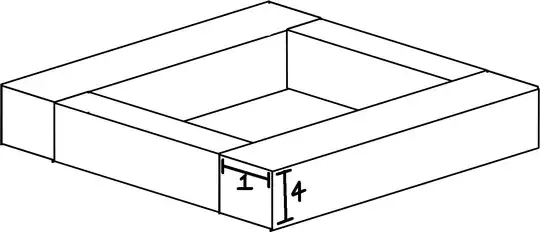
enter image description here This is just the simplified view of the X-axis frame. It's just a normal rectangular frame..

Sodrohu
  • 33
  • 1
  • 1
  • 5

4 Answers4

4

How do I connect [1x4 wood] together at 90 degrees while maintaining a solid connection?

If you can obtain a hand-saw (e.g. tenon-saw/back-saw), some sandpaper and some wood glue, you can make lap-joints. I find they are the easiest way for me to make rigid joints in wood.

enter image description here

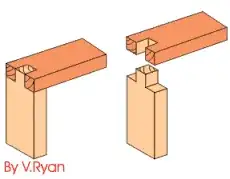
To join wood the other way, for a strong joint I'd try a simple finger joint (box joint)

enter image description here

at best I can get a hand drill, a jigsaw and some vices

I find jigsaws are a good way to make wobbly uneven cuts in sheets of wood. Maybe that's just me. Chewing through wood with your bare teeth is not much worse. A back-saw and a miter-box might be more useful to you if you can obtain them.

RedGrittyBrick
  • 24,700
  • 12
  • 50
  • 94
3

I would just drill pilot holes and screw it together, you don't need to do fancy cuts in the wood. If you need extra stability, put in a diagonal (diagonal cuts all the way across a board are much easier than notching). I would put in a small diagonal brace on each corner, although it would be easier to just use a large one across the whole frame.

I built a fairly nice CNC out of steel and aluminum and the framing members were butted togther and bolted to corner plates (which also added some diagonal support). The thing weights almost 200 pounds and I can lean it up on one corner of the X-axis frame and it doesn't budge at all. Butt joints don't look very nice, but they are easy and work just fine if you brace them properly.

While you could make your machine out of 1x4s and a dremel tool, I would at least use solid sheets of MDF and 2x4s or aluminum square tubes. Wood is cheap; most of your budget will be on your linear slides, screws/belts, motors, and controller(s) and it just isn't worth it to greatly limit the performance of your whole machine by skimping on what will end up being such a small part of your overall budget
2

Which way is the 90 degrees connection going? ie are the pieces of wood in the same plane (a flat joint)?

If they are, you could use a use a half-lap joint (or perhaps a mitre).

Or are the pieces of wood in different planes?

This gives you various options for the joint, for example:

  • Rebated joint.
  • Mitre
  • Biscuit joint (possibly also with a mitre)
  • Box / finger joints
  • Dovetails
  • Mortice & tenon

In this case, you might even be best with a fillet across the corner for reinforcing the joint to give maximum stiffness.

Hard to say for sure without seeing your machine design intentions.

John
  • 2,440
  • 14
  • 17
0

An easy yet secure method would be to use a pocket-hole jig, like a Kreg jig. Go to their website and watch the explanational video. There are also Youtube videos explaining how you can make your own jig if you don't have the money for a Kreg or other brand.