2

We have a pond with a fountain fed by a closed centrifugal pump. The fountain looks great... for 30 minutes. When its turned on, the pump sucks up sediment suspended in the water, and deposits it inside the hose. Over time this reduces the flow rate of the fountain to a trickle. If I use a water supply with higher pressure, such as that of the house, I can clean out the fountain hose (by simply forcing the sediment through the hose) and it runs perfectly - until it clogs up again.

The fountain is partly concrete, so a replacing the hose with a larger bore is not an option, therefore I need a new pump.

I am concerned though that buying a more powerful centrifugal pump will only result in the same problem. I am aware that you get either pressure or throughput with these, but don't know enough about fluid dynamics to be able to tell if, if I get a big enough one it stop it getting clogged up.

Ideally we would have a pump that maintained a constant flow rate, and increased the pressure as the line was constricted, until I presume some sort of equilibrium is reached where the pressure in the hose is large enough to displace the sediment on the walls.

Do I need something like a displacement pump, or will a correctly sized centrifugal pump do what I want?

sebf
  • 155
  • 9

2 Answers2

1

Put the pump in a 5 gallon bucket with two bricks in it; something to keep it off the floor of even it. Improvise some kind of intake screen if necessary.

Install a 'T' fitting on the output, valved, so that you can bleed off the desired amount of over pressure in the line directly back into the pond.

It's probably clogging where you have it choked down and possibly not making the pump happy from lack of cooling water flow.

Mazura
  • 13,598
  • 2
  • 20
  • 58
1

I am posting this to document what I have found so far in case it helps anyone else, but am leaving the question open in case someone more knowledgeable has something better to contribute!

Both this and this explain the principles behind how pumps perform and how to select one really well.

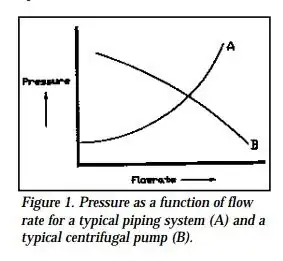
My understanding is that with a centrifugal pump the flow rate varies with pressure along a curve. The pumps can support high pressures but are designed to operate at one point on this curve, with pressure and therefore flow rate being constant.

enter image description here

The pump is selected by calculating the requirements of the system. That is the pressure required to achieve a specific flow rate (total head) given the system. This consists of both the static head (what is required to simply lift the water and fill the system) and dynamic head (losses due to friction, etc). As the pressure increases the returns in increasing flow rate fall off, like the inverse of the centrifugal pump curve. Where these two curves intersect will be the point at which the pump operates.

I measured my pond and found I could achieve a flow rate of 384 lph at 10 psi, but achieving 857 lph required 42 psi.

A good description of PD pumps is here as well. PD pumps have a different response, with a constant flow rate more independent of pressure. (I say more, because, the data sheets for actual PD pumps are far from the ideal shown in the docs above!)

So, my fountain having an undersized bore is not a problem so long as I select a powerful enough pump. The problem of the sediment though will cause an issue for the centrifugal pump, unless I can measure at what pressure the sediment is no longer deposited, and keep the system operating above this point.

So far I am leaning towards a PD pump, since my actual flow rate requirements are low (~10 l/min) but due to the design of the fountain the head requirements are high (10-20 psi). PD pumps matching these specs can be found for a reasonable amount from places like RS, while centrifugal pumps which achieve those pressures are considerably more, because I assume they are really designed for high flow. The problem is finding a PD pump designed to operate continually.

sebf
  • 155
  • 9