20

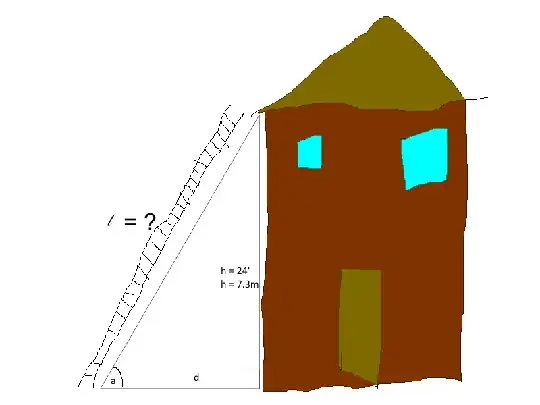
My roof-line is 24' from the ground. What length ladder should I purchase to ensure I can reach the this height safely?

A diagram describing the way a ladder would line up against a house

I'm guessing there is a "safe" angle (a) for a ladder, regardless of the height (h). So more generally what is an easy way to calculate the length of a ladder (l) to safely reach a particular height?

shufler
  • 884
  • 3
  • 10
  • 18

10 Answers10

12

You have to take into account a few factors:

  • extension ladders have an overlap that isn't shown in the nominal length - for example, a 16' extension ladder has two 8' sections, but fully extended is only 13' long.

    • the ladder will be used at an angle (usually a four to one pitch / 75 degrees) so the top of a 16' ladder won't even be at 13' in use

    • you don't want to stand on the top few rungs

    • some tasks take more ladder than others, if you're painting, you can reach up and work a little higher than the top of the ladder, but if you have to get on a roof, you need the ladder that extends well past the edge of the roof (usually about three feet)

Trig tells us the height of the top of a ladder tilted at 75 degrees will be .97 the length. For example, a 16' extension ladder (which is really 13' long extended) set up at a 4:1 / 75 degree pitch will touch a wall at about 12'7" (13' * .97).

This chart has all you need to know, no math:

Ladder Size Chart

batsplatsterson
  • 25,515
  • 1
  • 34
  • 83
8

I was always taught for every 4 feet up you go out a foot. This is given that you have level ground. Without level ground you might go a little further out.

So "A" is 6, "B" is 24, meaning "C" is more or less 25 feet. However you want a few rungs to hang over roof line. So given that you have a level yard, a 28 foot ladder would be the shortest. Probably around 30 feet is a safer bet.

wallyk
  • 12,399
  • 3
  • 24
  • 51
DMoore
  • 50,637
  • 16
  • 93
  • 208
5

Really guys, all that math? The most important consideration is safety, just google deaths in US caused by falls from height. Please use a ladder with appropriate duty rating and go online to take safety training before using it. Consider a fall-protection system.

Extension ladders should be 7 to 10 feet longer than the highest support or contact point, which may be the wall or roof line. This will allow enough length for proper setup, overlap of ladder sections, height restrictions of the highest standing level, and where appropriate, the extension of the ladder above the roof line. The highest standing level is four rungs down from the top. http://us.wernerco.com/support/ladder-safety-tips/how-to-choose-a-ladder

Werner is the leader in ladder manufacturering. Go to their website via the above link and become educated don't listen to any of the other clowns that have responded

Jimmy Fix-it
  • 37,916
  • 35
  • 62
1

Take the height you are trying to reach. Add three feet (so that you have something to hold onto at the top once you get up there). Add an extra foot for every four feet of height (to account for your angle).

In your example 25 + 3 + 6 = 34.

The formula for this is: (h รท 4) = (a). h + 3 + a = l (where h = the height of your house, a = the amount you should allow for your angle, l = the length of ladder you need).

ChrisF
  • 16,973
  • 5
  • 51
  • 74
Heather
  • 11
  • 2
0

A squared + B squared = C squared

75 degree angle (4:1)

A = 24 B = 24/4 = 6

576 + 36 = 612

Square root of 612 = 24.74

24.74 + 3 = 27.74

Answer: 28 to 30 foot ladder will be fine for this job.

Rob
  • 1
0

You guys are confusing the hell out of me and I have a Master's Degree. There is no simple math that can be used for every unique situation. For example, every post mentions this 4:1 ratio which the average reader would assume is accepted and safe for every roof height, or that the 4:1 ratio can be achieved at any house. In my situation, I have 2 issues with the 4:1 ratio. First, I don't feel SAFE with a 4:1 ratio (75 degree tilt), and my max roof height is only 18 feet, but I do not plan on actually getting on the roof because of the severe pitch. Second, due to numerous obstructions around my house (bushes, overhangs, etc), my "math" will force me to purchase a ladder that has more like a 6:1 ratio, which will account for the obstructions and simultaneously provide a safer tilt.

So here is my math for the group:

Step 1: Formula AH (Actual Height) + DO (Desired Overhang) + DP (Desired Pitch)

Measure the actual height of your roof line (18 ft in my case), plus desired overhang (in my case 2 ft will do since I am just cleaning gutters and will never get on my roof, plus desired pitch that you choose for safety and obstructions (6 ft from house in my case). 18+2+6=26

Step 2: Find a ladder with an actual fully extended length of 26 feet or greater (regardless of what the length is advertised as).

If you math wizards find something wrong with my math please let me know ASAP, because I am going to buy The Gorilla 26 (with wheels) or a 28 foot extension ladder today or tomorrow.
0

Well, this is the perfect use of the Pythagorean theorem. Pythagorean theorem tells us that in a right triangle c^2=a^2+b^2 which means that c=sqrt(a^2+b^2) sqrt=square root. In your artwork c=ladder length, a=height(h) and b=d. It DOESN'T matter if a=h and b=d or a=d and b=h! Therefore the length of the ladder is equal to the square root of the distance from the house squared plus the height squared, that is ladder length=sqrt(d^2+h^2).

Now there is another solution! Suppose you know the safe angle, e.g. you know what angle you feel safe at for example lets assume it's 30 degrees. Trigonometric function sine(sin on the calculator and in math) is equal to the length opposite of the angle(h in your case) divided by the length of the hypotenuse(ladder length) this is written mathematically like this sin(a)=h/(ladder length) where 'a' is the angle. By doing some algebra you get that (ladder length)=h/sin(a). When you calculate this make sure that the calculator is in the degrees mode NOT IN RADIANS. Just use Google calculator and set the slider to deg as oppose to rad.

Hope this helps and I didn't just solve your homework! :)

0

IIRC, angle a is supposed to be roughly 75 degrees. And you definitely want more ladder length up above roof level (unless you are just cleaning gutters) - plus you will often find a few feet missing in the overlap on an extension ladder (2 12 foot sections sold as a 24 foot extension ladder only add up to 21 feet of usable ladder...) so you probably need a "32 foot" extension type ladder (actual length in use - 29 feet)

isherwood
  • 158,133
  • 9
  • 190
  • 463
Ecnerwal
  • 235,314
  • 11
  • 293
  • 637
0

Don't forget to add your height, minus to runs. That usually makes up for what's lost in the angle, and then some. That is, unless you are planning on stepping off unto the roof.

sborsher
  • 756
  • 5
  • 6
-2

Don't the rungs have flat spots on them? Simply set up the ladder so the flat spots on the rungs are level. Should work for any height. No math required.

Conrad
  • 1