3

Hello Internet DIYers!

I'm in the process of remodeling my bathroom and I've just realized something I might have done wrong around my shower.

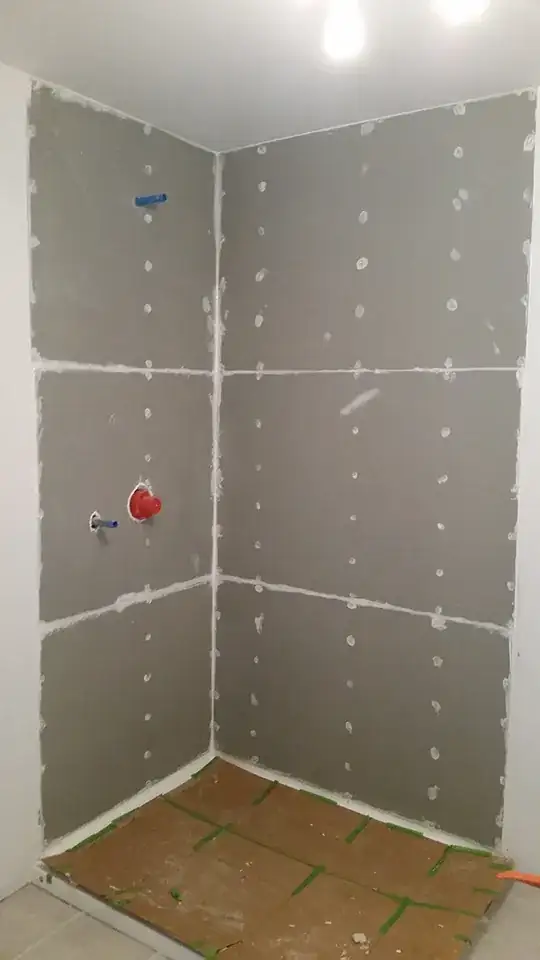
One of the two walls of the shower is an exterior wall, so there was, and there still is, a plastic membrane vapour barrier. Then I installed there a layer of DensShield backer board. And then I waterproofed all the seems and screw heads with 100% silicon (along with the gap I left between the DensShield and the shower base lip). Now I would be ready to reinforce the DensShield seams with alkali resistant mesh tape and thin-set before installing my tiles.

But now I'm concerned that I just created a mold sandwich.

The vapour barrier comes behind my shower base lip, so if there is water stuck between the DensShield and the barrier, it will not be drained into the shower base, it will go on the subfloor. If there is moisture stuck in there, it will stay there.

According to what I have read, I need a vapour barrier on my external wall (according to code).

Now what are my options?

  • Remove the DensShield, remove the plastic vapour barrier or cut holes into it and use something like KerdiBoard as a tile substrate AND vapour barrier? (The idea is to "make it right".)
  • Leave everything like that, follow the plan BUT add a liquid membrane (e.g. RedGard) over everything before installing my tile. (The idea is to prevent as much as possible water from getting to the DensShield.)
  • Other options?

Thanks for any input!

Here is an image of the actual state of my work, if you need a reference... enter image description here
Bob R. Shake
  • 267
  • 4
  • 9

2 Answers2

4

For a pure shower (not bathtub), I always put a membrane on over the backerboard. Redgard is my preferred choice right now so I would be fine with that choice.

I really don't think there is anything that you need to do. If I am putting plastic behind my backer I should see it sticking out under the backer and over the base in the picture - it would be covered by the lowest row of tile. It's not... not the biggest deal in the world if you have a membrane plus backer.

Final take: There is nothing wrong with Zhentar's advice. If I were doing a bath/shower combo it is exactly what I would say. However with the use of caulking for all of the gaps I would one a solid membrane over the area. The fact is the caulk will dry out expand/contract and may leak after 5 years or so. You are binding the caulk to larger materials like the DS which will have different expansion rates. With a membrane you have one solid surface that is made not to crack.

DMoore
  • 50,637
  • 16
  • 93
  • 208
2

DensShield is a Class II vapor retarder (at least, after tiling), which should meet your code requirement (YMMV). I would recommend tearing out the plastic membrane vapor barrier, using only the DensShield.

As things are, I think you're probably okay, though. The DensShield will still allow some (though limited) drying for any moisture that makes it in there, and the middle of a DensShield+Plastic Membrane sandwich isn't a great environment for mold to grow before it dries (not much for it to eat in there).

I'd strongly recommend against adding RedGard. It will give you a true vapor barrier sandwich with little possibility for drying, and any missed detail that allows liquid past the DensShield will likely be missed by the RedGard as well.

Zhentar
  • 1,272
  • 6
  • 7