2

If you are in a house with interconnected smoke detectors (hardwired or hardwired/battery combo), can you interconnect them with the waterflow switch for a home fire sprinkler system, or do you need to upgrade to a full fire alarm control panel at this point?

(It seems that since most (all?) hardwired smoke detectors use 9V on their interconnect line (as per this and this) relative to the neutral to activate the interconnect circuit, one could make a very simple interconnect setup using a 9V battery, a 9V wall-wart adapter, and a couple of garden-variety Schottky diode rectifiers to provide a 9V supply to the waterflow switch; but would such a contraption violate the fire alarm or fire sprinkler codes?)

ThreePhaseEel
  • 87,685
  • 36
  • 144
  • 243

3 Answers3

5

I can't speak to the regulatory side of this, other than to say I'd be very surprised if a custom-built circuit like you're describing would pass an inspection just for the fact that it's a non-UL/CSA approved device on a life safety circuit. Being in a private residence at least will relax the requirements compared to a commercial or multi-tenant building, but connecting non-listed circuits and devices is tough in any case.

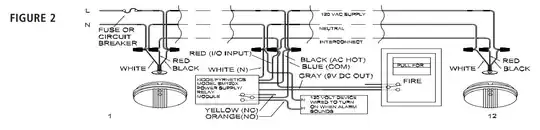
Rather than using a custom circuit, there are interconnect relays on the market that are designed for doing precisely this type of thing. For example, Kidde has a SM120X module that is designed to interface to external strobes/sirens/etc, as well as accept activation input for the interconnect circuit (using pull stations and rate-of-rise heat detectors as examples).

enter image description here

You should be able to use one of these and hook up your flow sensor in place of the pull station in the diagram above.

To me, it seems there is a low risk of impact:

  • This device is UL-listed
  • It's a manufacturer device, designed to interconnect with the manufacturer's own products
  • In this case, the signal between sprinkler and fire alarm is really a secondary system: if there is smoke, whether the sprinklers have activated or not, a detector should be activated and signal the other alarms anyway. In other words, if this device/connection fails in anyway, it is not critical to safety.
gregmac
  • 29,300
  • 17
  • 89
  • 162
1

I am doing the exact same thing.

Most likely your local (fire) code authority (AHJ) will specify that you need to have your fire sprinkler flow alarm integrated with your smoke detectors (but not your CO detectors, because that makes sense -not-). And all of those have to report to a UL certified central dispatch station. Some AHJ's (very small towns) will allow direct calls to the authorities but beware of false alarm fines. You will thus need an alarm panel capable of integrating your hard wired alarms.

The problem is that each manufacturer has different ways of interconnecting hard wired alarms. You cannot mix and match brands or even types. If it is a high voltage smoke detector with a third wire, you most likely cannot just jigger something on the third wire and expect it to work (also, not UL approved means it won't be accepted by your AHJ). Some high voltage system manufacturers MAY sell a relay that you can integrate into your low voltage alarm system, more modern systems actually do some sort of communication on the third wire. Also, most AHJ's will require that if one alarm goes off, all of them need to go off so if your fire sprinkler system goes, all alarms have to go so there needs to be communication in both directions.

I have opted to go for a Honeywell Vista system with System Sensor low voltage CO/Smoke/Heat alarms (COSMO2W). It is probably the easiest way to go. You then can integrate the fire sprinkler detector as a hard wired zone into your panel as another fire zone and all alarms will sound at the same time. Remember to use the super-expensive fire-rated wires as regular good-quality wire although physically the same material and on-paper has the same melting properties, is not the right color)

Guru Evi
  • 41
  • 1
-1

The main rule you have to worry about is the rule about combining low voltage and high voltage wires in the same raceway (pipe).

Even though the signal wire is 9volt, is has to be treated as if it had 120v on it. Whatever contraption you make has to isolate that voltage from outside it.

So simply connecting a 9v wall-wart to it is no good - if there was 120v on the line from elsewhere you would back feed the wall-wart and cause a hazardous condition.

You could maybe put the wall wart inside a closed electrical box. But how will you connect to it from the waterflow switch?

An optoisolator may be your best choice here.

Be sure prevent backfeeding the wall-wart - you don't want to pump voltage out of it (if it's a simple transformer). Any diodes, etc, must be rated for 120v.

Ariel
  • 1,926
  • 11
  • 23