4

I'm looking to build a retaining wall on my sloped backyard. I'll be using cinder blocks (with mortar to join them together and rebar for added stability).

(added info: at the lowest point the wall is going to be close to 4 feet tall, not counting how deep I have to dig and how much of the wall needs to be underground)

Some questions:

1) Footing or no footing? Can I start setting the cinder blocks directly on base gravel, with rebar vertically every 3-4 feet for added stability, and filling them up with mortar as I go? Or do I need footing?

2) If I need a footing, how deep into the ground should my footing be? Not how deep the footing itself should be (I'm thinking I'll go with a 1' footing—feel free to comment on that), but rather how deep into the ground do I need to dig my trench in order to set the footing?

I know that for gravity walls on sloped yards I need to measure 5' out of where I plan my wall to be and dig the difference. What about for cinder block walls, is it the same? Or the added strength and stability of rebar+mortar, or footing+rebar+mortar, makes it so I don't have to dig as much?

Hope the info I provided is sufficient to get help and answers from. Let me know if you need me to try and sketch the design of the wall for added context.

Thanks

Jack
  • 38,117
  • 2
  • 30
  • 66
ttothec
  • 191
  • 1
  • 2
  • 5

5 Answers5

5

Can I convince you to not do this ?

Honestly not trying to be an ass.

Please, please - Get a quote from a company that builds retaining walls.

The quote will cost very little or nothing.

You will be shocked at the cost, and not in a good way.

The quantity of material needed to build the wall, will amaze you.

Please get a quote or two first.

I promise you, you will not regret it.


Block walls work in compression, heavy things directly on top of them is fine.

Side to side, their goal in life is to tip over, and they are damn good at it.

Blocks work because they are tied to very solid, heavy things at the top and bottom that run the length of the wall, and have regular supports at a right angle to the length of the brick.

A 1' deep pile of soil, behind a 4' block wall, 1 block long, weighs 500 pounds.

The path of least resistance is to knock over the wall.

Blocks, attached with mortar, to the soil behind the wall about as strong as a 2x10 resting on its edge.

The question is more one of how many yards of concrete will you need to build the footing.

Some Guy
  • 2,275
  • 12
  • 13
2

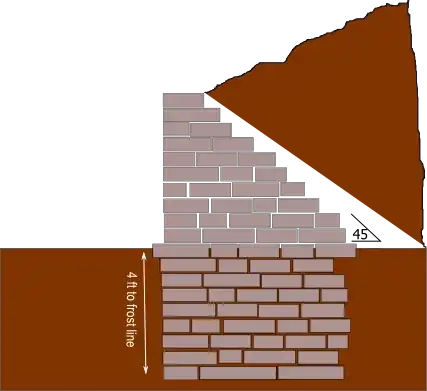
To make a retaining wall the stone (or other immutable material) must be make a 45-degree angle into the hillside.

The footing must be as broad as the plinth and must go as deep as the frost line. In New England where I live the frost line is 4 feet deep, so I have used that depth in the diagram.

Any other form of wall will eventually collapse. If the wall depends on metal in any way then it will collapse when the metal rusts. If the wall depends on mortar, then it will collapse when the mortar erodes. If an angle less than 45-degrees is used or if a non-fixed material, like gravel, is used as fill, then the wall will bulge out over time and eventually collapse.

The Roman walls still standing on the Appian Way and in other places that have lasted for 2000 years are all of the design I have shown.

retaining wall

Tyler Durden
  • 6,971
  • 13
  • 66
  • 113
1

A footing would be nice; if you do one with solid concrete, I'd leave some channels through for drainage. Another options is to use road base; the different sizes of rock lock together very tightly. Make sure that any loose base is well-compacted.

Note that in many places any wall higher than 3' requires a permit and/or engineering.

Eric Gunnerson
  • 2,977
  • 14
  • 10
0

I landscape in MN where the frost table is much greater. We bury the base course of our retaining walls which is generally 6"-7" with at least 4" of Class 5 gravel underneath. Any wall greater than 4' needs a permit in general. The one thing that nobody has taken into account is the need for water drainage. Compact class 5 on the backside of your baseblock and install a perforated drain tile that drains at the lowest point of the wall or put outlets on the first unburied course generally one every 50'. in your case i would have put in two 10' in from the outside of the walls. Put permeable (allows water to pass through) fabric underneath the drain tile and up the back side of the wall.

Back fill with round rock of any sort a foot behind the wall and all the way to the top of the wall; allowing 6 inches for black dirt if you want grass to grow. Anything behind that 1' of round drain rock can be the fill that was taken out during initial excavation. All of this back fill should be compacted to avoid settling and also washing of the fill into the drain rock. Put 1/16" lean on your base course per layer of block. So your 4' wall should have about a half inch of lean to it. An easier way to achieve this is the bubble on your level should be split in half by the line facing the front of your wall. Apply this to any wall and as long your building material, whether it be block or concrete and mortar, stays intact your wall should not push forward due to proper drainage, proper lean, and proper compaction of base and back fill.

ThreePhaseEel
  • 87,685
  • 36
  • 144
  • 243
0

Building code states that a footing supporting a structure above must be 8” below the local established frost line depth.

Nader
  • 1