15

I'm digging a 36" deep post hole for a fence I'm putting up, and about 15" down I ran into a very large root. Since the root seems to be running almost directly in line with the fence, and there isn't a tree attached to said root, I'd like to get rid of the root.

I've been using a reciprocating saw to cut out hunks of it, but this has been very tedious and not as effective as I would like. Is there a better way to get rid of the root? It appears to be around 9" in diameter

Dugan
  • 657
  • 2
  • 10
  • 17

16 Answers16

14

A reciprocating saw works nicely, with the proper blade. You can buy a tree cutting blade for work like this, 10-12 inches long, with long sharp raking teeth.

We had an ice storm, and the clean up of hundreds of large branches and trunks was done entirely by reciprocating saw, wearing out only three of those blades in my Porter Cable. Some trunks were over a foot in diameter. (My chain saw chose that time to be singularly uncooperative.)

8

A chisel-point digging bar might help. Depending on what type you get, you may even be able to sharpen it with an angle grinder for an axe-like end. Just be prepared for a workout!

Doresoom
  • 15,873
  • 32
  • 83
  • 122
7

You may find it easier to use a drill with an extension or extra long bit attached so you can do most of the hard work without too much leaning over. Punch a bunch of holes in each side, and then attack the little bit left with a saw.

BMitch
  • 43,263
  • 15
  • 98
  • 204
2

I have learned the hard way that it is not a good idea to use a PTO post hole digger with your tractor near trees.

To avoid getting the auger stuck in tree roots, first dig with a shovel. If you find roots larger than 4 cm diameter, use a spade to clear the dirt from around the root as much as possible and then use a small chain saw to cut the roots on both sides of the hole.

You'll probably have to resharpen the chain afterwards, but this is the still the fastest way. If the roots are less than 4cm in diameter, cut them with loppers.

Machavity
  • 26,498
  • 8
  • 44
  • 100
Bill Hood
  • 21
  • 1
1

I had a similar issue a few weeks ago and ended up having to relocate the post hole a foot or two down and just making a longer section of fence. Though I do know this is not always an option. It just happened to work perfect for me.

Another idea might be to burn it out. Or perhaps use the same stuff they use on stumps to get rid of them.

Tim Meers
  • 756
  • 4
  • 7
  • 13
1

I just ran into the exact situation yesterday afternoon. My fix... multiple drill holes. No blisters. No multiple hours. No making the hole bigger. No excessive force with saws. No running to the store for that special tool. 1/2 hour extra time. The worse part was running the extension cord. Actually the worse part was reading all the suggestions and the time wasted on all the posts. Just get it done.

BMitch
  • 43,263
  • 15
  • 98
  • 204
kimmy
  • 11
  • 1
0

Drilled a few holes all the way through a 12 inch thick root with a paddle drill bit. Then widened the holes with wider bits until they almost joined. Then levered the root with a spade and snap! Dead simple, took 10 minutes in total! I had wasted hours researching numerous websites, looking at all the suggestions and researching specialist tools that were being recommended when all that was needed was a little common sense.

0

I just used a splitting wedge welded to the end of a 6 ft round steal bar. Place the sharp edge of the splitting mall on the root then use a fence post driver on the steel bar to drive the wedge through the root. Worked pretty well. You can purchase something call a BRoot Bar and do the same thing if the fence post driver will fit over it

Bob
  • 1
0

You can probably rent a concrete core drill with a 8 or 10 inch cutter head and bore right on through it. The old root will then help to anchor the new post when you back fill or cement it back in place. It's always something.

Niall C.
  • 20,909
  • 19
  • 95
  • 135
0

I just got my hole punched through a stubborn root system using a half inch drill motor with a 2 inch hole saw. I was able to reach down far enough to do several starts and finally got it sawed away. Slow going and not the most practical idea but it potentially works using tools you might already have in your garage.

Niall C.
  • 20,909
  • 19
  • 95
  • 135
0

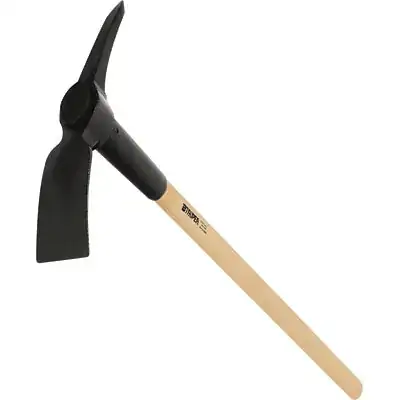
When I had a similar problem I just sharppened a Hoe and went all in. For the really tricky parts I hit it with a Pickaxe.

This will wear you out fast so try to plan it over a couple of days or get an extra pair of hands so you can take breaks.

Frankie
  • 101
  • 2
0

You can use a mattock........................................ or a double bevel mattock.

The difference is with large roots(forarm thickness and above), you won't be able to smash through is with a digging bar. Think of a root as a large branch, you can't use brute force to break through it, so you need to simulate the action of an axe. The mattock was made for just this. Use the flat sharpened end to slice layers off, then rotate around to the other side to fully remove the slices. Its like using an axe or hatchet.

allindal
  • 2,044
  • 3
  • 17
  • 24
0

If the root is running all the way right up to the length where you wanna put your fence along the same line, you may well want to make use of the root as well for building up the fence. That would look pretty odd as well as fancy too .What really you can do is get a good fence build up on the root itself with all the major polls for the fence attached stiff to the root and joining each of them with a fancy strings or Steel rods each of which covered by Money plant. I guess that would cover less destruction and will also give a retro Vintage look to your Fence.

Vral
  • 111
  • 1
0

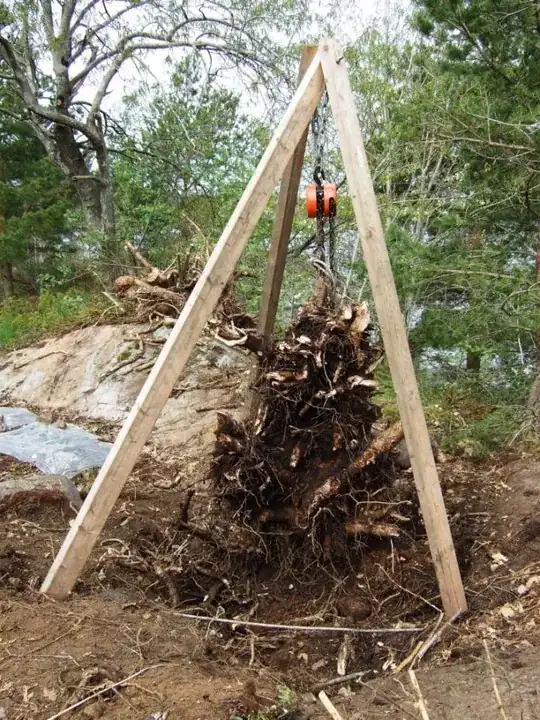
The best way is to get a "Stubbebryter"(norwegian name for it)

In english this is translated with google translate to: "stump break"

You can see it here:

enter image description here

This is how to build one

Tester101
  • 133,087
  • 80
  • 327
  • 617
patchie
  • 101
  • 1
0

I've dug my share of trenches and post holes and found that a chainsaw does the trick quite nicely.

Warning: Don't use this tip if the ground has a lot of rocks in it. Also, if you want to avoid excessive cleaning of your chainsaw, dig a good berth around the root first.

JohnFx
  • 4,755
  • 15
  • 45
  • 50
-1

A breaker /hammer with a couple of sharp bits... adios root!!

Jim
  • 1