10

I have a colonial built in 1913 and I live in NYS. My roof was just completed today and I have exposed nails across the entire roof!

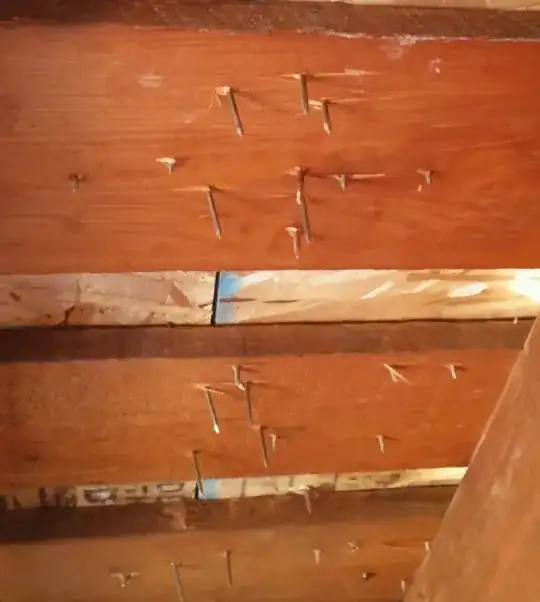
image of roof nails

It was not like this before. When I asked the contractor about it, he said this is normal, but I'm having a difficult time accepting this answer. I have included a picture to show what the entire roof looks like from the inside of the attic.

Darrick Herwehe
  • 379
  • 1
  • 11
lea
  • 101
  • 1
  • 1
  • 3

7 Answers7

17

That's perfectly normal. I would have preferred to see the vertical joints in the sheathing line up with the rafters, but that's about it. Roofing nails actually should come through about a quarter inch - I'd be more concerned if they didn't.

Comintern
  • 6,965
  • 1
  • 17
  • 22
6

Most sheathing now is 1/2 to 3/4 at most and a shingle is only about an 1/8 so with that being said the distance with synthetic is about an inch. If you're using a nail gun, which most roofers do, then your coils are 1-1/4 inch long at a low end (they don’t make smaller). So, unless you're hand nailing, yes there will be about 1/4 inch showing. It is normal for this to happen; it is unlikely for there to be no nails showing unless your roof is made of planks, in which case they won’t show.

isherwood
  • 158,133
  • 9
  • 190
  • 463
Nick
  • 61
  • 1
  • 1
1

Looks to me like someone was too lazy to go to the hardware store to get proper length nails or the hardware store was out of the desired size or they didn't want to pay the price for a full box of roofing nails...or buy a full box of roofing nails...and the nail gun was broken. This length and type of nail used is just wrong on multiple levels. They just used whatever they had on hand.

DAS
  • 919
  • 7
  • 18
0

I think there is a big problem with nails extending through the sheathing into the attic space. When the temperature falls below 32 degrees the humidity in the air will condense on the nails (frost). Above 32 degrees, the frost melts and water soaks back up into the wood (capillary action) and over a few winters you will have a moist wood surface - and a mold problem. That is the cause of my problem, I think. I know proper attic ventilation - air flow - is suppose to eliminate humidity but humidity is in all the outside air. The humidity is increased by improper ventilation from bathrooms etc, but air flow does not eliminate or reduce humidity in the air. Temps around 32 and humidity around 70 to 90 will result in frost and water and mold. Nails extending through the sheathing seem to be source of a serious problem in my attic. Other opinions most welcome.

Steve A
  • 11
-2

Once you fully nail through the roofing wood to the other side you end up with a stress fracture for moisture from both sides.nails should nit reach the full thickness to the floor roofing material and if its a new home structure as it makes the electricians and heating /cooling people work slower at times too.

Bob
  • 1
-3

This is not normal nor correct. It is common because most people who install roofing systems have no idea what they are doing. The roof deck should be 1 inch or thicker ply wood and the nail should be 3/4 inch nails, with 3/8th inch heads, galvanized and coated. When the nails are driven too deep, they supply a water channel which causes mold to grow on the roof and eventually destroy the whole house. Once the house is infested with mold, you will have to burn it down just to get rid of the mold. That mold could kill your family. Eventually the mold will show outside on the roof and grow under the areas where the nails are penetrating the roof deck. The reason this nail penetration is common is to save the labor of changing the nail pack in the nail gun, and the extra cost of using real roofing nails. It only saves about 100 dollars / house. Some contractors also substitute particle board for plywood which grows mold even faster. Google images for mold on roof.


This is a copy of the code that is about the same in all 50 states. The code states that the nails only penetrate when the roof deck thickness is below 3/4 of an inch. To hold snow, ice, and withstand wind, it has to be at least one inch thick plywood. So if you can see the nail heads and the right nails were used, the roof is too cheap to last anyway. The correct way to do this is with 1 inch or thicker ply wood for the roof deck/sheeting, and 3/4 inch galvanized nails with 3/8th inch heads. Also, the building codes are ridiculously outdated. They should not allow the roof sheeting/decking to be less than one inch or less than 3/4 inches when made of wood, especially in areas with snow.

https://up.codes/viewer/north_carolina/irc-2009/chapter/9/roof-assemblies#R905.2.5

R905.2.5 Fasteners

Fasteners for asphalt shingles shall be galvanized steel, stainless steel, aluminum or copper roofing nails, minimum 12 gage [0.105 inch (3 mm)] shank with a minimum 3/8-inch (10 mm) diameter head, ASTM F 1667, of a length to penetrate through the roofing materials and a minimum of 3/4 inch (19 mm) into the roof sheathing. Where the roof sheathing is less than 3/4 inch (19 mm) thick, the fasteners shall penetrate through the sheathing. Fasteners shall comply with ASTM F 1667.
Niall C.
  • 20,909
  • 19
  • 95
  • 135
-4

Nails should never go through the plywood, water does go under the shingles and rust the nail thus making it thinner, more water to go through, the correct nail length should be the sum of the shingle thickness plus the underlying materials minus 1/4 inch...it is strange that protruding nails are thought to be normal! it is a common error in American building construction methods...you will not find this elsewhere in the world!

Adam
  • 1