32

Backround

I'm going to pour some concrete to anchor a swing set. The base of the swing set that is being anchored is two 4x4s with a 2x4 footer crossed perpendicularly to the 4x4s.

I have a bunch of large softball-sized rocks in my yard. I was thinking I could buy less concrete mix, and get rid of some of these rocks, if I threw some of the rocks into the wet concrete.

I assume the concrete will harden around the rocks and they will set together to become a solid mass.

Question

Is my assumption correct? or will the rocks damage the integrity of the concrete anchor?

Here is a drawing of posts and anchor (with rocks depicted)
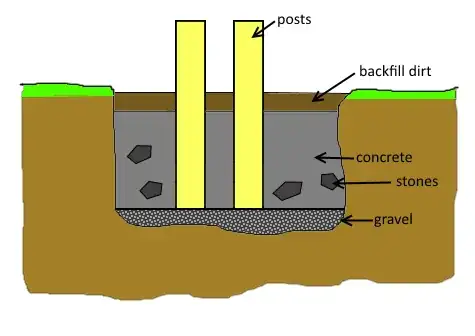
Drawing of posts and concrete anchor

Update

I poured the cement in June 2015 (about a year and a half ago). The swingset is still standing strong.

The biggest takeaway from this experience is the consistancy of wet cement. I assumed it was like latex paint, but it was more like thick oatmeal or damp sand. It didn't really pour and fill up all available space. I had to spoon it in with a shovel and pat it down into place around the posts.

isherwood
  • 158,133
  • 9
  • 190
  • 463
Walter Stabosz
  • 683
  • 1
  • 13
  • 21

8 Answers8

21

Concrete is a mix of large aggregate, small aggregate, and cement (a 4:2:1 ratio is a good approximation - though designed mixes will be more calculated than that).

The size of the large aggregate isn't particularly important, unless you are working in very tight spaces or around reinforcement, in which case you want suitably small aggregate.

In this case there won't be a problem at all using softball-sized rocks. Just make sure that they are clean (ie don't have soil stuck to them).

(I remember seeing a section cut through a piece of concrete at the Hoover Dam Visitor Centre, and some of the large aggregate in that was rocks up to perhaps about 8 inch / 200mm or more).

John
  • 2,440
  • 14
  • 17
12

With regard to using wood posts in concrete:

enter image description here
Image Source

Note that any water that drains down the side of the wood post will drain through to the subsoil. The post should be in a collar, not a cup...

(Feel free to integrate into the answer of @sch )

FreeMan
  • 48,261
  • 26
  • 101
  • 206
DJohnM
  • 1,050
  • 1
  • 7
  • 14
6

It is not good practice to bury wood in concrete as you depict. Best to use metal anchored in the concrete and attach the wood to the metal. Your result will be inevitable rot and failure, probably not before the kids outgrow it but maybe. Something like this (http://milspecanchors.com/shop/accessories/6x6-post-anchor-heavy-duty-cast-aluminum-structural-ornamental/) would be better, but you will need some additional diagonal bracing for a swing set. Your design is rigid but short lived even with creosoted lumber. As to the rocks, they neither add nor detract to the concrete, use them at will.

sch
  • 69
  • 1
5

Reducing the amount of Portland Cement in the concrete will reduce its strength. That is, adding rocks to an already-blended mixture of concrete will reduce its strength over the same mix without the rocks. If this weren't true, they would just add rock to the original mix, since rocks are way cheaper than Portland Cement.

The other issue, as John mentions, is that the bond with your yard rocks may not be as strong as with the aggregates that the concrete mix people are using, as those aggregates have to conform to certain standards. Any powder, salt, or oil that is on the surface of the rocks will change the bond it will form with the cement.

Having said all that, whether this will impact your specific design just depends on how critical it is that your concrete perform per its design specs, ie, how much you've overengineered your design. However, you are certainly introducing a large unknown by adding the rocks.

Joel Keene
  • 962
  • 1
  • 5
  • 9
3

It is pier size that matters. My God, yes to the above answers if you were building a very serious structure. Yes less Portland the less PSI. 6 sack Portland cement is about 4000 psi. You can drive a 10,000 pond bull dozer on it all day. % sack which you can buy at Home Depot is about 3000-3500 psi. It is pier size. Dig a 12" x 2' and add some of your rocks, your swing set will be fine!

Chris C
  • 71
  • 4
3

People have bound stone in concrete since...well, since they started using concrete. I don't think adding rock is a bad idea in principle but it matters what sort of rock you are adding. Adding round igneous rock isn't as good as adding broken igneous rock but both are better than adding sedimentary or aggregate rock. I'd support using a metal or plastic socket to seat your wooden posts as they will rot otherwise. At least with a socket you can replace the posts over time without having to dig up your concrete anchor. I'd disagree about forming a collar though. Not because it's not a good solution but it's not good for this use case. A collar is just something for the little ones to get hurt on. Indeed, I'd set my post anchors so that there is a few inches of dirt above so I could grow some grass around the posts. A quick splash of creosote up to ground level will help keep the water out of the wood and since you are using a socket you can treat it every 3-4 years.

This is all rather academic. In fact, almost any concrete, with or without stones will be more than adequate. You aren't expecting it to support a great weight or handle huge stresses. It's a swing set, not an antenna array pylon.

user284529
  • 31
  • 1
2

You need the concrete to be strong at the bottom and next to the post, otherwise it just needs to be heavy.

So put some concrete in the bottom, the rocks round the sides and fill the center up with concrete.

You can even brace the post with a few bricks on two sides of the post least most of the post clear, then fill round with concrete. The concrete only needs to grip the post and have enough wight to keep the post stable.

Walker
  • 6,275
  • 22
  • 66
  • 87
0

You don't really show the scale; my concern would be the posts + concrete mass rotating in the hole due to alternating side loading. Depends on how it is used, of course; little kids swinging +/-30..50 degrees of arc seems non-problematic, while a pack of (larger and heavier) teens swinging in sync and going for +/-170 degrees, or full wraparound.

Technophile
  • 393
  • 2
  • 8