6

I'm planning on building a home climbing wall, made from a mild steel subframe. It will probably be around 10 feet tall approx.

I was thinking along the lines of using mild steel angle, cutting to size, drilling bolt holes then joining the peices together.

Like this:
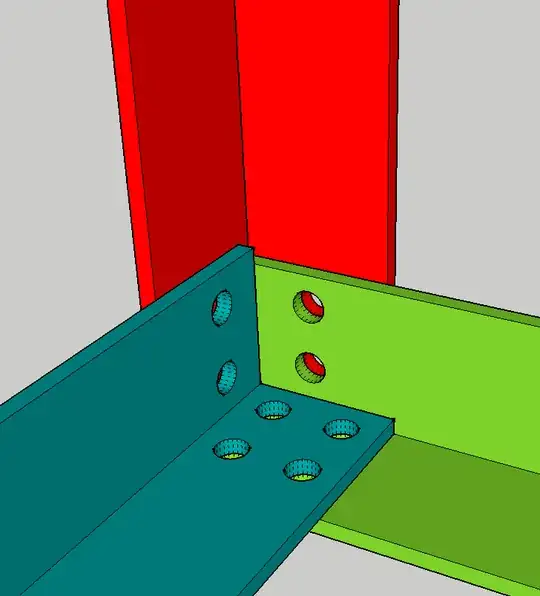
enter image description here

Does anyone have any idea as to the strength of such joints compared to welding?

Also, the wall will be freestanding, not attached to an existing wall so I'll need to lay some foundations, for this I was hoping to get away with a concrete base with bolt holes alligned to accept the sub frame being bolted straight to it. This would allow me to remove the wall and not leave a big RSJ poking out of my garden or some other such thing.

So my other question is, would such a foundation be acceptable? Is their other longer fixings availiable that could take the place of using bolts?

Tester101
  • 133,087
  • 80
  • 327
  • 617
Dave
  • 163
  • 1
  • 1
  • 5

4 Answers4

11

Unless your holes match the bolt size very precisely (like, you have to hammer the bolts home), you will get racking, which will weaken the joint over time. Likewise, the bolts will loosen up (use lock washers and check it frequently). It's something you'll have to watch for; as the holes get stretched, you'll need to figure out what to do. Think about how thin the piece of metal between the holes and the edge of the piece is; that's the weak point, strain-wise.

Also, a freestanding wall is going to be a tremendous strain on the footings, especially with someone (or a pack of neighborhood kids) scrabbling around at the top of it. A person can throw their weight around to the tune of 5x actual weight. At a distance of 10'-15' that is tens of thousands of ft-lbs on the bolts, and any weakening in the joint will make things worse and worse.

If you can arrange it, build it as an A-frame (climb the sides of the 'A') with at least four footings to reduce the mechanical advantage the climber has over the footings; think of a playground swing. Otherwise, it doesn't matter how strong the wall is, the whole thing may tip over or may be yanked down or ripped off its moorings.

Given that people's safety is at risk, you probably should consider consulting with a professional structural engineer. The strain strength of steel under sudden load is much smaller than you'd expect.

Alex Feinman
  • 3,532
  • 7
  • 30
  • 41
7

A welded connection can always be made the same strength as the original steel by using a full penetration but weld but this all depends on the quality of the materials used for the welding and the quality of the welding itself. Therei s a very good reason why there is a lot of non destructive testing used when welded joints are being used for structural reasons. Other types of welds such as fillet welds will be weaker than the origianl material with the strength depending on the quality and the design.

For a bolted connection, the connection will not normally be as strong as the original material without some form of strengthening because of issues like the reduction in area caused by drilling the holes and the small lever arms caused by overlapping plates.

In this instance, if you are not intending to get the design professionally done, I would suggest a bolted connection would be more suitable unless you have absolute confidence on the quality of the welding and the design of the joints. A simple bolted connection should give you more confidence about the strength than a welded joint even though the capacity of the connection may be lower.

Ian Turner
  • 1,062
  • 3
  • 10
  • 16
3

From having drilled many holes in metal, its no picnic. If the metal does not already have holes in, you'll need a pillar drill - a pistol drill is a nightmare in comparison.

Metal is heavy and awkward to work with, I'd recommend wood for this purpose, especially if its temporary.

If your heart is set on metal, I recommend large diameter rolled hollow section. You'll get a lot more sturdyness than using angle strips! Drill one, two holes per joint at most to keep it simple. Four holes to hold two pieces of metal together? Avoid! Too much work; two holes is sufficient to stop it twisting and doesn't weaken the metal as much (not that that matters so much with RHS, as there are four faces rather than two).

hole_drilling

Most importantly make sure your frame is braced. Better that each connection has one bolt and your frame is braced than unbraced with four bolts at each connection. Here is some bracing I used for a punch bag stand, at the base those angled braces meant it was strong enough for me to swing on. The RHS was 30mm diameter; you might consider 40mm for a climbing wall just to be safe.

stand_i_made

The easiest way to build it strong is to cross brace - again, for less money you could use copious amounts of wood to achieve the same support.

If you can secure the climbing wall at the top too, that'd be great - it wouldn't need to be as sturdy

xxjjnn
  • 131
  • 3
1

I'd suggest that this is maybe over-engineered. What about 3 10' wooden posts arranged in a triangle and then 1" ply bolted between them to anchor the holds? Anchor the entire thing into the ground with swing-set stakes/screws.

DA01
  • 24,586
  • 30
  • 82
  • 153