35

I am buying an already-built new home. I find this in the basement. The builder says it's okay, but I am really concerned. Is this really a big issue? What steps would be required to repair it?

This house is close to the retention pond. Is that the reason why the soil is getting soft?

enter image description here

BMitch
  • 43,263
  • 15
  • 98
  • 204
John
  • 351
  • 1
  • 3
  • 3

11 Answers11

42

I'm not familiar with USA house construction methods (I live in the UK) but speaking as a mechanical engineer, I wouldn't even stand near that thing while debating how safe it was.

That bolt is presumably supposed to be fixing the post against it popping out sideways. I suppose it was meant to be bolted to a metal beam underneath the concrete. So either that whole beam has sunk, or all the rest of the concrete floor has heaved up for some reason (ground water underneath. maybe?) or there isn't any beam there at all, and it's just an undersized-looking bolt sticking into a bit of broken concrete.

It looks to me like it's just waiting for the right moment to make a nice loud PING as the post flips out sideways and the whole floor above it collapses.......

One more thing. That metal post didn't get longer by magic. So if it has pushed a hole in the floor, whatever is on top of it must have settled. That could mean the whole house is sinking unevenly for some reason.

alephzero
  • 884
  • 6
  • 8
24

This should make the hairs on your neck stand-up. What my first thought was is the sand fill that the concrete was floated on has been undermined. Is there a sump pump well in the basement? And if so, do you live in an area that gets a lot of rain? Also, what's missing from that photo ( that hasn't been installed) is a concrete footing of some sort to distribute the weight from the floor joists. The metal column was forced into the floor because: 1) a void under the slab was eroded and 2) the column wasn't seated on a footing. Too be absolutely safe have an inspector look at it. But I'd be very concerned about this issue. Something is very wrong.

ojait
  • 11,108
  • 3
  • 14
  • 36
13

Definitely get a home inspector to look over tbe place; there may be other damage from this subsidence...

If the price is attractive enough that you'd consider trying to have this redone properly, I'd suggest getting an engineer who know the local soil and hydrology to look at it and tell you what it'd cost to redo this properly. Better to spend a few hundred up front making sure it can be repaired than to spend a few hundred thousand in buying the place only to discover it can only be torn down and rebuilt.

And the engineer's estimate is a good argument for having them lower the price to cover that work.

(I've got a few columns in my own basement, but they seem to be staying where they were put.)

keshlam
  • 33,603
  • 5
  • 56
  • 110
9

If your gut is telling you to run then run. But if you are still thinking about purchasing the house I would make sure that the builder gives you something in writing to back up what he/she is saying. If they are wiling to put it in writing then all is good, as long as they can be found if something does go wrong. Also ask the builder for the compaction tests on the soil, a test on the concrete for slump and test on the cured concrete for how much weight it can withstand (can not remember the name of the test). Ask to see these tests and ALL of the city inspection done during the build. If the builder gets mad or evasive tell them to forget it and call the city.

"A verbal contract isn't worth the paper it's written on."
--Misattributed to Samuel Goldwyn

WarLoki
  • 996
  • 5
  • 12
6

This may be a problem or non-problem depending on the foundation construction. You'll be much better off consulting an expert who knows how foundations are built in your area and how to diagnose them.

One option is that the foundation is designed with separate large thick concrete pads that bear the load and then the space between them is filled with concrete just to cover the ground. In this case the failure you see may be no big deal - the pads still carry the load as intended and they slightly sunk into the ground. If they sunk evenly - that's likely okay. The filling between the pads gets no load from the above so surely it cracked and separated.

Another option is that the foundation is designed to be a single enforced concrete plate under the whole house. In this case the failure you see shows that there's little or no reinforcement in the concrete and it is not strong enough to bear the load. The house has good chances of sinking into the ground unevenly and collapsing at some point.

TL;DR consult an independent expert.

sharptooth
  • 9,717
  • 20
  • 65
  • 89
6

No this is not okay - especially for a new house. If the builder is saying it is okay, run away from this house because you have no idea what else they have screwed up. You can't put a post on a slab if it is structural (i.e. not decorative). A concrete slab is not designed (and shouldn't be) to handle structural loads like this. The concrete looks fine. If it was crushed into a fine powder under the post, it would be a sub-standard concrete issue. This is really poor construction technique (as in not sure how it passed the building inspection - which in our town is pretty good).

It is an easy fix though requires some hard work and doesn't need a structural engineer (though I am one) unless it is an unusually designed house (e.g. significant cantilevers/very large open floor plan) - but given the concerns of the person asking the question, he definitely needs to get a good carpenter/builder to do this work according to the local building codes which specify the footer and post requirements.

Get some jackposts for temporary supports beside it. Make SURE you put nice big blocks of wood under them to spread out the load on the slab and that they are carrying the load from the load-bearing walls/columns above. Take off the current post, dig out out a footer for the post (sized according to the building codes - but probably around 2'x2' and 12" deep but the actual measurements will be completely determined by the structural loads being supported and the soil. Put the post back in (built up out of wood or steel/concrete). You generally only use jackposts when you are trying to slowly re-level up a house.

If you have a good sense of construction/building and can read building codes books reasonably well (unlike the builder for this house), this is a simple DIY project.

William
  • 179
  • 4
4

One thing that I have learned in my short life, is that when you are buying a house, always put in clauses so you can get out/get money removed from the asking price if something like this is found to be wrong. With a home inspectors and an engineers opinions, you may be able to get a sizable portion of the price of the house knocked off.

Not an expert opinion, but the general way to fix this would be to support the main beam of the house with several posts, remove this current post, cut out a portion of the floor, dig down, pour a good footing, and then replace that post.

ImonFyre
  • 41
  • 3
1

That is a massive issue

I don't now what the load on that post is but I know they don't just put them in for show. That's an integral structural member have your support system in your house. The fact that the Builder says it's okay would scare the crap out of me. I wouldn't even consider buying that house because that statement speaks volumes of the builders quality of work.

This is what a footing is supposed to look like for the structural postenter image description herewww.cottagelife.com
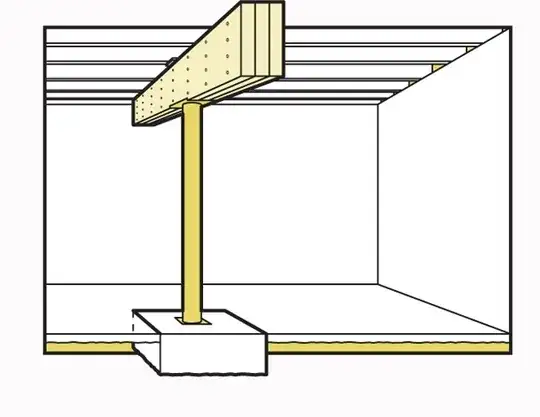
Footings will vary in size depending on the ground conditions. In my area our soil is mostly clay or sand we don't have much in the way of aquifers and we don't get sinkholes in the middle of the street. a typical size for a foundation in my area is approximately 24" by 24" by 1 foot thick, reinforced with rebar. The biggest one I've ever seen was 3 feet by 3 feet and two feet thick reinforced with rebar.

Keep in mind that the ground didn't rise around the post. If that were to happen it would have just pushed up the house. Your house has sunk and everything above that post has dropped along with the it.

The repair

First you need to have an engineer tell you how big of a footing you need and the engineer should also be able to tell you the method for repairing it. Usually it would involve something like, building a false wall on either side supported by multiple adjustable Jack posts where you would jack up the house to the correct height. You would then cut the concrete excavate the appropriate amount of dirt, gravel or whatever and then pour the appropriate footing. In my neck of the woods structural member designs need to be certified by somebody in case something awful were to happen. A finger needs to be pointed at somebody. The engineers and architects design a plan and give it the stamp of approval. If that plan is followed and something awful happens they are responsible, if the plan was not followed then whoever did the work is responsible. For some reason city inspectors don't often get the finger pointed at them even though they pass the inspection.

Joe Fala
  • 6,414
  • 10
  • 36
1

I'd like to add another vote for "this looks bad". To proceed with buying the house, get a written report from an engineer and they use that to get it fixed, or get an allowance at closing to get it fixed. Are there other support poles that the same thing could happen to?

BrianK
  • 5,475
  • 8
  • 30
  • 38
0

You don't give very much information, but just looking at the photo the "foundation" looks like crap. It looks like it is way too thin and the concrete is cheap. Of course, that is the construction style in America now, build crap houses out of crap plywood on crap "slabs" 2-inches thick then wire the whole thing with crap Romex and plumb it with crap PEX pipe. Welcome to the brave new world where houses only last for 30 years.

The collapse is due to subsidence. There is no telling how bad it could be. There will already be damage to the house due to settling.

Tyler Durden
  • 6,971
  • 13
  • 66
  • 113
0

Run away and do not look back. Anyone showing a new home with a flaw such as this is waiting to sell someone a "bridge". This is a text book scenario of Buyer Beware