6

First time poster. I feel like I have researched everywhere and not found the answer I am looking for. I've called a few manufactures of ceiling fans who didn't have any answers either. I began searching the web and came across this website. I don't see any existing articles on this topic yet however.

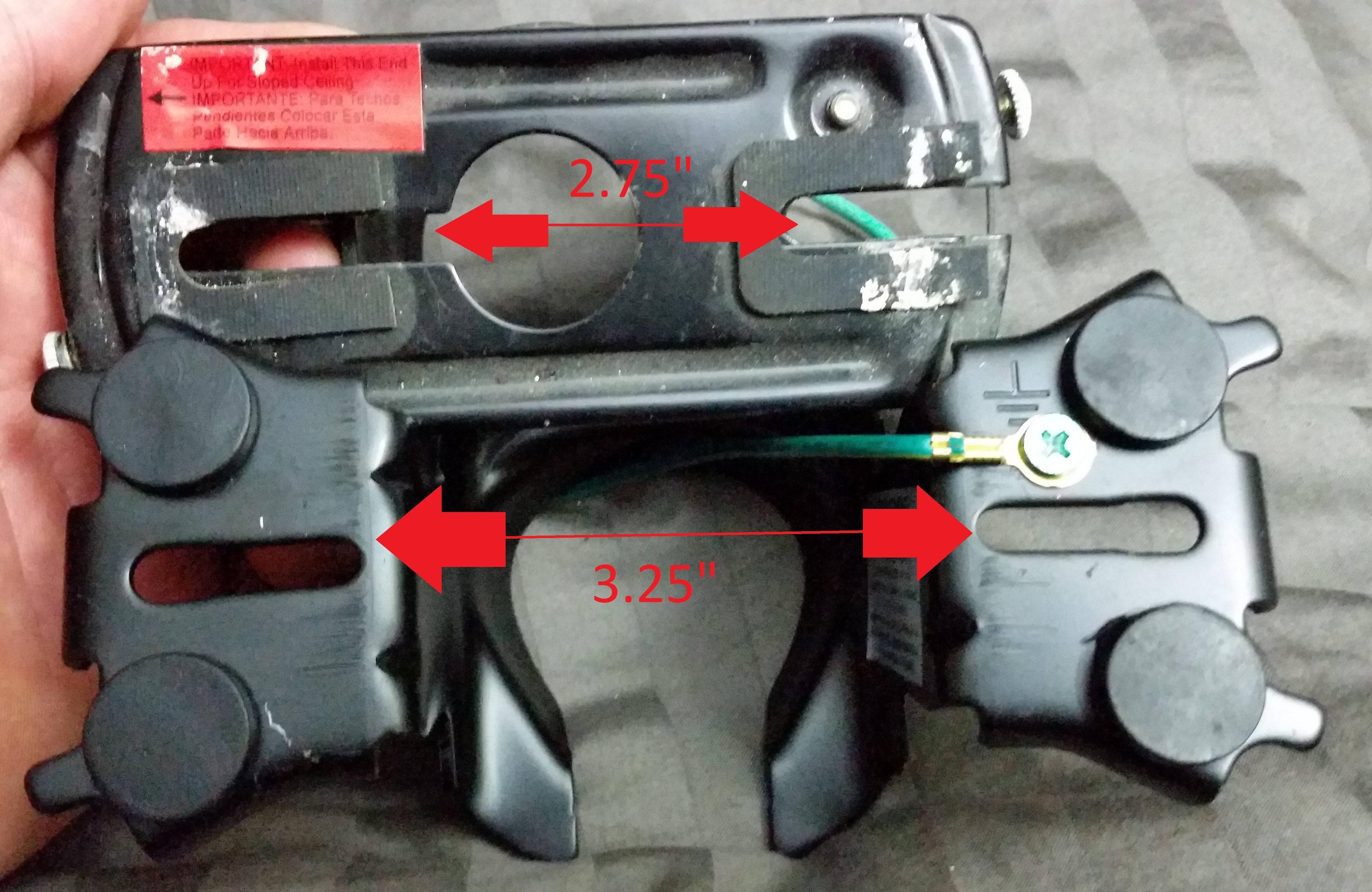
My problem. I'm in a old rental unit that had a broken ceiling fan. The landlord is lazy but approved me replacing the ceiling fan myself. I've done about 6 before in a new house environment. However, what I ran into was I removed the existing ceiling fan and went to install the new one. I found that the existing junction box mounting screw holes are 2 and 3/4s(2.75) inches apart and the bracket from the new ceiling fan(Hunter) is about 3 and 1/4(3.25) inch apart and can adjust wider but not narrower. I did a lot of research and this does not seem to be a measurable characteristic on the data sheets. Hunter ceiling fans say all their fans are that way these days. The old ceiling fan does not have a make or model visible on it that i can tell. Seeing as how this is a rental and an old one at that, I do not want to replace the junction box.

My question is does anyone know if there are brands of ceiling fans out there that have a mounting bracket that can accommodate 2 and 3/4s(2.75) inches or an adapter kit that would help? I have attached a picture of the old bracket that fits(top) and the new bracket(bottom) that does not. Unfortunately, the new ceiling fan does not fit in that bracket either though. As you can see in the old one, it has a more accommodating screw sliding space for smaller junction boxes.enter image description here
Thanks in advance!

Jloco

DrewJordan
  • 880
  • 1
  • 7
  • 12
jloco
  • 61
  • 1
  • 1
  • 2

4 Answers4

5

If your box is that small it is almost certain that it is not a fan rated box. If it is not, then the box MUST be replaced with a fan rated box.

Sorry, but even with approval, someone unlicensed, uninsured, and unqualified SHOULD NOT be doing electrical work in a place that they rent. This is a perfect example; something as "simple" as changing a ceiling fan turns into a project since the box has to be replaced, and in an older house this can be met with issues.

Speedy Petey
  • 16,708
  • 2
  • 29
  • 54
3

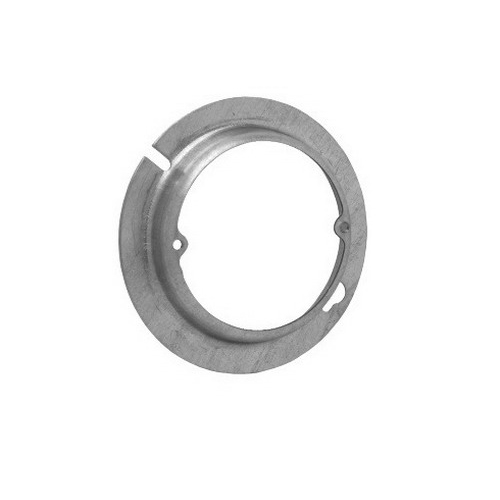
In most cases it isn't that the box is too narrow, it's that a cover was installed to narrow it on original installation. In other words the 4 inch box is covered by something like a TP331 narrowing it to 2.5 inches. If it is, just drill access holes perpendicular to the existing mounting holes, and mount to those newly exposed screw terminals. You will be screwing directly into the octagonal box and forgoing the TP331, but the cover is generally not needed and difficult to remove completely. You may need longer screws though.

TP331

enter image description here

ArchonOSX
  • 20,870
  • 3
  • 30
  • 53
1

Just ran into this problem installing a new fan in an older house. Read the posts above and decided to find the ceiling stud. I bypassed the junction box and went right into the ceiling stud with four long wood screws - two on each side. Worked perfectly!! No wobbling, no noise no nothing. Its as sturdy as can be. I could hang 100lbs on that bracket. The fan is only 20 pounds - so its definitely doable without having to change out a smaller older fan junction box to install a newer Hunter fan. Also it was a sloped ceiling so I couldn't use the new fan triangle bracket and ball. So I used another bigger bracket and round ball but the cover plate didn't match up to the screw holes on the other bracket so I placed paint stick sized shimmies between the ceiling and the bracket till the holes matched up. Again perfect!! :)

1

First check to see if the new bracket actually fits in the hole for the electrical box, not including the fact that the screws don't line up. Second, it would be better to replace the box with one that is fan rated, but assuming that you don't care about this:

You can either attack the old bracket with a hack saw or buy 2 pieces of 1" x 1/2" x 1/16th metal and drill 2 holes in it. Screw the pieces of metal into the old screw holes. Now attach the bracket to outer screw holes. Assuming your metal pieces are thick enough, they won't bend, and if you use a thread locker, hopefully your ceiling fan won't fall, or at least not until you move out.

gbronner
  • 5,752
  • 1
  • 19
  • 47