I understand that 240v in a house current, the flow is in out/ out in through the two 120v lines from the transformer. What continues to confuse me is the role of the neutral wire in a 120v circuit. If its ac, (and I know it is) then the same sloshing flow as the 240v will take place. So current flows, just as in a 240v circuit, on the first ac pulse. But when current reverses, in a 240v circuit, current simply retraces the path of the preceding current, but on 120v, it seems that there is no push/voltage driving back towards the voltage source from ground.
Asked
Active
Viewed 3,332 times


4 Answers
4
In a 120/240V system, the neutral is a center tap on a 240 volt transformer secondary coil. So your home is not fed by two 120 volt wires, it's fed by a 3-wire 120/240V single split-phase system.
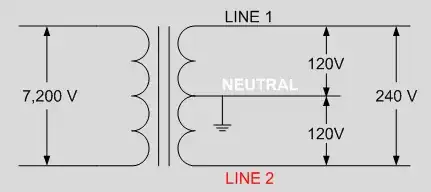
If it helps, you can think of it as three separate circuits. There's the 240 volt circuit, which flows through the whole secondary coil (L1 to L2). Then there's the first 120 volt circuit, which flows through half of the secondary coil (L1 to neutral). Finally there's the second 120 volt circuit, which flows through the other half of the secondary coil (L2 to neutral).
The information in this answer might also be helpful.


1
You might find it easier to think of voltage as a potential or difference rather than a discrete number. Yes, a single live wire has a potential between itself and earth, but the single wire by itself has a potential of 0.
This is why birds can sit on electrical wires without getting a shock - the current needs a return path. It's also the reason why if you have two DC power supplies of different voltages and link their negatives together, the reading across the two positive terminals will be the difference in voltage.

John
- 121
- 1
- 1
- 6
0
The concept of voltage comes from the antiderivative (aka indefinate integral) of the electrostatic field. Things get a bit messier once electrodynamics come into play but for the most part the definition from electrostatics is "good enough".
Being an antiderivative means a couple of things.
- There is an arbitrary constant we must pick. Or to put it another way voltage only makes sense relative to some reference. Most power distribution systems are deliberately referenced to the general mass of the earth.
- Relative to whatever arbitrary constant we pick, the voltage can be arbitrarily positive, or arbitrarily negative.
When initially introducing electricity to novices, people often use a hydraulic analogy and speak of voltage as analogous to pressure. And that analogy works up to a point, but this is one of those places where it breaks down.
As much as a "positive" voltage can "push" charge, a "negative" voltage can "pull" it. This is in contrast to hydraulics and pneumatics, where "pulling" is much less effective than "pushing".

Peter Green
- 5,358
- 13
- 29
0
Voltage doesn't "flow in and out", rather you are seeing plus or minus 120V potential to ground. If you were looking at a graph of the voltage, you would see a sine wave at 60hz between +120V and -120V, hence why when you add up the two legs of your service, you get 240v and not 0v.
Unlike three phase power where all three phases from the generator are delivered to your home, in residential systems, you are being fed two "legs" from a transformer on a single phase.
The neutral provides a non-energized path for the electrons to return to ground.

Steven
- 27,770
- 10
- 56
- 90