7

In all the UK homes I remember, the skirting boards (baseboards) are designed to collect dust by exposing a horizontal or sloping surface. See a cross-section on the left of this image:
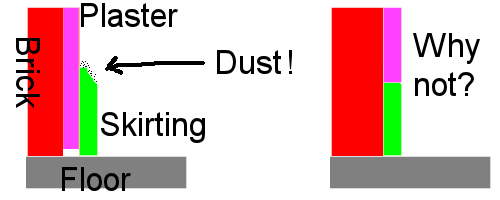
Skirting boat collects dust

Surely we could fit a rectangular profile piece of skirting to the walls before plastering, and make the plaster flush with the front face. See cross-section on right above. A bead of flexible caulk would bridge the join to conceal the crack (you often need this on normal skirting anyway).

I'm not about to demolish my house to fit new skirting boards, but why didn't some genius think of this 100 years ago? Or is there a flaw in my design?

MerlinMags
  • 465
  • 3
  • 7
  • 14

3 Answers3

16

Wikipedia

In architecture, a baseboard (also called skirting board, skirting, mopboard, floor molding, as well as base molding) is a (generally wooden) board covering the lowest part of an interior wall. Its purpose is to cover the joint between the wall surface and the floor.

https://en.wikipedia.org/wiki/Baseboard

The purpose of a baseboard is to easily cover the joint so that it does not have to be seen. It's much easier to finish the plaster and then tack on the board that take the time to ensure everything is flush and not get any plaster onto the board. I don't believe that they are "designed" to collect dust, that is simply a side-effect of using them.

TFK
  • 3,784
  • 7
  • 25
  • 44
11

Trim in most all forms (window casings, baseboards, even crown moulding at times) is primarily there to make the finishing between two different surfaces easier.

Done well, they also add detail, of course, but for the most part, it's a practical solution first and foremost.

You could certainly do what you propose, but some of the challenges you will run into would include:

  • Houses are rarely square. Overlapping the baseboard makes that a lot easier to deal with. With your design you'd have to work hard scribing both the wood and the plaster/plaster boards to accommodate even the slightest bit of out-of-squareness

  • details still matter. You likely will still need some sort of reveal (gap) between the baseboard and wall simply for aesthetic reasons. This is done, but typically costs more in labor, as it's a finicky thing to deal with.

  • maintenance/remodel. An overlapping baseboard is easy to remove/replace anytime in the future, while an 'embedded' one would require a lot more finesse and limit one's options.

DA01
  • 24,586
  • 30
  • 82
  • 153
2

As others have pointed out, the two main reasons are practicality and aesthetics. It is much easier to build with a baseboard. But also, you are fixing cosmetic imperfections that will look incredibly jarring to the eye if they were left exposed.

Notice, for example, that baseboards often times also have a "quarter round" attached to them (example). The reason for these is because the tall section baseboard will have a very easy time "hugging" the wall imperfections, whereas it won't be able to readily hug the floor imperfections. So in many houses, simply slapping a rectangular baseboard without the quarter round will result in an unseemly gap underneath it. Floors, while straight, will vary by more than a few mm per 10m, and a 2mm gap under a section of baseboard is very clearly visible.

The quarter round solves this problem.

Once again, as others have pointed out, there is also the order of construction. Generally speaking you do not want to put your finished hardwoods floors on before you have built the walls. Workers, tools, wet plaster are all things that will damage your beautiful (expensive) finish surfaces. Which means that when you put the sheet rock on the wall, it will go down all the way to the subfloor.

user48518
  • 21
  • 1