20

Let's say I have a hole like this (not my actual hole just one that I found for my situation)

enter image description here

As you can see the existing drywall is flush with the 2x4. What I want to do is cleanly cut away enough of the existing drywall (about an inch) on both sides so I can put in a new piece to fill the hole and screw to the existing 2x4s. This seems like a better approach than screwing pieces of wood to the top and bottom and mounting the repair to the existing drywall. The problem is that the only way I can think to get that inch is to kind of stab at the drywall and pick away little bits at a time.

Edit

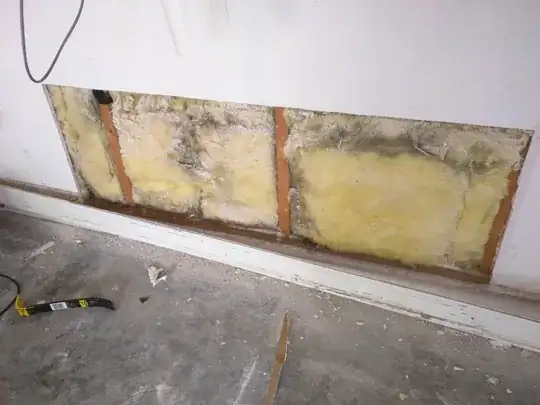
Due to all the interest, here's my actual wall/hole. On the left I ended up cutting it past the stud because there was another dent in the wall. The story is that the previous owners, in their 80s, hit the wall leaving big caved in portions of the drywall.

[Real situation
Dean MacGregor
  • 795
  • 4
  • 10
  • 24

11 Answers11

31

You want to add backing to the inside sides of the existing studs as well as to the centre of the span. The simplest way to do this is to cut the new backing (preferably 2x4, or whatever the existing stud dimensions are) about 4" longer than the height of the opening and screw them to the existing studs. The cut one more piece of backing to the same length as the other two, but this time place it in the centre of the opening and screw through the top and bottom of the existing drywall to attach it. See the picture below for reference.

enter image description here

This method will be much easier than trying to score the existing drywall back on the existing studs and will provide a solid patch.

Monty Harder
  • 115
  • 4
pdd
  • 6,609
  • 17
  • 28
11

I'm a Drywaller of 25 years, the saw blade suggestions are DANGEROUS there are possible screws going up the center of that stud ... do not use a saw blade, the guy who suggested the utility knife had it right, make sure you have a screw gun handy incase you come across a screw.

9

Use a utility knife to score through the drywall. It will take several passes to get all the way through. Go slow, be careful, and don't over cut at the ends. Only go 3/4" onto the stud, going an inch or more could cause you to expose the whole stud and weaken the drywall on the opposite side.

I do agree that doing this is not enough for that wide of a span. You really do need to screw some wood (furring strip 1x2, or bigger) to the top and bottom of the hole to support the seams.

Speedy Petey
  • 16,708
  • 2
  • 29
  • 54
3

Assuming the hole is the width of a typical stud bay, just attaching the patch on the edges is not a sufficiently strong solution. Screws (or nails) near edges weaken the structural integrity of drywall and the patch is likely to shift and crack eventually.

I would attach short pieces to each stud for mounting the sides and 1x3s top and bottom to span the gap.

While you could carve a strip from the drywall with a utility knife to expose the studs, I would urge against it.

bib
  • 33,975
  • 10
  • 68
  • 102
3

I have an abused cordless circular-saw for situations like this, where adding furring isn't an option. The accepted answer tells you how to patch a hole in some drywall where adding furring is an option. It fails to entail how to cut drywall half-off a stud (upvoted however, because as pictured, that's what you do).

Draw a line. Set the appropriate depth. Everyone else goes to lunch. Don a mask and cut it. You WILL hit screws (hence: abused), be sure to wear gloves and glasses. Also, tack the existing drywall all around the hole for stability, which you've weakened by cutting its screws.

The crappier the saw the better. Mine (an early model 12v Dewalt), will just stop if it hits something too hard, there's no kick-back left in it.

Mazura
  • 13,598
  • 2
  • 20
  • 58
3

WHile the selected answer is the cleanest way, if you wish to cut back to the existing studs, use the RightToolForTheJob (TM). That is, get yourself a multi-tool oscillator, like this one Genesis . There are better, more expensive ones, but either way this tool will do a hundred different jobs.

For your purpose, put the saw blade on and it'll be easy to cut a clean piece of drywall without damaging the stud underneath.

Carl Witthoft
  • 4,012
  • 15
  • 15
1

holy macaroni - this is the biggest series of exchanges i have seen over an incredibly simple problem. you need nothing more than a utility knife, a drywall knife and a handsaw

1) just cut vertically through the drywall with a sharp utility knife about 3/4" in from the edge (studs are typically 1 1/2" thick). its easy and will only take you about 5 minutes. use a straightedge as a guide if you want to, buts its not necessary. you may cut over the heads of nails or screws - just come back and remove them or cut around them in your patch piece.

2) screw a horizontal strip of plywood, cutting board, coffin - whatever (you will have to figure out where to get this and how to make it) on to the back of the drywall at the top and bottom of the hole. this is to leave an anchoring flange on the back of the hole to screw your patch to - so make sure at least 2" is projecting into the hole.

3) cut your patch to fit the hole. dont go bonkers cutting it to perfectly, it just has to fit into the hole and have enough meat to screw to the two side studs and the two horizontal nailers. screw it and the original drywall onto the studs and nailers around the perimeter of the hole with #6 x 1 1/4" drywall screws

4) once done, put mesh tape (or drywall paper tape over the 4 joints). don't overlap the tape/mesh and do put mud on top of it to seal it in (and under if its paper tape)

5) once dry, scrape off any high spots or chunks. repeat, this time with a more careful, sweeping motion with a wider drywall knife, over a broader area. repeat as many times as necessary, as wide as you need to in order to have a smooth flat surface of mud

6) lightly sand with 150gr sandpaper, prime and paint

done

0

A HAT PATCH WITH ITS EARS OR FLAPS 1 1/4 " BRIDGING THE JOINT. NO TAPE NEEDED -- THE EARS ARE THE TAPE.

ALOOOHA

JERRY MAUI

'

0

On a hole this small, it wouldn't matter, if you opened it up, all the way to the other side of both 2x4 studs. The sistering solution above is probably the simplest, except for the strip in the middle - as long as your patch is 16" or less, on the loose side - it won't flex. I'd follow along the other side of the stud, with a hole saw, and call it a day - you're not going to compromise the rigidity of the wall, with a patch that small.

tahwos
  • 726
  • 3
  • 10
0

Doesn't look to me that you need furring strips Just cut over to next stud then don't be stupid with utility knife, use a strait edge to slowly trim away remaining 3/4 in. of drywall on that stud. It is best to go a little bit at a time until you reach the wood. And remove any screws you may run into there. Be sure to clean up any loose material on the edges put up new piece and mud the damn thing! Let dry over night, sand and paint. TA DA!!!!!!!!!!!!

user54105
  • 11
  • 1
0

Utility knife to score drywall along center of stud or joist is a
way to do it but takes alot of elbow grease, especially for a large repair. Ive found that an oscillating tool such as Dremells multi max is the best way to get a clean straight line without as much effort. The oscillating tools blade vibrates through as opposed to spinning through as a circular saw does, therefore it doesnt stir up the dust. It just falls to the floor.

Jabo
  • 21
  • 1