28

Where I'm from (Serbia) everybody says to turn off the water boiler (the container that heats up water and stores it for use in the bathroom and shower) when you take a shower or use the bathtub. They say that if the boiler becomes faulty, the current can go through it and hence the water and kill you.

Now I would understand if we used some home-made boilers that aren't insulated or such, but can this actually happen with a modern boiler? In my country this belief is some kind of a cultural thing, everyone believes it and says that they know many people who died this way, so every time we take a shower we turn off the boilers...

JonathanReez
  • 530
  • 3
  • 10
  • 23
NeoXx
  • 383
  • 1
  • 3
  • 6

7 Answers7

30

I'm from Serbia, just like the OP, and we do have such a myth there. After my initial rant, aimed at explaining why some of the safety assumptions that many answers here may have are wrong, I'll show installation of a typical water heater and explain a couple of issues that I see with the installation.

(Feel free to skip this part)
First, some background, so that others can understand the issue:
Most water heaters are made by domestic or ex-Yugoslavian manufacturers. Furthermore, unlike the "western" countries, we do not have strict regulation of electricians and the "National Electrical Code", which so many Americans like to talk about, is not nearly as accessible here. The newest book on the topic that I could find was more than 20 years old. The result is that the regulations themselves are not easy to check for actual home-owners and there's a justified lack of trust in electricians, since a large number of them actually, and with no exaggeration at all, know less than someone who did a 10 minute Google search.

Next, there's the topic of electricians and superiors.
An electrical installation project for a building should be done and signed-off by a graduated electrical engineer that has a valid license as a "responsible designer of low and medium voltage electro-energetic installations".
The actual implementation should be supervised by an electrical engineer who has a valid license as a "responsible contractor of low and medium voltage electro-energetic installations".
I was unable to find if there's actual licensing for electricians that are doing the installation itself!

Next we have a degraded civil engineering ecosystem: during communism there were huge companies making entire neighborhoods at one time, with many engineers and a strong internal structure. This changed and now we have small "investors" who are constructing one or two buildings at a time, focusing mostly on being as cheap as possible, with a huge flow of employees. The licensed EEs I talked about previously will sometimes just glance at the project done by someone else, sign it and take the money for that. The "responsible" contractors will never appear on the site to see what is done and the electricians are sometimes just some guys that know what to do with wires. Safety inspectors are there mostly to take their share of the bribes as well.

This was all assuming actual sort of legal building construction. In some cities, for many decades, it was pretty much impossible to get a construction license, resulting in entire settlements illegally built with no government oversight at all.
(End of background)

So the above resulted in low quality installations done quite often by uneducated people, or semi-responsibly done installations with heavily outdated safety standards. The majority of houses don't have ground fault interrupters and, disturbingly often, there's no ground in the bathroom at all!

Grounding systems are often TN-C, TN-C-S or TT, not uncommonly of the "rotten electrode" variety.

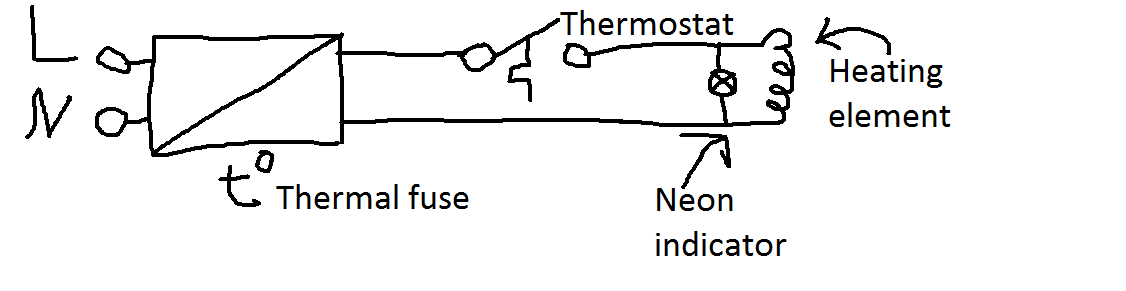
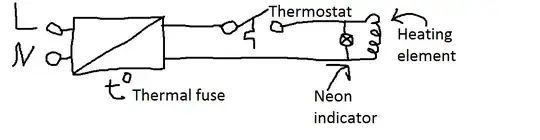
OK, so let's take a look at usual water boiler (as we call them here) installation: Heater circuit
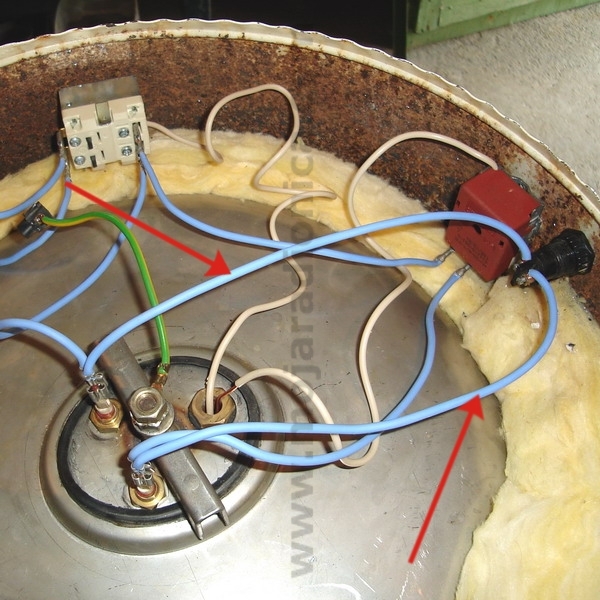
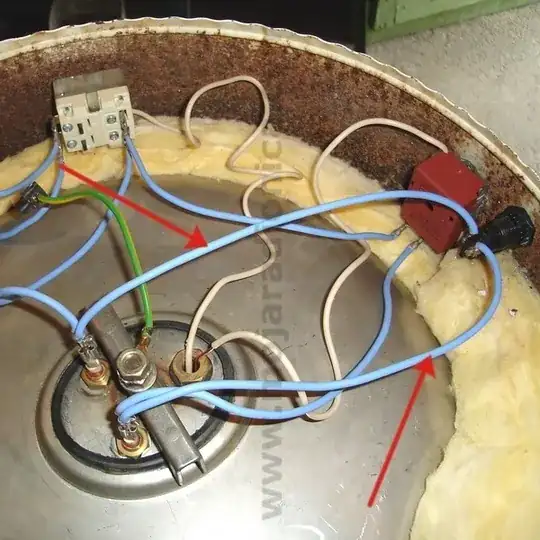
Here's a "representative" photo of an actual installation from "Moja Radionica" website:
Wiring from a boiler

So there's a live and a neutral connection, if we're lucky a bi-metallic thermal switch (not pictured here), a regular thermostat, the heating element itself (sometimes several in parallel) and a neon indicator light. Today they also have a ground connection that's connected to the tank and outer chassis as well, but the pictured unit only has a ground connection to the heater. Usually the tank is also grounded through the pipes, which are often metallic, but the outer chassis in some designs doesn't have a good electrical connection to the tank and instead just sits on the glass wool, with the tank having wall attachment points.

The big hole on the picture is usually closed by a plastic hatch that attaches to the bottom part of the heater.

The heating element itself usually has resistance wire inside of a copper or nickel-plated copper tube that is connected to live and neutral via two connectors. The connectors are isolated from the tank itself with two ceramic insulators.

So in a properly functioning heater, there should not be any conductivity between the heating element connectors and the tank itself. One of the common issues is that the outer tube of the heating element cracks and water gets inside, often causing the resistance wire to break. This results in conductivity between the resistance wire and the tank itself, which could be potentially not very safe. Combine this with no ground fault interrupter or pipe-only or NO ground for the tank and then we have some cause for concern.

Another issue is the plastic hatch at the bottom, "neatness" of the wires and the rubber gasket between the heating element holder and the tank. Namely, these gaskets wear out and are sometimes not replaced after opening the tank, which results in leaks. The leaking water accumulates in the bottom of the heater and, depending on the neatness of the internal installation, may submerge some of the conductors inside of the water heater, which in my opinion can again raise some safety concerns. In a "Magnohrom" heater I've had, the wires were completely lying at the bottom of the heater and resting on the hatch.

Another side-note about installation: This type of water heater should definitely not be installed somewhere out of the way, due to the safety valve. It's not shown in this picture, but on the cold water side, these heaters have a safety valve that is supposed to leak in the case of over pressure. Since many of the units do not have a thermal safety cut-off, in case the thermostat fails, this can cause flooding that might be undetected for some time. Furthermore, old valves do get stuck, so activating it by hand from time to time is recommended! If the heater is out of way, somewhere, this might be messy, this way discouraging the testing.

psmears
  • 185
  • 6
AndrejaKo
  • 529
  • 1
  • 4
  • 13
23

If the water heater is not properly grounded, it could be dangerous but then it would be dangerous all the time, not just when you take a shower.

Sounds to me like a myth that got started because someone once was injured by a faulty water heater and then the myth took on a life of its own.

If the water heater is wired properly you have nothing to fear.

EDIT: I agree with some of the comments. This IF is an awfully big IF. And a mighty flimsy thing to base your life on if you are unfamiliar with the installation. If you are travelling and have the option to turn off the water heater while showering then why not shut it off.

ArchonOSX
  • 20,870
  • 3
  • 30
  • 53
10

In the UK we have electric showers which heat water on demand - ie they're supplied with 230V using about 9kW, which is enough for a moderate flow of cold water to be heated to about 50C as it flows through the shower.

Not only are they directly connected to the shower hose, they're usually inside the shower cubicle - so the unit gets wet and the electrical connections are inside. Obviously you couldn't turn this off before showering, and I've never heard of anyone being electrocuted by one.

However I would expect that there is a good earth connection and an earth leakage detector on the circuit breaker, so if any current does leak to earth the circuit breaker will trip. It would be worth checking these on your heater if you are unsure.

user1908704
  • 1,621
  • 8
  • 12
7

I have never heard of such a thing, and in the USA the water heater is usually tucked away in some hard-to-access place like a basement or utility closet. Turning it on and off all the time would be totally impractical. I know in some other countries it is typical to have the water heater installed in the kitchen or bathroom.

Hank
  • 14,213
  • 10
  • 46
  • 48
5

In any administration where internationally recognised regulatory rules are used and means are provided to ENSURE that all except a few rogue installations are installed to the standards then the risk of electric shock from such installations is extremely small. I have never heard of such an installation causing shock or death in New Zealand (where I live).

About 5 years ago I repaired some lighting wiring in a university owned and maintained premises in a large so far at least notionally still-Communist country. The quality of the installation was the worst that I have ever seen by a comfortable margin. A hot water system wired that way MIGHT kill you if you were unlucky. If water pipes are metal and shower tray and pipes are bonded to ground and system supply neutral is also ground connected, then you;d have a good chance of surviving.

The second worst home wiring I've seen was in the USA.

Russell McMahon
  • 1,089
  • 6
  • 8
3

Ex-communist or not, real reason is that many older building have substandard wiring, especially grounding which in combination with metallic plumbing can cause electric shocks even without insulation fault.

2

One could always come up with hypothetical scenarios, but this seems pretty unlikely for several reasons.

One: For electric current to be in "contact" with the water, there'd have to be physical damage to wires or heating elements, with just the right bad luck that they came in contact with the tank. And the tank itself would have to conduct electricity. This seems pretty unlikely, but without examining the design of a particular water heater, (we call them "water heaters" in the US), I guess it's possible.

Two: Water itself is a very poor conductor of electricity. If you have hard water, other materials in the water may turn it into a good conductor. But assuming you don't have very hard water, so little current will flow through the water that I doubt it would give you a dangerous shock. I suppose if you had a short like we've been discussing, and you then took hold of the shower head to adjust it or some such. But electricity only flows in a circuit. What are bath tubs typically made of in Serbia? If they're made of metal, okay, current could flow from the shower head, through your body, to the tub, through the drain pipe, and from there to ground. Here in the US most bath tubs are made of various plastics and ceramics, which are terrible conductors, so you'd have no circuit.

Three: Electricity travels through the shortest path to ground. If you did get a short circuit in your water heater, the current would flow through the inflow pipe to the ground, not through the outflow pipe, all the way to your shower, through your body, through the drainpipe, and then back down to ground.

Four: Even if you stuck wires in the socket and held on to them, household current is not normally enough to kill you. Ok, I understand Serbia uses 220V, which is more dangerous than the 120V here in the U.S. I've gotten shocked with 120V many times with no apparent long-term ill effects. I don't think I've ever been hit with 220, I imagine it would hurt, probably knock you down, but not kill you. And in this scenario you're talking about the current passing through all sorts of materials not intended to carry current well, including dirt. The resistance in the circuit would be very high, thus the current would be very low.

So just from a logic, theoretical point of view, I'd say the danger is very small.

Here in the U.S., lots of people have electric water heaters, and I've never heard of anyone turning them off to shower, nor have I ever heard of an injury from such an accident.

I'd be interested to hear if there have really been any significant numbers of injuries or death from such accidents reported. As the old saying goes, an ounce of experiment is worth a pound of theory.

Frankly, this reminds me of the warning I heard many years ago that you should always plug something into every electrical outlet, because otherwise the electricity will leak out onto the floor and you could get a shock if you walk across the room in bare feet. :-)

Jay
  • 161
  • 3