15

I need to build a footbridge across a creek and, due to soft and low land around it, will need a long span crossing the creek. I found this tutorial by Ron Hazelton where he makes a bridge with a 12' span with two beams supporting it, with supports only at the ends.

Each beam is made up of two 2x6 boards mated together with construction adhesive and bolts every 2'. This creates a single 4x6 beam.

Is there a reason for doing this with two 2x6x12 pieces instead of a single 4x6x12 board? Would it be as strong (or stronger) if I did the same with a 4x6x12?

gbronner
  • 5,752
  • 1
  • 19
  • 47
Tango
  • 528
  • 1
  • 8
  • 27

4 Answers4

16

It has to do more with the quality of the the 2x6s vs the 4x6. A 4x6 x 12 board would have to be clear all the way through, with no cracks or knots. Most softwood logs won't produce this board, and if it cracks, it is likely to break more easily vs the 2x6.

On the other hand, drilling a bunch of holes in a 2x6 does it no favors, though because the two boards are tied together, weak spots in one board are often compensated by its partner.

So, if you could find a really good 4x6, go with it, but otherwise use the 2x6. In most cases, the 4x6 will be more expensive due to its rarity.

In colonial times, they would have gone with the 4x6, as they had lots of hardwood timber and each individual cut took a long time.

gbronner
  • 5,752
  • 1
  • 19
  • 47
8

Boards that are laminated in some fashion get an overall durability increase (not necessarily net strength increase) because they no longer suffer from a single grain dimension through the thickness. Primarily, in the case you describe a split or warp will not impact the whole board, only half of it. A properly laminated beam (like VersaLam or Glulam) does have a strength rating beyond a comparably sized dimensional board but it's partly due to the process they use to glue it without adding a lot of weight.

In the case of your footbridge, I strongly suspect the process was chosen because it saved significant cost and was more manageable for a smaller construction team (maybe even 1 man). Optimizing for overall strength on a footbridge is usually not done, they prefer them to be inexpensive and last a long time without costly maintenance.

Jeff Meden
  • 815
  • 4
  • 5
5

In architecture we use laminated timber in order to reach long distances. It would be impossible otherwise. Here is just to reduce weak spots.

By the way, that is not a real laminated timber but just a pair of beam. laminated beam are mated differently:

___________ ____________ ___________
_____ ___________ ___________ ______
___________ ____________ ___________
isar
  • 163
  • 3
5

Unless height is an issue, why limit yourself to a 6" deep timber? It's the height that's going to give the beam its rigidity. Why not look at an 8" or 9" deep floor joists? We use 9" x 2" and even 9" x 3" floor joists all the time.

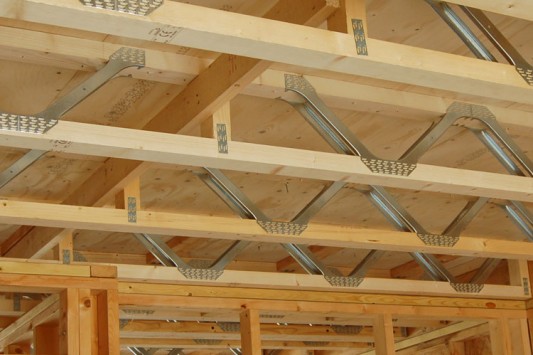
Although, the last bridge we made (over a stream to a rough old fishing pond so aesthetics wasn't an issue) we used 'open metal web floor joists' because we had a couple lying around. Super rigid and super easy to 'feed' over to the other side being so light.

Like this...open web joists

handyman
  • 3,421
  • 13
  • 19