In gardening, especially container gardening, you will run into the phenomenon called a 'Perched Water Table' (PWT). What is a perched water table, and how does it work?
Asked
Active
Viewed 2.4k times

1 Answers
26
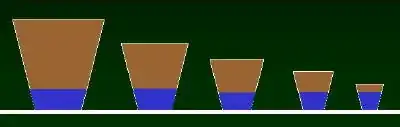
Well, basically, the perched table is the saturation point, where the capillary action in the soil is canceled out by the force of gravity. Every type of growing media has a different perched table. Capillary action will pull water up from a certain point, and below that point, gravity keeps the water from moving up. The size of the container does not affect the height at which the perched table occurs. See the figure below.
From here:
There is, in every pot, what is called a "perched water table" (PWT). This is water that occupies a layer of soil that is always saturated and will not drain at the bottom of the pot. It can evaporate or be used by the plant, but physical forces will not allow it to drain. It is there because the capillary pull of the soil at some point will equal the GFP; therefore, the water does not drain, it is "perched".
If we fill five cylinders of varying heights and diameters with the same soil mix and provide each cylinder with a drainage hole, the PWT will be exactly the same height in each container. This is the area of the pot where roots seldom penetrate & where root problems begin due to a lack of aeration. From this we can draw the conclusion that tall growing containers are a superior choice over squat containers when using the same soil mix. The reason: the level of the PWT will be the same in each container, with the taller container providing more usable, air holding soil above the PWT.
From here:
Water is not distributed evenly throughout the container. Adhesion, cohesion, and capillary action attract water to particles and resist gravity. The ability of media to ‘hold’ water through adhesion and cohesion is referred to as matric potential. Matric potential is the same throughout the container. Gravity pulls water down through the container and out of the drainage holes. While gravity is constant throughout the container, gravitational potential is greater at the top of the container and lower at the bottom. Because of this gradual decrease in gravitational potential towards the container bottom, matric potential is higher at the container bottom and media particles are able to hold more water. This causes water to form a perched water table at the container bottom. The perched water table is a layer of saturation on the container bottom.
Container height affects the relative amount of water versus air. With the same media, the perched water table occurs at the same height, regardless of the container size. Short containers will have the same perched water table as large containers, thus a greater percentage of container volume is filled with water. This explains why a 5-gallon container hold less water than a 5-gallon squat container.
Should you use gravel at the bottom of a plant's pot?
Not usually. Soil is like a sponge, and won't drip down into most gravel unless it becomes fully saturated. That doesn't mean that there is no air space in the soil, it means that as it is, the soil can't hold more water without it running out.
I only occasionally use gravel, but I use small pea gravel in a thin layer, to keep the drainage hole from getting clogged, in large planters (in my case they were 6x6', you shouldn't use it in small pots/planters) that will not be disturbed for a while. Generally, the growing media will drain better without any gravel.
