I have always used pre-grown sweet potato slips, but since the source of sweet potatoes I have been using is unreliable, I am looking for how to grow my own in fairly large quantities. How should I do this if I am using a cold frame?
Asked
Active
Viewed 571 times
14


1 Answers
7
Sweet potato slips are very easy to grow at home. First, if you're picky about the taste, you might want to try a few out till you hit the right one(s). You'll need only the ends (a 1/3rd on each end) to grow the slips, so you can probably cook the middle 1/3rd and try it out for taste. Once you've settled on a sweet potato, follow these steps:
- Take the 1/3rd pieces from each end and stick the base (i.e., the cut, exposed part) into a jar of water. The common method to support the piece is to stick toothpicks in its sides and let them rest on the rim of the jar. Some people use the entire potato (see second picture below)
Place this setup in a warm place with lots of sunlight. Now what's going to happen is that the cut bottom part will serve to transport water to the rest of it, while the starch in the potato serves as food for growth. Little shoots will start forming from each "eye" of the potato and little roots will form from the base. Some folks use the entire potato to grow slips (see second image below), but I've grown only from halves.
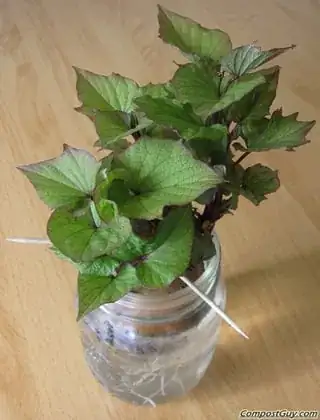
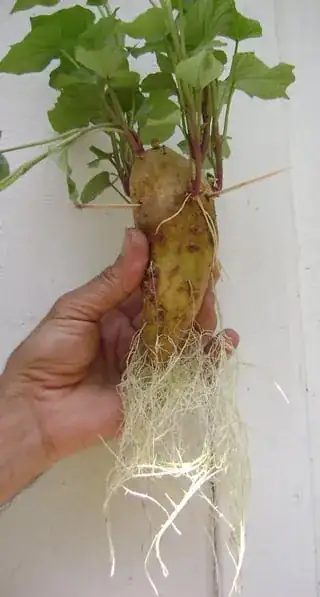
(Click on the image for the source)Next, when the sprouts are about 3-4" tall, remove them from the eye and put them in a shallow dish with water, with the bottom end in water. The goal is to get them to sprout roots.
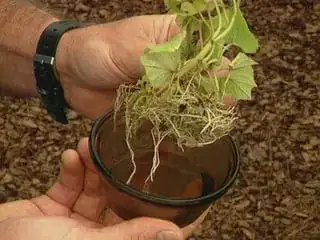
(Click on the image for the source)When the roots are about 2" long and not looking flimsy, they're ready for planting.
You should be able to get quite a lot of slips (20-30?) from a single sweet potato and you can extrapolate that to how much ever "fairly large" means. You might also want to try out with just one, for starters, and then once you're satisfied with the process and fine tuned things, you can proceed growing them in larger quantities. I also found some good advice on this website re: preparing the soil for it.
Regarding using cold frames, I apologize, but I have not used cold frames and hence can't comment on them. As long as you can guarantee a warm, well lit environment for the sprouts, anything will do.

Lorem Ipsum
- 11,219
- 8
- 58
- 95