You most certainly can change and SHOULD change the pH of your alkaline ish soil. I've done the same thing as I live in a high cold desert with volcanic pumice soil, little organic matter.
Definitely need a soil test that you can get from your Coop Ext. Service in your area. How did you get your 7 - 8 pH number? That soil test will also tell you what the chemistry of your soil or nutrients for plants.
First, I would make my garden beds so that you won't have to mess with the walkways and you'll be able to make some beds acidic for blueberries and acid loving plants such as potatoes. There are few plants that do well up at pH 8 however and it might not be that high anyway after a real soil test. Most plants do best at neutral or 6.5 to 7.0. If the test you've done is accurate after getting your real soil test then you've got a good method, you'll be needing to test your pH quite a bit.
.
Lowering pH is tougher than raising it but totally doable. Sulfur is the best way and least expensive to lower pH. I wouldn't use aluminum at all for a vegetable garden, it is a heavy metal. Aluminum also messes with chemicals like phosphorous the plants need.
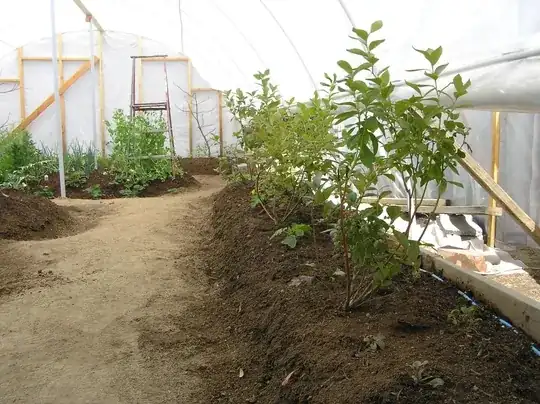
Sulfur is your best bet. Once you get your beds double dug and firmed such as mine in the picture you sprinkle sulfur on top of the bed. This is better than mixing it in as you are forming your beds so that you can control how much you are using. You'll be doing this when it is warm weather. If it is cold at night no big deal but the sulfur only works when it is 60 and above and when the soil has warmed. These beds are considered raised beds. No sides or support. As I make my beds the first and only time I am throwing DECOMPOSED ORGANIC MATTER purchased in bales of 2 cubic feet into the pile of soil that gets a good 3 to 4 feet high. Then I form the bed with a rake and get a piece of plywood throw it on top and jump up and down on it to get rid of air pockets. 3-4 feet is now down to a foot as you see in my picture. Then I decide which beds need to be acid such as that back bed with the blueberries and where I want to grow potatoes.
This is best done in parts versus going for the full number or one point lower than 7.0 for instance. The formula is 4 to 10 oz per square yard. I did 4 oz per square yard for the beds I wanted to reduce from 7.5 to 6.0. For the others I only did 2 oz per square yard to reduce from 7.5 to 6.5. This is only the first application which would be half of what is necessary by the books. Then I dig those trenches at the bottom that you see. These are to collect water as it trickles through your bed and they are slightly sloped to drain outside the garden. I go for 10" wide by 6 to 8" deep and throw the soil up on top of the beds on top of the sulfur. Rake to smooth and do the plywood jumping again. Water well, at least 4 to 6" deep. Best to use an oscillating sprinkler so that the water has time to soak in before the next pass of the sprinkler. Water every other day for a good 2 weeks. Test your pH again.
For most beds your pH should have dropped half a point and I would start planting in those beds. Your potatoes and blueberries should wait for one more application without being planted. Just easier. You could go ahead and plant if you have a short growing season. Based on the change of pH in your soil you observed from the first application. All soils are different such as a clay soil or a soil with lots of organic matter will need more applications and more sulfur than a sandy soil low in organic matter (such as mine). Temperature matters as well.
You need to let us know where you live, what your zone is and it would be nice to know the soil type. Grab a mason jar and put a cup of your soil and fill with water shake it up real well and allow to sit undisturbed for a day or two until the water is clear again. You'll be able to see the different percentages of sand and silt and clay as well as a little layer of organic matter on top. Sand on the bottom then the silt and last layer is clay then organic matter. Get your soil sent in following the instructions of the Cooperative Extension Service you use.
When that soil test comes back you will find your soil has very little of the chemicals plants need with which to make their own food through photosynthesis. This is because a virgin ecosystem, think of rain forests, have all the nutrients and chemicals plants need tied up in the living part of the system. Very very very efficient. As soon as something dies it is decomposed and then that decomposed matter is gobbled up by the life in the system. When forests are cut down by good old humans we are actually MINING the ecosystem and removing all of the nutrients and chemicals. Guess what? We are then relegated to REPLACING these chemicals or our crops will not do well. Your test should give you an idea of what is lacking in both macro (NPK) and micro nutrients such as calcium, molybenum, iron...boron...there are quite a few. Later you will learn how to tell when your plants have too much of a certain nutrient or too little just by looking. You'll want higher nitrogen for your leafy greens and lower nitrogen in relation to phosphorus and potassium for your tomatoes.
There are also pH UP and pH DOWN in liquid form now for your garden. I use that for my potted plants. Here I pot tomatoes, peppers so that I can treat them individually and move them inside to my little greenhouse at night. We have a hard freeze once or twice per month all growing season long, sigh.
Always use potting soil for pots and starting seeds in doors. Never use your garden soil in pots. Here is another place to use your pH tester (s). I always use 2 or 3 different methods to ensure one of the testers isn't malfunctioning. That is how important knowing the pH of your soil is. I congratulate you for caring at this level to set up your soil and garden! You must have gardened before or had master gardener training?
To add organic matter, after throwing it in for your initial bed making, just put it on top of your beds, after you've planted your starts and at least once or twice more through the season. This is the DECOMPOSED organic matter I get from the dang store. I have horse manure that I use for the winter and that has to be
DECOMPOSED, DRIED OUT, NEVER FRESH.
Because herbivores eat lots of weeds and weed seeds there will be lots of weeds BUT if you dump 2" on top of your soil 2 or 3 times during the growing season you inhibit germination of those seeds. Smothers the weeds already growing. Weeds are the least of your worries in a garden. I just don't know why others get so wigged out over weeds, grins! And I've done this commercially as well, no problemo. No pesticides or herbicides...until later in the season but that is based on your area, your weather, if you have a polytunnel like the one I started out with in the picture...so not to worry. I use great fertilizer that is 'organic', low in numbers and has the micronutrients I need as well as certain bacteria and fungus necessary for 'happy' plants. Keep asking questions. We can try to help you not to make the same mistakes we did...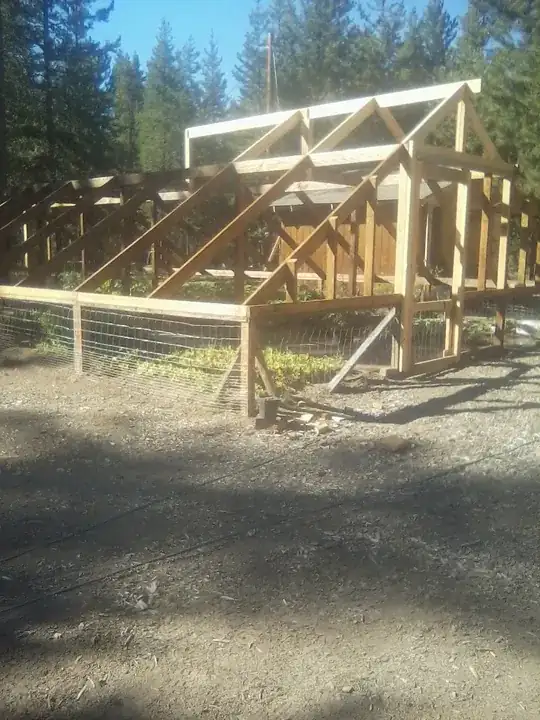
btw; don't use manure or organic matter for 'fertilizer'. Great for tilth but you need to know what you've got to include micronutrients and pH.
..