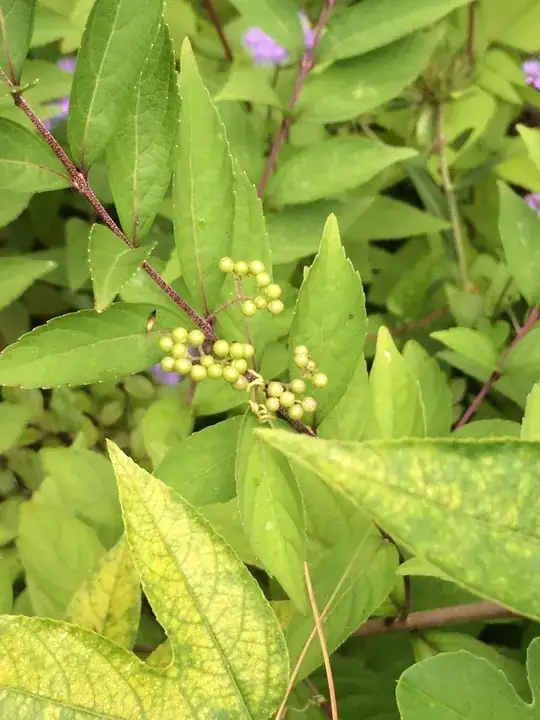
 The plant I had the question about had very small blooms on it in July, although it could have been late June. At that point I still didn't know what it was, but now (September 1, 2017) it has small berries, still green, but at least one is beginning to show some purple. I am very certain that I now know the Genus of this bush. It is Callicarpa, a beautyberry bush. It is either Callicarpa dichotoma or Callicarpa japonica, I think dichotoma. I will take another picture when the berries are purple, as long as I am allowed to answer my question a second time. Here is a nice three and a half minute description of the species at YouTube: https://youtu.be/1d_-qKL_Z1s
Once I take the picture of the ripened berries I will pull this shrub out. I tend to use native plants. I have Callicarpa americana in the garden, a U. S. Native. It's leaves and berries are larger. The bush is larger also, but I cut it down to about 1 or 2 feet in late winter or early spring. Then it grows to about 5 feet by the end of the growing season.
The plant I had the question about had very small blooms on it in July, although it could have been late June. At that point I still didn't know what it was, but now (September 1, 2017) it has small berries, still green, but at least one is beginning to show some purple. I am very certain that I now know the Genus of this bush. It is Callicarpa, a beautyberry bush. It is either Callicarpa dichotoma or Callicarpa japonica, I think dichotoma. I will take another picture when the berries are purple, as long as I am allowed to answer my question a second time. Here is a nice three and a half minute description of the species at YouTube: https://youtu.be/1d_-qKL_Z1s
Once I take the picture of the ripened berries I will pull this shrub out. I tend to use native plants. I have Callicarpa americana in the garden, a U. S. Native. It's leaves and berries are larger. The bush is larger also, but I cut it down to about 1 or 2 feet in late winter or early spring. Then it grows to about 5 feet by the end of the growing season.
As noted above, I've identified this plant. At least I know the Genus. It is Callicarpa. The berries are what tipped me off. Though the flowers I remember seemed smaller and green, not purple or lilac, as I see in pictures of Callicarpa dichotoma flowers. I wish now that I had taken a picture of the blooms. Perhaps I will cut it down to the ground, rather than pull it out, after I take pictures of the berries, which will be turning from green to purple soon. That way I can have another opportunity to see the blooms. Certainly it was transported to the yard after a bird ate a berry elsewhere. I suspect either an American Robin or a Gray Catbird made the contribution, both species frequent the yard often. Where the bird found the berry it swallowed I'm not sure. Catbirds migrate south in Winter and return in summer. Robins, in winter, seem to just shift their location to wherever they can find berries. I know berries are in a bush when I see Robins flocked and active in certain shrubs or trees, especially in fall, winter and early spring. It seems the bush must be in the area. The seed likely did not remain in the bird's belly for very long, perhaps a day or two at most?


